
Best Ford Explorer Dog Barrier: 4 Options Compared

The adjustable 42.5-to-62-inch barrier is the best starting point for a Ford Explorer because its width range is broad and it can sit behind either the front or rear seats. Choose a cargo-area mesh gate instead if your dog rides behind the second row, but measure the opening and check the Explorer’s seat and headrest layout first.
We earn a commission if you buy through links on this page. As an Amazon Associate I earn from qualifying purchases. Products are compared on manufacturer specifications, not hands-on testing.
- Best overall: Adjustable Steel Barrier, 42.5–62 in. – Its 42.5-to-62-inch width adjustment and front- or rear-seat placement give it flexible fit options.
- Best for cargo areas: NOAMOO Cargo-Area Mesh Barrier – The expandable mesh barrier is designed to keep a dog in the cargo area and reaches 61.9 inches.
- Best for seat movement: ZooKeeper Adjustable Metal Barrier – Its 42-to-61-inch span and movable-seat design accommodate tilt, slide, and recline.
| Product | Best for | Width range | Height | Placement | Shop |
|---|---|---|---|---|---|
| Adjustable Steel Barrier, 42.5–62 in. | Flexible placement | 42.5–62 in. | 27.6 in. | Front or rear seats | Check Price on Amazon |
| NOAMOO Cargo-Area Mesh Barrier | Cargo-area dogs | Up to 61.9 in. | 16.1 in. | Cargo area | Check Price on Amazon |
| Gtongoko Steel Mesh Cargo Barrier | Rigid mesh divider | 60.6 in. | 16.5 in. | Cargo area | Check Price on Amazon |
| ZooKeeper Adjustable Metal Barrier | Moving seats | 42–61 in. | 28.75 in. | Back seat | Check Price on Amazon |
Ford Explorer Dog Barriers
Match the barrier style to where your dog rides, then compare its dimensions with your Explorer’s interior.
Adjustable Steel Barrier, 42.5–62 in.

This barrier differs from cargo gates by fitting behind either the front or rear seats, with a 42.5-to-62-inch adjustable width. It stands 27.6 inches tall and weighs 7.2 pounds, with galvanized steel components, five elastic cords, and steel hooks. The maker says the lower section moves with the seatback angle, making it a candidate when passengers adjust their seats. Measure the intended span and confirm the headrest posts can accommodate its cord-and-hook attachment; a barrier’s vehicle fit does not establish a fit in every Explorer configuration.
Bottom line: Choose this if you want one barrier that can sit behind either row.
NOAMOO Cargo-Area Mesh Barrier

Unlike the seatback-spanning options, this NOAMOO mesh divider is designed to keep a dog in the cargo area. Its main panel measures 38 by 16 inches, with two side panels measuring 16.6 by 12.2 inches; the maximum extension is 61.9 inches. The maker describes the side panels as having added stability. This layout suits an Explorer owner who wants a three-sided cargo divider, but its 16.1-inch overall height may leave a large dog more room to climb over than a taller barrier. Measure cargo width at the height where the panels will sit.
Bottom line: Choose this for a cargo-area setup where its low panel height is adequate.
Gtongoko Steel Mesh Cargo Barrier
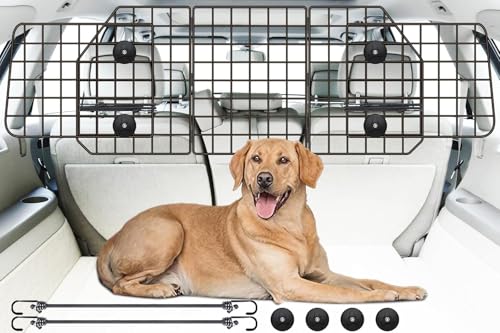
This Gtongoko option has a fixed 60.6-by-16.5-inch steel wire mesh frame, unlike adjustable-width barriers. It is intended to separate a cargo area from passengers and includes four knobs for headrest attachment plus elastic ropes to limit movement. The maker says the frame is reinforced against bending and has rounded corners. Its fixed width is the key limitation: measure the Explorer’s intended mounting span before choosing it, especially if trim, seat angle, or headrest spacing reduces the usable area. It is best suited to buyers whose measured opening is compatible with the frame.
Bottom line: Choose this when a fixed-width steel mesh divider suits your measured cargo space.
ZooKeeper Adjustable Metal Barrier

ZooKeeper’s metal-tubing barrier is notable for being designed to move with vehicle seats, including tilt, slide, and recline. It adjusts from 42 to 61 inches wide and measures 28.75 inches high by 0.75 inch thick, with a weight of 7.5 pounds. Its open metal-tube style offers more visibility than a solid fabric panel, while the mounting geometry still needs to suit the Explorer’s headrests and seat layout. This is a back-seat divider, so it is not the right style for someone seeking a barrier that encloses the cargo area behind the second row.
Bottom line: Choose this if seat movement and a taller open-frame barrier matter most.
How to choose a Ford Explorer dog barrier
Start with the dog’s riding location: a seatback barrier separates passengers from a dog behind them, while a cargo divider keeps a dog behind the second row. Measure the usable width at the actual mounting height; interior trim and angled seats can make the clear span narrower than a tape measure taken elsewhere. Also compare height: the options here range from 16.1 to 28.75 inches, a difference that affects how much of the opening is blocked. For a dog that can climb or jump, a low panel is a poor choice; favor a taller barrier only if its attachment points suit the vehicle. A barrier is not a substitute for a crash-tested pet restraint.
Measure the Explorer before choosing a barrier
Measure between the intended mounting points with the seats in the positions you normally use, then repeat after moving or reclining them. Adjustable models in this group span roughly 42 to 62 inches, but that range does not guarantee compatibility with every seat, headrest, or trim configuration. For a cargo gate, measure the width of the opening behind the second row and check the side contour where panels would rest. A measured opening narrower than 42 inches rules out the adjustable models here without a secure way to mount them; a fixed 60.6-inch frame requires a close match. Check that cords or hooks cannot interfere with seat belts or seat movement.
Seat barriers versus cargo-area dividers
Seat barriers and cargo-area gates solve different layout problems, so choose by where the dog rides rather than by the word “universal.” Seatback barriers span behind the front or rear seats and may allow seat adjustment; cargo-area dividers use panels to limit movement into the passenger cabin. The two styles cannot be treated as interchangeable: their attachment points and blocked openings differ. Use this comparison to identify the layout before narrowing by dimensions.
| Need | Barrier style | Check before choosing |
|---|---|---|
| Separate dog in rear seat area | Seatback barrier | Width and headrest mounting |
| Keep dog behind second row | Cargo-area divider | Cargo opening and panel height |
| Adjust seats around barrier | Movable-seat design | Clearance through full seat travel |
Safe installation and everyday use
A properly fitted barrier should remain stable when the vehicle is parked and the seat is adjusted, but a dog barrier alone should not be treated as occupant-grade crash protection. Secure cords and hooks away from seat-belt webbing, latch points, and areas where a paw or collar could snag. Check the barrier after installation and whenever the seats move; loose fasteners and shifted panels can create gaps. Keep the driver’s sightlines clear, and do not let a barrier obstruct rear visibility or access to controls. For travel, a crash-tested harness or secured crate is a separate restraint choice; use one suited to the dog and vehicle rather than relying on a divider to restrain the animal in a collision.
Frequently Asked Questions
How do I measure for an Explorer dog barrier?
Measure the clear span between the intended mounting points at the height where the barrier will attach. Repeat with the seats in their usual positions and through the range of movement you need, because a reclined seat can change the available width.
Can a dog barrier keep a dog safe in a crash?
A barrier is primarily a divider, not a crash-tested restraint. For collision protection, use a properly secured crash-tested harness or crate, and keep the barrier from interfering with seat belts.
Will a universal dog barrier fit every Explorer?
No universal width range guarantees a fit across every interior and seat configuration. Compare the measured mounting span with the barrier’s range, then check the headrest posts, seat travel, and cargo trim.
Is a low cargo barrier enough for a large dog?
A panel around 16 inches high may not block a dog that can jump or climb. Choose a taller design only if it mounts securely, and use a separate suitable restraint for travel.
Should a dog ride behind the second row or in the back seat?
Choose based on the restraint and space that fit your dog and passengers. A cargo divider separates the cargo area from the cabin, while a seatback barrier separates a rear-seat area; neither by itself replaces a travel restraint.