
Best Fuel Additive to Clean O2 Sensors: 5 Picks

AUTOPROFI OXICAT is the best fit for most people seeking a fuel additive to clean O2 sensors because it is made for exhaust-system cleaning during regular use. Buyers focused on a one-time fuel-system detergent should choose a different type, since general fuel cleaners are not the same as exhaust cleaners.
Fuel additives cannot repair a failed sensor or damaged catalytic converter; diagnose persistent warning codes rather than relying on a cleaner alone.
We earn a commission if you buy through links on this page. As an Amazon Associate I earn from qualifying purchases. Products are compared on manufacturer specifications, not hands-on testing.
- Best overall: AUTOPROFI OXICAT – Designed to clean the entire exhaust system with regular use and activates when the catalytic converter reaches working temperature.
- Best for O2 and EGR claims: MotorPower Care Catalytic Cleaner – The maker says the formula targets O2 sensors, EGR valves and the exhaust system.
| Product | Best for | Intended target | Bottle size | Fuel compatibility | Shop |
|---|---|---|---|---|---|
| AUTOPROFI OXICAT | Regular exhaust care | Entire exhaust system | 500 mL | Gasoline and diesel | Check Price on Amazon |
| MotorPower Care Catalytic Cleaner | O2 and EGR claims | Catalytic converter, O2, EGR | 8.45 fl oz | Gas and hybrid | Check Price on Amazon |
| MotorPower Care Catalytic Cleaner, 2-Pack | Two treatments | Catalytic converter, O2, EGR | 8.45 fl oz each | Gasoline and hybrid | Check Price on Amazon |
Fuel additives to clean O2 sensors
The main difference is whether a formula targets the exhaust system or focuses on cleaning the fuel system.
AUTOPROFI OXICAT

AUTOPROFI OXICAT is the clearest match for routine exhaust-system cleaning: the maker says it is designed to clean the entire exhaust system with regular use and activates once the catalytic converter reaches its working temperature. The 500 mL pack of two suits owners who want a maintenance product rather than a one-time general fuel detergent. The maker also identifies it as TUV certified and made in Germany. Its limitation is that activation depends on the converter reaching operating temperature, so it is not an instant fix for a fault code or damaged sensor.
Bottom line: Choose this for regular exhaust-system maintenance when the vehicle can reach converter operating temperature.
MotorPower Care Catalytic Cleaner
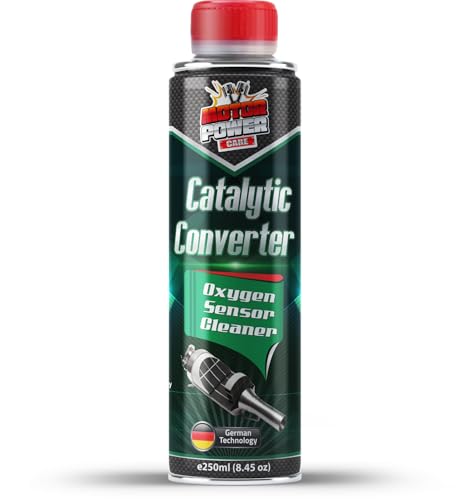
MotorPower Care Catalytic Cleaner stands out for its specific claims about O2 sensors and EGR valves alongside the catalytic converter. The maker says to add it to a tank with 5–15 gallons of gas and describes a 40-minute treatment; its emissions figures are presented as the maker’s test results, not a guarantee for an individual vehicle. The 8.45 fl oz bottle may suit a buyer looking for a single treatment. The maker’s claims about fixing codes or passing emissions should not replace diagnosis: a cleaner cannot correct a failed sensor or physically damaged converter.
Bottom line: Pick this if you want a single-treatment cleaner whose maker explicitly targets O2 sensors and EGR valves.
MotorPower Care Catalytic Cleaner, 2-Pack

MotorPower Care Catalytic Cleaner, 2-Pack differs from the single-bottle option by providing two 8.45 fl oz bottles, and the maker describes it as compatible with gasoline and hybrid vehicles. Its strongest practical distinction is the explicit caution: the catalytic converter must be intact, because the cleaner will not repair a cracked, broken or melted converter. That makes this a poor substitute for mechanical repair when converter damage is suspected. Buyers who need only one treatment may prefer a single bottle; buyers planning repeat use should first verify that the vehicle and fuel amount fit the product’s directions.
Bottom line: Choose this if you want two treatments and have an intact catalytic converter.
How fuel additives relate to O2 sensor cleaning
Fuel additives can only help where their chemistry and route through the engine reach the deposits they target; a fuel-system detergent is not automatically an oxygen-sensor cleaner. Oxygen sensors sit in the exhaust stream, and catalytic-converter cleaners are intended to work through exhaust-system operation, often after the converter heats up. A persistent P0420 or P0430 code can result from a sensor, wiring, exhaust leak or converter problem, so read the code and inspect the cause before adding treatments. A practical rule: if the check-engine light is flashing or the engine runs poorly, stop treating the issue as routine maintenance and arrange diagnosis promptly. Do not expect a bottle additive to restore a physically cracked or melted part.
Choose by the problem and additive type
Choose an exhaust-system cleaner when the product specifically says it targets the converter or O2 sensors; choose a fuel-system detergent for fuel and intake deposits. The product target is the key distinction, not the words “emissions” or “cleaner” alone. For a routine preventive approach, favor directions that explicitly call for regular use; for a one-time treatment, match the bottle’s specified fuel amount and treatment instructions. The table separates the roles so a buyer does not mistake one category for another.
| Need | Product type | What it targets |
|---|---|---|
| Exhaust deposit maintenance | Catalytic-converter cleaner | Converter and exhaust system |
| Fuel residue or sludge | Fuel-system detergent | Fuel system deposits |
| Persistent sensor code | Diagnosis first | Sensor, wiring, leak or converter fault |
When an additive is not enough
An additive is not a substitute for a functioning oxygen sensor, intact wiring or a mechanically sound converter. O2 sensors monitor oxygen in exhaust and provide feedback used to manage the air-fuel mixture; faults can come from contamination, age, wiring damage or leaks. A converter efficiency code can also be triggered by problems beyond deposits, including exhaust leaks or a failing sensor. If a warning returns after the prescribed treatment and a normal drive cycle, have the vehicle scanned and inspected rather than repeating doses. Never ignore a flashing check-engine light, which can signal a misfire capable of overheating the catalytic converter.
Frequently Asked Questions
Can fuel additive clean a faulty oxygen sensor?
An additive may help with deposits only when the formula is designed to reach and clean the relevant exhaust components. It cannot repair a failed sensor, damaged wiring or an exhaust leak, so a returning code needs diagnosis.
How long should I drive after adding a catalytic cleaner?
Use the treatment time and fuel quantity printed for that formula; the 40-minute claim applies to the maker’s single-treatment MotorPower product. Converter cleaners also need the converter to reach operating temperature to activate.
Can I use catalytic cleaner with a damaged converter?
No cleaner repairs a cracked, broken or melted catalytic converter. The maker of the two-bottle MotorPower product specifically says the converter must be intact, so suspected physical damage calls for inspection.
What does a P0420 code mean for an additive?
P0420 indicates catalyst-system efficiency below the vehicle’s threshold, but it does not prove deposits are the cause. Check for sensor, wiring and exhaust-leak faults before treating the converter.
Should I add cleaner before an emissions test?
Only use a product according to its treatment instructions and allow the required operating drive, because a warmed converter is needed for cleaner activation. An additive cannot guarantee a pass when a component is faulty.