
Best Gas Mask for Nuclear Fallout: 5 Options Compared

For nuclear fallout, MIRA SAFETY CM-8M CBRN Mask is the closest match because it is identified as a CBRN mask, but its maker says protection depends on pairing it with an appropriate filter. A gas mask filters some airborne hazards; it does not shield the body from penetrating radiation.
Choose a different respirator for ordinary industrial tasks or if its filter compatibility is not confirmed. For fallout, sheltering in a substantial building and following emergency guidance matter more than relying on a mask.
We earn a commission if you buy through links on this page. As an Amazon Associate I earn from qualifying purchases. Products are compared on manufacturer specifications, not hands-on testing.
- Best overall: MIRA SAFETY CM-8M CBRN Mask – The product is explicitly identified as a CBRN mask, with protection conditional on an appropriate filter.
- Best for a 40mm filter interface: Owenri Full Face Mask, 40mm Filter – The product specifies a 40mm activated-carbon filter, but does not identify it as a fallout-rated CBRN filter.
- Best for industrial work: Parcil PT-100 Full Face Respirator – Its applications include painting, agriculture, construction and metal work.
| Product | Best for | Filter or interface | Stated use | Shop |
|---|---|---|---|---|
| MIRA SAFETY CM-8M CBRN Mask | CBRN mask category | Appropriate filter required | CBRN and general use | Check Price on Amazon |
| Owenri Full Face Mask, 40mm Filter | 40mm interface option | 40mm activated-carbon filter | Gases, vapors, dust, chemicals | Check Price on Amazon |
| Parcil PT-100 Full Face Respirator | Industrial task coverage | Bundled filters; type unspecified | Organic vapors and particulates | Check Price on Amazon |
| HANUU Full Face Mask, 40mm and P-A-1 Filters | Dual-interface choice | 40mm screw and bayonet interfaces | Vapor, chemicals, dust | Check Price on Amazon |
| LPTYHGJ Full Face Respirator | Adjustable facepiece | — | Painting, spraying, welding | Check Price on Amazon |
Gas Masks for Nuclear Fallout
Compare the facepiece and filter information, then verify the filter is appropriate for the hazard before relying on any respirator.
MIRA SAFETY CM-8M CBRN Mask
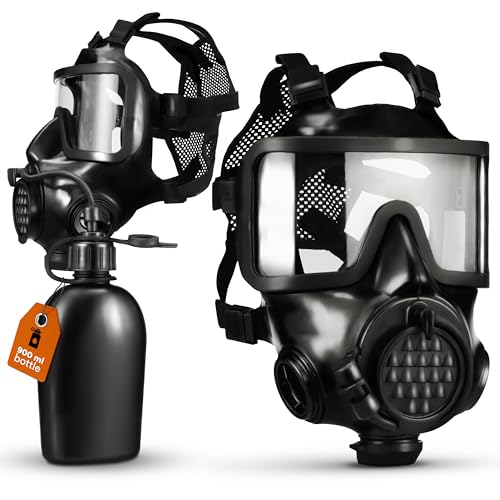
Unlike the other options, this facepiece is specifically identified as a CBRN gas mask. The maker says it can protect against a range of toxic industrial chemicals and chemical warfare agents when paired with an appropriate filter, including radioactive dust; that claim does not mean the mask blocks penetrating radiation. The product also specifies a panoramic visor with a 92.5% field of view. It suits buyers seeking a CBRN-designated mask, but the filter is the critical limitation: confirm its exact compatibility and hazard rating before depending on the system.
Bottom line: Choose this if you want a CBRN-designated facepiece and can verify the matching filter.
Owenri Full Face Mask, 40mm Filter

The Owenri is the option here that specifies a 40mm activated-carbon filter, along with dual activated-carbon filter wording. Its maker says it is intended for gases, vapors, dust and chemicals, and describes an anti-fog, anti-scratch shield and speaking diaphragm. The filter information does not establish suitability for radioactive fallout or a CBRN hazard, so this is not a substitute for a verified fallout-rated filter system. It may suit general respiratory tasks when the specific filter matches the hazard; buyers focused on fallout should confirm the filter type and interface before use.
Bottom line: Choose this for general tasks only when the specific filter matches the hazard.
Parcil PT-100 Full Face Respirator

The PT-100 is framed around industrial and work applications rather than a specifically identified CBRN system. Its maker says the bundled filters address organic vapors and particulates and names uses including painting, agriculture, construction, wildfire work and metal work. The product also specifies a 200-degree field of view and an ANSI Z87.1 impact-resistant lens. Those features do not establish protection against fallout; the filter type and approval for the intended contaminant remain essential. It suits buyers comparing a work respirator, but not anyone assuming that a general particulate-and-vapor claim equals CBRN protection.
Bottom line: Choose this for listed work applications, not as an assumed fallout system.
HANUU Full Face Mask, 40mm and P-A-1 Filters

The HANUU distinguishes itself by stating both a 40mm screw interface and a bayonet-style interface. It is a full face silicone mask with a communication diaphragm, and the product name mentions 40mm activated-carbon and P-A-1 filters. The maker describes intended use for vapor, chemicals, spray paint, resin and dust, but that wording does not establish CBRN or radioactive-fallout protection. Buyers comparing interface options may find the compatibility useful; anyone planning for fallout must verify the exact filter model, connection, and hazard rating as a complete system.
Bottom line: Choose this when you need the interface options for general respiratory tasks.
LPTYHGJ Full Face Respirator

The LPTYHGJ emphasizes an adjustable elastic headband and a silicone-mixture facepiece rather than a named filter type. Its maker describes a treated optical-plastic lens and lists painting, spraying, welding, sawing, grinding and polishing among its intended tasks. The specifications do not establish a filter rating or a fallout-specific capability, so its survival wording should not be taken as proof of protection from radioactive particles or gases. It may be relevant for the industrial tasks when used with an appropriate, verified filter, but fallout preparedness calls for a documented compatible system.
Bottom line: Choose this only for a task with a verified filter matched to its hazard.
How to choose a fallout respirator
A fallout respirator must be a complete, compatible facepiece-and-filter system; a mask name alone cannot establish protection. Radioactive fallout can include contaminated particles, while a carbon sorbent targets certain gases and vapors rather than serving as a universal filter. Check the exact filter model, connection, and hazard rating together, and look for applicable approval for the intended use. NIOSH-approved respirators have an approval number that can be checked in the NIOSH Certified Equipment List. A measurable decision rule: if the filter cannot be positively matched to the facepiece and labeled for the airborne hazard, do not count that combination as protection. Fit and seal matter as much as filter selection.
What a gas mask can and cannot do
An air-purifying respirator cleans air that passes through its filter; it does not supply oxygen or block penetrating gamma radiation. A properly fitted particulate filter may reduce inhalation of radioactive particles, but a mask does not prevent radiation exposure from contaminated ground, buildings, or objects. In a radiological emergency, getting inside, staying inside, and following official instructions take priority. A basement or the center of a substantial building generally offers more distance and shielding than a vehicle or an exterior room. Do not enter an area with unknown oxygen levels or immediately dangerous concentrations relying on an air-purifying mask; such conditions require specialized equipment and trained responders.
Face fit, filters, and replacement
A respirator only works as intended when its seal fits the wearer and the filter matches the hazard. Facial hair across the sealing surface can break a tight seal, and a user seal check should be performed each time a tight-fitting mask is donned; it is not a substitute for formal fit testing. Replace filters according to their labeling and applicable guidance, and sooner if they are damaged, wet, hard to breathe through, or contaminated. Store filters sealed and dry, and check expiration dates before an emergency. For a 40mm connector, confirm the thread standard and filter approval rather than assuming all 40mm canisters are interchangeable.
Fallout preparation mistakes to avoid
The most consequential mistake is treating a consumer gas mask as a substitute for shelter, evacuation instructions, or professional protection. Another is assuming activated carbon by itself removes every chemical or radioactive hazard; filter media are designed for specific contaminants and conditions. Keep a mask and its matching filter together, preserve the filter packaging, and know how to don and seal the facepiece before an emergency. Do not remove a mask in a contaminated area to speak or adjust it. If a mask leaks, the filter connection is uncertain, or breathing becomes difficult, move to a safer location and follow emergency directions rather than continuing to rely on the equipment.
Frequently Asked Questions
Does a gas mask protect against nuclear radiation?
A gas mask does not block penetrating gamma radiation. A suitable particulate filter may reduce inhalation of contaminated particles, but shelter, distance, and time are central to reducing radiation exposure.
Can activated carbon filters remove radioactive fallout?
Activated carbon is not a universal fallout filter; it is used for certain gases and vapors, while airborne particles require suitable particulate filtration. Verify the specific filter’s hazard rating and compatibility with the facepiece.
How should a respirator fit on the face?
A tight-fitting respirator needs an uninterrupted seal against the face, so facial hair under the sealing surface can cause leakage. Perform a user seal check each time you put it on, and use formal fit testing where required.
When should gas mask filters be replaced?
Replace a filter by its labeled service-life instructions, expiration, or sooner if it is damaged, wet, contaminated, or breathing resistance increases. Keep replacement filters sealed and dry until needed.
Can an air-purifying mask be used in low oxygen?
No, an air-purifying respirator does not supply oxygen. Unknown or oxygen-deficient atmospheres require specialized equipment and trained responders, not a consumer gas mask.