
Best Golden Rewards Dog Treats Compared by Type

Golden Rewards Chicken Flavor Premium Dry Jerky Treats suit most buyers because the 64-ounce bag has a chicken-breast recipe with three ingredients. Choose another option if your dog prefers soft sticks, biscuits or sweet potato wraps rather than dry jerky.
Dog treats are supplemental food, so keep them to a small share of daily calories and account for treats when portioning meals.
We earn a commission if you buy through links on this page. As an Amazon Associate I earn from qualifying purchases. Products are compared on manufacturer specifications, not hands-on testing.
- Best overall: Golden Rewards Chicken Dry Jerky, 64 oz – The 64-ounce chicken jerky bag offers the largest size and a three-ingredient recipe.
- Best for training: Golden Rewards Chicken and Sweet Potato Sticks – Soft chicken-and-sweet potato sticks can be broken into smaller reward pieces.
- Best for biscuit fans: Golden Rewards Peanut Butter Chicken Biscuits – A peanut butter-flavored biscuit is wrapped with real chicken breast.
| Product | Best for | Form | Main flavors | Shop |
|---|---|---|---|---|
| Golden Rewards Chicken Dry Jerky, 64 oz | Chicken jerky | Dry jerky | Chicken | Check Price on Amazon |
| Golden Rewards Chicken and Sweet Potato Sticks | Training rewards | Soft chewy sticks | Chicken, sweet potato | Check Price on Amazon |
| Golden Rewards Peanut Butter Chicken Biscuits | Biscuit preference | Biscuits wrapped with chicken | Peanut butter, chicken | Check Price on Amazon |
| Golden Rewards Sweet Potato Wrapped with Chicken, 32 oz | Sweet potato wraps | Chicken-wrapped sweet potato | Chicken, sweet potato | Check Price on Amazon |
| Golden Rewards Chicken, Duck and Beef Jerky | Mixed meat flavor | Jerky | Chicken, duck, beef | Check Price on Amazon |
Golden Rewards Dog Treats
Compare the treat formats and flavor combinations to find the best match for your dog’s preferences and how you plan to offer rewards.
Golden Rewards Chicken Dry Jerky, 64 oz

The 64-ounce bag separates this option from the smaller packs, and its chicken jerky format suits dogs that prefer a dry, chewable reward. The maker says chicken breast is the first ingredient and the recipe has three ingredients, with no by-products, artificial colors, flavors or preservatives. The product is also described as grain-free and free of corn, wheat and soy. Choose it for chicken-focused treating or a larger pack; it is not the match for dogs that need a soft, breakable stick or a biscuit-style treat.
Bottom line: Pick this for a chicken jerky treat in a larger stated pack size.
Golden Rewards Chicken and Sweet Potato Sticks
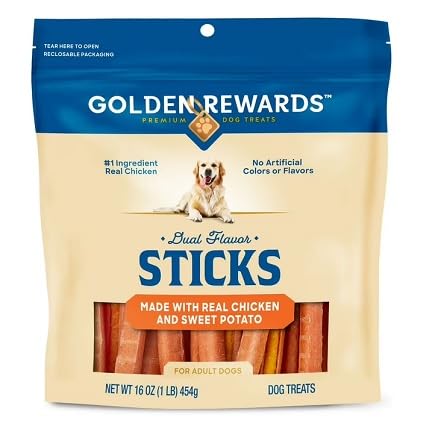
Soft, breakable sticks make this the clearest fit for portioning rewards during short training sessions. The maker describes a dual-flavor chicken-and-sweet potato recipe with real chicken as the primary ingredient, and says the treats contain no animal by-products, corn, soy, artificial colors or artificial flavors. The resealable 16-ounce bag is sized differently from the 64-ounce jerky option. Pick these when a softer texture and smaller reward pieces matter; skip them if your dog prefers crisp biscuits or dry jerky.
Bottom line: Choose these when a soft stick that can be broken into pieces suits your routine.
Golden Rewards Peanut Butter Chicken Biscuits

The biscuit format and peanut butter flavor set this treat apart from the jerky, wrapped sweet potato and soft-stick options. The maker says the biscuits are made with real chicken breast, are high in protein and contain no preservatives. The 16-ounce pack suits buyers who want a familiar biscuit-style reward with chicken wrapped around it. The product is not described as a soft, breakable stick, so it may be a less convenient choice when rewards need to be divided into tiny pieces during training.
Bottom line: Choose this if your dog favors biscuits and peanut butter flavor.
Golden Rewards Sweet Potato Wrapped with Chicken, 32 oz

Sweet potato wrapped with chicken gives this treat a distinct form and flavor pairing within the group. The maker says it contains real chicken breast and describes the ingredients as a source of fiber, iron, calcium and vitamin C. The 32-fluid-ounce pouch is resealable and easy to open. The feeding direction calls this an intermittent or supplemental food and says to watch dogs to ensure the treat is chewed before swallowing. Choose it for that wrapped texture; dogs that need tiny training pieces may be better served by breakable soft sticks.
Bottom line: Pick this for a chicken-and-sweet potato wrap and resealable pouch.
Golden Rewards Chicken, Duck and Beef Jerky

Chicken, duck and beef give this jerky a three-meat flavor profile, unlike the chicken-only jerky option. The maker describes it as high in protein and low in fat, and says it contains no by-products or artificial ingredients. Its one-pound resealable bag is smaller than the 64-ounce chicken jerky pack, making it a different pack-size choice. Pick this recipe if you want several named meat flavors in one treat; it is still jerky, so it will not meet a preference for biscuits or soft sticks.
Bottom line: Choose this when a mixed-meat jerky recipe is the deciding factor.
How to choose Golden Rewards dog treats
Start with texture and use: soft sticks are easier to divide, while jerky, biscuits and wraps are distinct formats. For training that needs frequent tiny rewards, choose the breakable sticks; for an occasional treat, choose the form your dog accepts comfortably. Treats are supplemental food, and a common veterinary guideline is to keep them at or below 10% of daily calories, with at least 90% from complete, balanced food. Count treats toward the day’s calories rather than adding them on top. If a treat is large for your dog, break it into manageable portions only when its texture allows, and supervise chewing rather than assuming any format is safe to swallow whole.
Compare treat types and flavors
The form is the clearest difference among these treats: biscuits, soft sticks, jerky and wrapped pieces serve different preferences. Use this comparison to narrow the choice by texture and named flavors, then match portion size to your dog’s daily feeding plan.
| Format | Flavor combination | Useful distinction |
|---|---|---|
| Biscuit wrapped with chicken | Peanut butter and chicken | Traditional biscuit form |
| Soft chewy sticks | Chicken and sweet potato | Can be broken into smaller pieces |
| Jerky | Chicken; or chicken, duck and beef | Two different meat profiles |
| Sweet potato wrapped with chicken | Sweet potato and chicken | Resealable pouch |
Dogs have individual preferences, so introduce a new treat in a small amount and observe how your dog handles its texture.
How to portion and serve dog treats
Keep treats at 10% or less of daily calories as a practical ceiling, and reduce meal portions if treats contribute calories. A treat’s package weight is not the same as a serving’s calorie content, so use the feeding directions and calorie information on the package when calculating portions. For dogs that gulp food, offer only a piece they can chew safely and supervise each treat; the sweet potato wrap’s directions specifically call for watching the dog until it is adequately chewed. Provide clean drinking water, and do not give a treat that is too large or hard for the individual dog’s chewing ability.
Common mistakes when choosing dog treats
A common mistake is choosing by flavor alone and overlooking texture: a biscuit, a soft stick and jerky are not interchangeable for every dog. Another is treating a large pack as a serving size; 64 ounces describes the package, not how much to give at once. Keep daily treat calories within the 10% guideline and consider the dog’s full diet, especially if treats are used repeatedly for training. Supervise chewing because dogs can swallow pieces before chewing them adequately, and provide water. When a dog has a prescribed diet or food sensitivities, check with its veterinarian before introducing ingredients that are new to its diet.
Frequently Asked Questions
How many dog treats should I give each day?
Keep treats to about 10% or less of daily calories as a general guideline, with complete, balanced food supplying the rest. The right number depends on each treat’s calorie content and your dog’s daily calorie needs.
Are dog treats a substitute for dog food?
No, these treats are intended as rewards or supplemental food rather than a complete daily diet. Keep at least 90% of calories from complete, balanced food as a practical rule.
Should I supervise my dog while eating treats?
Yes, supervise chewing because dogs may swallow pieces before chewing them adequately. Offer a portion suited to your dog’s size and chewing habits, and keep fresh water available.
Can I break soft dog treats into pieces?
Soft sticks can be broken into smaller reward pieces, according to the product features. For any treat, make pieces small enough for your dog to chew safely and supervise while eating.