
Best Granite Composite Sink Cleaner: 5 Picks Compared

Shieldon WOW Composite Sink Cleaner is the best granite composite sink cleaner for stubborn discoloration because its maker says the spray targets deep stains on composite sinks. For regular upkeep or a water-repellent finish, choose a different formula; for a Blanco SILGRANIT sink with white film or limescale, BLANCO BlancoClean Daily+ is specifically formulated for that surface.
We earn a commission if you buy through links on this page. As an Amazon Associate I earn from qualifying purchases. Products are compared on manufacturer specifications, not hands-on testing.
- Best overall: Shieldon WOW Composite Sink Cleaner – Its maker says the spray targets deep stains and discoloration on composite sinks.
- Best for SILGRANIT upkeep: BLANCO BlancoClean Daily+ – It is formulated for BLANCO SILGRANIT and targets hard-water deposits and white film.
- Best for multi-step restoration: Shieldon Protects Sink Restorer Kit – The kit combines a heavy-duty cleaner, a hard-water stain remover and a nano sealer.
- Best for daily cleaning and sealing: Shieldon Sink Care Kit – The kit pairs a multi-surface cleaner with a nano protector and cleaning accessories.
| Product | Best for | Size | Main use | Surface fit | Shop |
|---|---|---|---|---|---|
| Shieldon WOW Composite Sink Cleaner | Deep discoloration | 8.45 fl oz | Deep stains | Composite, quartz composite | Check Price on Amazon |
| BLANCO BlancoClean Daily+ | SILGRANIT upkeep | 15 fl oz | Weekly maintenance | BLANCO SILGRANIT | Check Price on Amazon |
| Shieldon Protects Sink Restorer Kit | Three-step restoration | 23.67 fl oz | Stains, mineral buildup, sealing | Granite composite, quartz, porcelain, ceramic | Check Price on Amazon |
| Shieldon Sink Care Kit | Daily cleaning | 16.9 fl oz | Daily cleaning and protection | Granite composite, ceramic, natural stone | Check Price on Amazon |
| HOPE’S Perfect Sink Cleaner and Polish | Polish and shine | 8.5 fl oz | Cleaning and polishing | Composite, cast iron, Corian, acrylic | Check Price on Amazon |
Granite composite sink cleaners compared
Match the cleaner to the job: routine care, hard-water buildup or stubborn discoloration.
Shieldon WOW Composite Sink Cleaner

For deep stains and discoloration, this spray is the most directly targeted option here. Its maker says it is designed for dark marks from coffee, tea, wine and food residue on composite sinks, and that it can restore the surface’s natural tone. The formula is also described as suitable for ceramic sinks and colors including white, beige and black. Choose it when stain removal is the priority; its 8.45-fluid-ounce size is smaller than the 15-fluid-ounce routine-care cleaner in this group.
Bottom line: Pick this when stubborn stains matter more than routine weekly upkeep.
BLANCO BlancoClean Daily+

For owners of BLANCO SILGRANIT sinks, this is the only cleaner here specifically formulated for that brand’s composite surface. Its maker says it controls hard-water deposits and limescale, removes soap residue and white film, and is suitable for once- or twice-weekly maintenance. That makes it a better match for recurring buildup than a spray aimed at deep discoloration. The key limitation is its specific surface fit: buyers with another sink material should choose a product whose compatibility matches their sink.
Bottom line: Choose this for recurring film or mineral deposits on a BLANCO SILGRANIT sink.
Shieldon Protects Sink Restorer Kit

This kit takes a three-step approach rather than relying on one cleaner: a heavy-duty sink cleaner, a hard-water stain remover and a nano sealer. Its maker says the cleaners target deep-set stains and mineral deposits, while the sealer enhances sink color and helps prevent future spots and stains. It is intended for granite composite, quartz, porcelain and ceramic sinks. The multi-step format suits a sink needing both stain and hard-water treatment, but is more involved than a single spray for one isolated mark.
Bottom line: Pick this when the sink needs both stain removal and hard-water treatment.
Shieldon Sink Care Kit
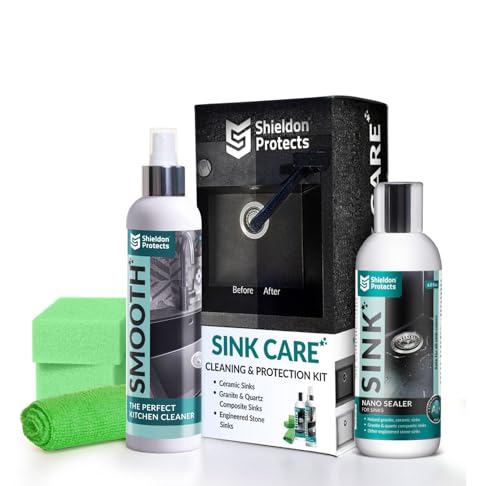
This kit pairs daily cleaning with a separate nano protector, while also including two sponges and a microfiber cloth. Its maker says the cleaner removes grease, grime and food residue from sinks and other kitchen surfaces, and that the protector repels water, oil, wine and hard-water stains. It suits buyers who want ongoing care and a protective finish rather than stain restoration. The limitation is important: the kit is not intended to remove deep-set stains, so choose a restorer for that job.
Bottom line: Choose this for day-to-day cleaning paired with a separate protective treatment.
HOPE’S Perfect Sink Cleaner and Polish
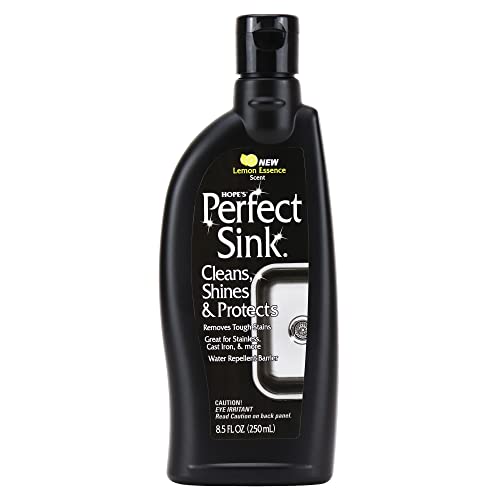
Unlike the sprays aimed specifically at composite discoloration, this cleaner combines cleaning and polishing across several sink materials. Its maker says the formula shines, polishes and protects in one step, creates a water-repellent barrier, and targets stains, water spots and rust stains. It is described for composite, cast iron, Corian and acrylic sinks, and has a lemon scent. At 8.5 fluid ounces, it is a compact option; buyers focused on hard-water control should compare it with a cleaner specifically described for limescale.
Bottom line: Pick this for a combined cleaning-and-polishing formula across several sink materials.
How to choose a granite composite sink cleaner
Choose by the residue you need to remove: routine food grime, white mineral film or dark stains call for different product claims. Mild dish soap and warm water are a sensible starting point for everyday cleaning; use a soft sponge or microfiber cloth and rinse the surface. For white film or recurring limescale on BLANCO SILGRANIT, a cleaner formulated for that surface is the more specific match. For dark discoloration, choose a product whose purpose is stain removal. If a sink has both deposits and stains, a multi-step restorer may suit better than a single-purpose spray.
Granite composite commonly combines mineral material with resin, so care guidance can differ by sink maker and finish. If the sink maker restricts a chemical or treatment, follow that rule rather than assuming every composite surface responds alike.
How to clean composite sinks without dulling them
Use a soft sponge or microfiber cloth with warm water and mild dish soap for ordinary food residue, then rinse and dry the basin. Avoid steel wool, scouring pads and abrasive powders, which can scratch or dull a resin-containing finish. For hard-water marks, drying the surface after use helps limit mineral residue; a dedicated limescale cleaner is useful when deposits have already formed. Apply any stain product only as its maker directs, since formulas can differ in surface compatibility and contact time.
Never mix cleaning chemicals. In particular, do not combine bleach with acidic cleaners such as vinegar or descalers, because the mixture can release hazardous chlorine gas. Keep products away from children and pets, and ventilate the area when using sprays.
Cleaner types and the jobs they suit
Single-purpose cleaners are easiest to match to a specific task, while kits can combine routine cleaning with protection or restoration. Use this guide to narrow the type before considering the sink’s exact material and finish.
| Cleaning need | Product type to choose | Decision cue |
|---|---|---|
| Everyday grease and food residue | Daily sink cleaner | Use for regular surface cleaning |
| Soap film or mineral deposits | Surface-specific maintenance cleaner | Match the named sink material |
| Dark stains or discoloration | Stain remover or restorer | Choose when routine cleaning is not enough |
| Several issues plus protection | Multi-step restoration kit | Choose when the kit’s steps fit the job |
With only white film or limescale on a BLANCO SILGRANIT sink, a weekly maintenance cleaner is more targeted than a three-step restoration kit. With both mineral buildup and deep discoloration, a restorer that includes separate treatments may be more appropriate.
Common granite composite sink cleaning mistakes
The most common mistake is treating every mark as a stain: soap film, hard-water deposits and food discoloration can need different approaches. Start with mild soap and a soft cloth, then move to a purpose-made cleaner suited to the residue. Another mistake is using an abrasive pad to speed up scrubbing; that can damage the finish even when the cleaner itself is compatible.
Do not assume that a sealer or polish is a substitute for stain removal. Some kits explicitly focus on protection and shine rather than deep stains. Check your sink maker’s care rules before using a new chemical or coating, especially when the product names only certain materials.
Frequently Asked Questions
Can I use vinegar on a granite composite sink?
Avoid assuming vinegar is safe for every composite finish; acidic cleaners may conflict with a sink maker’s care rules. Use mild dish soap and water for routine cleaning, and select a compatible limescale product for mineral deposits.
How do I remove white film from a composite sink?
White film can come from soap residue or hard-water buildup, so use a cleaner suited to the deposit and sink material. Rinse and dry the basin afterward to reduce residue from remaining water.
What should I use for dark stains on a composite sink?
Start with mild soap and a soft sponge, then use a stain remover explicitly made for the sink material if the mark remains. Avoid abrasive pads, which can scratch or dull a composite finish.
Can I use a scouring pad on a granite composite sink?
No; steel wool and abrasive scouring pads can scratch or dull a resin-containing finish. A soft sponge or microfiber cloth is the safer choice for routine cleaning.
Can I mix sink cleaner with bleach?
No; never mix bleach with other cleaners, especially acidic products such as vinegar or descalers. Bleach mixed with acids can release hazardous chlorine gas.