
Best Handheld Portable Welder: 4 Models Compared

Handheld 110V Stick Welder, 20–120A suits most buyers because its 110V stick-welding design pairs five current settings with a size of about 9.84 × 3.94 × 9.84 inches. Choose another option if you need a specified 3/32–1/8-inch rod range or a weight; a handheld stick welder holds a consumable electrode directly in its gun-style body.
We earn a commission if you buy through links on this page. As an Amazon Associate I earn from qualifying purchases. Products are compared on manufacturer specifications, not hands-on testing.
- Best overall: Protmex 110V Handheld Welder, 20–120A – Its 3/32- to 1/8-inch rod compatibility, 20–120A range and 20 included rods are specified.
- Best for included gear: Handheld 110V Stick Welder, 20–120A – Its package includes a ground clamp, welding mask and five rods.
- Best for lighter carrying: Portable 110V Handheld Arc Welder, 20–120A – Its weight is 2.7 pounds.
| Product | Best for | Rod compatibility | Shop |
|---|---|---|---|
| Handheld 110V Stick Welder, 20–120A | Complete starter kit | — | Check Price on Amazon |
| Protmex 110V Handheld Welder, 20–120A | Wider rod sizes | 3/32–1/8 in. | Check Price on Amazon |
| Saker 110V Handheld Welder, 20–120A | Five-setting control | 3/32 in. | Check Price on Amazon |
| Portable 110V Handheld Arc Welder, 20–120A | Light carry | 3/32–1/8 in. | Check Price on Amazon |
Handheld portable welders
Compare current controls, rod compatibility and portability before choosing a stick welder for your projects.
Handheld 110V Stick Welder, 20–120A

Handheld 110V Stick Welder, 20–120A stands out for pairing a body size of about 9.84 × 3.94 × 9.84 inches with a ground clamp, welding mask and five rods. This 110V MMA stick machine has five current settings and holds the rod in a front chuck, with a handle-mounted button and top adjustment knob. It suits a home repairer who wants core accessories in one package.
Bottom line: Choose this if stated dimensions and included basic accessories matter more than a specified rod range.
Protmex 110V Handheld Welder, 20–120A

Protmex 110V Handheld Welder, 20–120A has the widest explicitly specified rod range among these options, covering 3/32- to 1/8-inch electrodes, and includes 20 rods. Its 110V inverter provides five current positions across 20–120A. The maker says automatic current compensation helps maintain output during voltage fluctuations from long extension cords. This suits home repairers who want to use more than one common rod diameter. The limitation is that its weight is not provided, which matters to buyers who prioritize a known carry weight.
Bottom line: Choose this when compatibility with both 3/32- and 1/8-inch rods matters most.
Saker 110V Handheld Welder, 20–120A
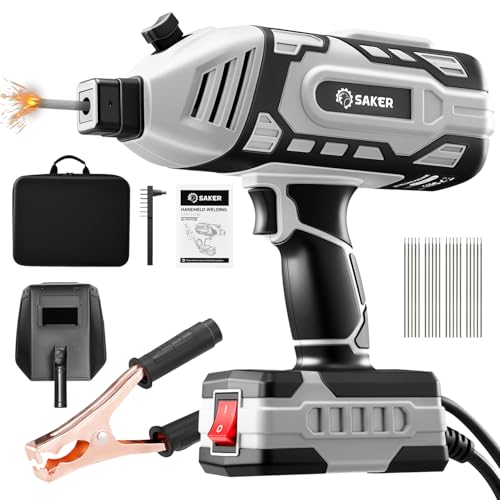
Saker 110V Handheld Welder, 20–120A focuses on five-step current adjustment from 20 to 120A, with compatibility for 3/32-inch rods. It uses a 110V supply and an IGBT inverter; the maker says the inverter supports arc stability and easier starts. The package size includes 20 rods, which may be useful for a small DIY project. This is a focused option for users already planning to use 3/32-inch electrodes. Its rod range is narrower in the specifications than the option listing both 3/32- and 1/8-inch compatibility.
Bottom line: Choose this for 3/32-inch rod work and five-step current adjustment.
Portable 110V Handheld Arc Welder, 20–120A

Portable 110V Handheld Arc Welder, 20–120A is the only option with a 2.7-pound weight, and its dimensions are 11.8 × 4.7 × 14.9 inches. It supports 3/32- to 1/8-inch rods and a 20–120A output range. The maker says its IGBT inverter provides arc stability and describes a six-position control. This suits buyers prioritizing a carry weight and broad rod compatibility.
Bottom line: Pick this when a 2.7-pound weight and broad rod compatibility matter most.
How to choose a handheld stick welder
Start with the electrode diameter and metal thickness, then match the machine’s current range to the electrode maker’s guidance. Typical 3/32-inch electrodes run around 40–90A, while 1/8-inch electrodes commonly run around 75–125A; the exact range varies by electrode type and manufacturer. A welder’s top setting does not guarantee that a 110V outlet can sustain it, because input current and circuit capacity constrain output. For repeated work near the machine’s upper range, compare its input requirements with the circuit rating rather than assuming a household outlet is sufficient. Choose the model with a rod range that includes your intended electrode, and favor an explicitly stated size or weight if frequent transport matters.
Rod size and current range
Electrode diameter is a practical starting point for setting current: thicker rods generally need more amperage, while thin stock needs careful heat control to reduce burn-through. A 3/32-inch rod is a common choice for lighter repair work; 1/8-inch electrodes are commonly used for heavier sections when the power source and joint allow. These are typical ranges, not universal settings: electrode coating, position, joint design and base-metal thickness all affect the usable setting. Make a test weld on scrap of similar thickness and adjust in small steps. Do not exceed the electrode manufacturer’s operating range just because the control dial offers a higher setting.
| Need | Typical electrode | Common current range |
|---|---|---|
| Light repair | 3/32 in. | About 40–90A |
| Heavier repair | 1/8 in. | About 75–125A |
Power, setup and safe use
A 110V welder still needs a suitable circuit, secure ground connection and sound extension cord; a long or undersized cord can cause voltage drop and unstable welding. Keep the work area dry, remove flammable material from the spark path and protect nearby people from arc flash. Stick welding produces ultraviolet light, hot spatter and fumes, so use a welding helmet with an appropriate shade, welding gloves, covered clothing and ventilation. Never weld a closed container or a surface that may contain flammable residue. Secure the workpiece before striking an arc, and let it cool before handling it without gloves.
Frequently Asked Questions
What rod size works for thin steel repairs?
A 3/32-inch electrode is a common starting size for lighter steel repair, often used around 40–90A. Use the electrode manufacturer’s range and test on scrap of similar thickness to avoid burn-through.
Can a 110V welder use an extension cord?
It can, but cord length and conductor size affect voltage drop and performance. Use a grounded cord rated for the welder’s input current, keep it as short as practical, and avoid coiling it during welding.
What safety gear is needed for stick welding?
Use a welding helmet with an appropriate lens shade, welding gloves and covered, nonflammable clothing. Provide ventilation and clear combustibles from the spark area before striking an arc.
How do I keep a stick electrode from sticking?
Set current within the electrode maker’s recommended range and maintain a short, steady arc; too little current often makes starting harder. Clean rust, paint and scale from the joint area, and clamp the work lead to clean metal.