
Best Hinges for Hidden Door Bookcases Compared

TamBee 4213 Hold-Open Pivot Hinge suits most builders who need the highest load rating: its maker claims support for up to 1,100 pounds and a 90-degree hold-open feature. Choose another option if your door is lighter, needs a 360-degree pivot, or you prefer a pin-style system.
Hidden door bookcase hinges support a bookcase that swings as a concealed doorway, so the hinge and its mounting structure must handle the loaded door, not just the empty cabinet.
We earn a commission if you buy through links on this page. As an Amazon Associate I earn from qualifying purchases. Products are compared on manufacturer specifications, not hands-on testing.
- Best overall: TamBee 4213 Hold-Open Pivot Hinge – Its maker claims a 1,100-pound capacity and a 90-degree stay-open feature.
- Best for DIY pin hinges: MURPHY DOOR Hidden Hinge Hardware – The pin system accommodates in-swing or out-swing doors with left- or right-side design.
- Best for a 360-degree pivot: 570-lb 360° Pivot Hinge Kit – The product is designed to rotate through 360 degrees around a central pivot.
- Best for alloy-steel construction: 700-lb Solid Alloy Steel Pivot Hinge – The maker claims a 700-pound capacity and specifies thick solid alloy steel.
| Product | Best for | Maker-claimed load | Pivot or opening feature | Material | Shop |
|---|---|---|---|---|---|
| TamBee 4213 Hold-Open Pivot Hinge | Heavy doors | 1,100 lb | Locks open at 90° | 304 stainless steel | Check Price on Amazon |
| MURPHY DOOR Hidden Hinge Hardware | DIY pin systems | 300 lb | In- or out-swing; left or right | — | Check Price on Amazon |
| 570-lb 360° Pivot Hinge Kit | 360° rotation | 570 lb | 360° rotation | — | Check Price on Amazon |
| 304 Stainless Steel 570-lb Pivot Hinge | Stainless construction | 570 lb | Ball-bearing pivot | 304 stainless steel | Check Price on Amazon |
| 700-lb Solid Alloy Steel Pivot Hinge | Alloy-steel doors | 700 lb | 360° and 180° swing | Solid alloy steel | Check Price on Amazon |
Hidden Door Bookcase Hinges
Compare load claims, hinge styles and construction before matching a kit to your bookcase door.
TamBee 4213 Hold-Open Pivot Hinge

For builders prioritizing the largest load, this pivot kit has a maker-claimed 1,100-pound capacity and a 90-degree stay-open feature. The maker identifies 304 stainless steel construction and says the kit is intended for concealed secret and bookshelf doors. That hold-open position can help when moving through the doorway, but it is not a substitute for a door stop or safe installation. Choose a different hinge if you need a full 360-degree swing; the hold-open angle is 90 degrees, not unrestricted rotation.
Bottom line: Pick this when the 90-degree hold-open position and claimed 1,100-pound capacity match your build.
MURPHY DOOR Hidden Hinge Hardware

The pin-based system differs from the other pivot kits by allowing an in-swing or out-swing layout with left- or right-side design. The kit includes top and bottom hinge sets with pins, a pin-removal tool, screws, and a door catch with plate; the maker says experienced carpenters can use it for a DIY door project. Its door capacity is 300 pounds, so weigh the complete bookcase with books before choosing it. The maker also gives the lower pivot bearing separate dynamic and static torque figures; those are not door-weight ratings.
Bottom line: Choose this for a 300-pound-or-lighter project where pin-style installation and swing orientation matter.
570-lb 360° Pivot Hinge Kit
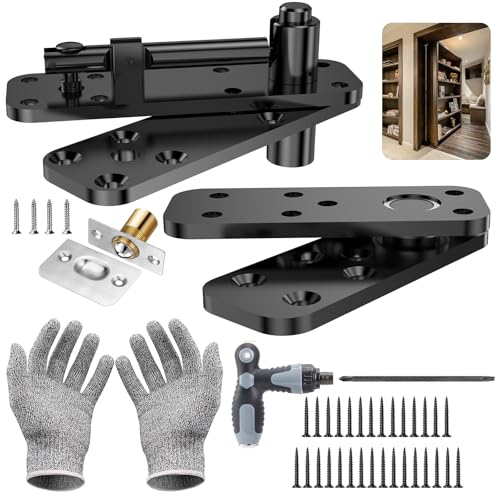
This kit emphasizes a central-axis pivot that the maker says rotates 360 degrees, unlike the 90-degree hold-open configuration. Its package includes a top-and-bottom pivot set, 30 screws, a ball catch with four screws, and a screwdriver. The claimed 570-pound capacity may suit a substantial bookcase door, but the figure is a maker claim and does not establish the capacity of your wall, header, or floor anchoring. Choose this style only if the doorway layout has clearance for the full pivot path; a full rotation can require more room than a conventional swing.
Bottom line: Pick this if you need a central pivot with a claimed 570-pound capacity and full rotation.
304 Stainless Steel 570-lb Pivot Hinge

Material is the distinguishing factor here: this pivot kit specifies solid 304 stainless steel, while the other 570-pound kit does not identify its material. The maker claims support up to 570 pounds and describes a lower ball-bearing design for smooth movement. The package is identified as one set, making it a straightforward option when stainless construction is a priority. The dimensions are compact, but hinge dimensions alone do not establish compatibility; confirm the required mortise and mounting geometry against your door construction before cutting.
Bottom line: Choose this when specified 304 stainless construction is more important than package extras.
700-lb Solid Alloy Steel Pivot Hinge

This solid alloy-steel pivot kit sits between the 570-pound choices and the 1,100-pound hold-open model by claimed capacity. Its maker describes 360-degree and 180-degree swing options and a bearing mechanism for rotation. That flexibility can help when the intended opening is not a simple one-direction swing, but actual clearance depends on the door thickness, pivot position, trim, and nearby shelving. The product’s load is not a substitute for checking the full bookcase assembly, including its contents and the strength of the structural attachment.
Bottom line: Pick this for a claimed 700-pound load and the 180- or 360-degree swing options.
How to choose hidden door bookcase hinges
Choose by the loaded door weight, pivot geometry, and structural attachment—not the empty bookcase weight. A bookcase door can gain substantial mass from shelves and books, and the hinge rating does not rate the surrounding framing. Leave a safety margin rather than sizing a hinge right at its claimed limit; exact margins depend on the hinge maker and installation. Decide whether you need a conventional swing, a central pivot, or a hold-open position before buying. A hinge that rotates widely may need clear space at the jamb and nearby furniture. For a door approaching a kit’s claimed capacity, have the framing and anchoring checked by a qualified carpenter.
Load ratings and safe installation
Load claims are not interchangeable: the 300-, 570-, 700-, and 1,100-pound figures refer to different kits and do not prove that a complete installation can safely carry that load. Weigh the complete door with its intended books, then account for dynamic forces as the door starts, stops, or is pushed. A pivot hinge transfers force into both the upper and lower mounting points, so fasteners need solid structural backing rather than drywall alone. Keep hands clear of pivot gaps during installation and operation; a heavy swinging bookcase can create pinch and crush points. Use the hinge maker’s installation geometry and fastener requirements.
Pivot styles and opening clearance
Central pivots can rotate differently from ordinary butt hinges, and a wider rotation path changes the clearance needed around a bookcase door. A 90-degree hold-open position suits a doorway where the door should stay partly open, while a full-rotation design requires room for the bookcase to travel through its full arc. Check trim, adjacent walls, ceiling height, floor level, and shelf overhang before cutting. Use a measured floor plan or a full-size swing template; with less than the bookcase’s projection in clear adjacent space, a 180- or 360-degree opening can collide before reaching its intended position. Confirm the pivot axis and mounting depth on the actual assembly.
Preparing and fitting a bookcase door
Plan the door as a rigid, square assembly because a flexible frame can bind even when the hinge is correctly rated. Bookcase shelves and a loaded door shift the center of gravity away from the hinge axis, increasing leverage on the pivots and fasteners. Secure shelves and contents so books cannot slide as the door moves, and use a catch to keep the door from drifting when closed. Before final fastening, verify the opening is plumb and the floor is level; a small alignment error can cause rubbing along a tall door. Avoid relying on trim, finish panels, or drywall as the only support for the hardware.
Frequently Asked Questions
How much weight should a hidden bookcase door hinge support?
Choose a hinge rating above the measured weight of the complete loaded bookcase door, not just its frame. Include books, shelves, hardware, and any facing because movement adds forces beyond static weight.
Can a pivot hinge turn a bookcase door 360 degrees?
Some central-pivot models are described for 360-degree rotation, but the room must leave clearance for the bookcase’s entire path. Measure the door’s projection and check nearby walls, furniture, and trim before installing.
Do hidden door hinges attach to drywall?
No; heavy pivot hardware should transfer its load into structural framing or another engineered support, not drywall alone. Fastener length and backing depend on the hinge geometry and the wall construction.
Why does a hidden bookcase door scrape after installation?
A door can scrape when the opening is out of plumb, the floor is uneven, or the frame has racked under load. Check alignment with a level and square before adjusting hinge positions or adding books.
Should books be loaded before adjusting a bookcase door?
Set the shelves and intended contents before the final alignment because added weight can change how the assembly hangs. Keep the door supported while adjusting heavy pivot hardware, and keep fingers away from the pivot gaps.