
Best Hospital Bed With Toilet Hole: 5 Options Compared

The TWJMV Electric Bed with Built-In Commode is the closest match for most people because its features include a built-in commode along with powered height adjustment and automatic turning. Choose another option only if a conventional bed is acceptable or its particular tilt, mattress, or capacity better suits the care setup.
A hospital bed with a toilet opening lets a caregiver position a commode or bedpan beneath the user; confirm the opening and toileting setup will work with the intended commode before ordering.
We earn a commission if you buy through links on this page. As an Amazon Associate I earn from qualifying purchases. Products are compared on manufacturer specifications, not hands-on testing.
- Best overall: TWJMV Electric Bed with Built-In Commode – It is the only option whose features explicitly include a built-in commode.
- Best for bedpan use: Full Electric Bed with Built-In Bedpan – Its features include a built-in bedpan, lateral turning, and CPR-flat positioning.
- Best for higher capacity: HaiyoHBED Model B, 5-Function – Its capacity is 600 pounds, higher than the other capacities.
| Product | Best for | Toileting feature | Capacity | Bed dimensions | Shop |
|---|---|---|---|---|---|
| TWJMV Electric Bed with Built-In Commode | Built-in commode | Built-in commode | 550 lb | 80.3 × 41.3 in | Check Price on Amazon |
| Fuzren 5-Function Electric Bed | Tilt positioning | — | — | 86.3 × 39.8 in | Check Price on Amazon |
| HaiyoHBED Model B, 5-Function | Higher capacity | — | 600 lb | 83.7 × 38.6 in | Check Price on Amazon |
| Electric Bed with Auto Side Tilt | Side tilt care | — | 550 lb | 78.7 × 35.4 in | Check Price on Amazon |
| Full Electric Bed with Built-In Bedpan | Bedpan access | Built-in bedpan | 550 lb | 82.7 × 44.0 in | Check Price on Amazon |
Hospital Beds With Toilet Holes and Alternatives
Compare the commode-equipped option with related beds that offer other care features but do not explicitly include a toilet opening.
TWJMV Electric Bed with Built-In Commode

Unlike the other options here, this bed explicitly includes a built-in commode, making it the closest match for shoppers seeking an integrated toileting setup. The electric adjustments cover the backrest, knee section, leg section, and bed height; the title also names a 550-pound capacity. Its dimensions are 80.3 inches long by 41.3 inches wide. Confirm the commode opening and your intended toileting equipment are compatible; buyers who need a particular opening size should verify it before choosing.
Bottom line: Choose this if an integrated commode is the priority and its opening suits your toileting setup.
Fuzren 5-Function Electric Bed

This bed differs from the commode-equipped choice by focusing on positioning rather than a toilet opening. Its five functions include backrest and leg adjustment, height adjustment from 17.72 to 29.52 inches, and Trendelenburg and reverse Trendelenburg tilt up to 14 degrees. The title names a 4.7-inch foam mattress and sheets; its dimensions are 86.3 inches long by 39.8 inches wide. It may suit a care setup where tilt and a taller maximum height matter. Because no commode or bedpan feature is named, it is not a direct substitute for a toilet-hole bed.
Bottom line: Pick this only when positioning and tilt matter more than integrated toileting.
HaiyoHBED Model B, 5-Function

The clearest distinction here is its 600-pound capacity, greater than the other capacities. This model has four independently adjustable functions; the maker says the five-function versions add Trendelenburg and reverse Trendelenburg. A mattress and IV pole are included according to the product name, and the frame dimensions are 83.7 by 38.6 inches. Choose it when capacity is a deciding factor and a conventional hospital bed fits the care plan.
Bottom line: Choose this when the 600-pound capacity is the deciding requirement.
Electric Bed with Auto Side Tilt
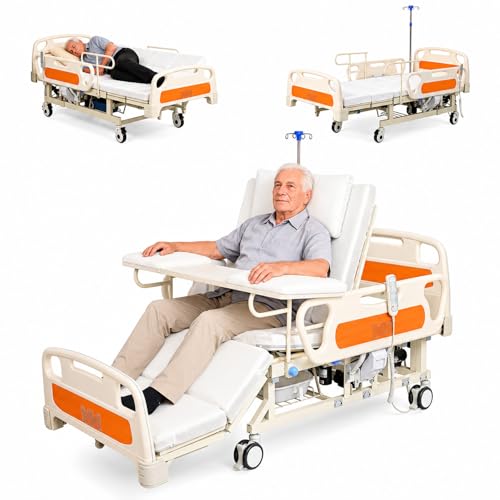
This option emphasizes powered side tilt rather than an integrated toileting opening. Its maker gives backrest adjustment up to 70 degrees, knee elevation, leg lowering, and side tilt up to 45 degrees; the title names a pressure-relief mattress, IV pole, and 550-pound capacity. The dimensions convert to 78.7 inches long by 35.4 inches wide. That narrower width may be useful where room clearance is tight, but compare the full bed footprint and caregiver access before committing. No commode or bedpan is named, so it is a related care bed rather than a toilet-hole match.
Bottom line: Pick this for a side tilt feature when integrated toileting is not required.
Full Electric Bed with Built-In Bedpan

This is the alternative most explicitly aimed at bedpan access: its name and features specify a built-in bedpan, rather than a built-in commode. It also lists lateral turning up to 45 degrees, timed turning cycles, a CPR-flat position, a high-density mattress, and a 550-pound capacity. The bed measures 82.7 inches long by 44 inches wide, wider than the other options. It may suit care routines centered on the included bedpan, but it should not be treated as interchangeable with a toilet-hole or commode bed without confirming the specific setup.
Bottom line: Choose this when a built-in bedpan, rather than an opening for a separate commode, meets the need.
How to Choose a Hospital Bed With a Toilet Hole
Start by deciding whether you need a cutout for a separate commode or a bed with a built-in commode or bedpan. These are different setups: the opening, removable insert, and toileting equipment need to work together, and the caregiver needs room to position equipment safely. Many standard hospital beds use a mattress area around 36 by 80 inches, but these options span 35.4 to 44 inches wide and 78.7 to 86.3 inches long. Measure the room, doorways, and route to the bed before selecting a footprint. If a separate commode must slide beneath the bed, verify the opening dimensions and available clearance before ordering; the specifications do not give opening measurements.
Commode Openings, Built-In Commodes, and Bedpans
A toilet-hole bed provides access through the bed platform for a commode or bedpan, while a built-in commode or bedpan may be integrated into the bed’s design. The labels do not guarantee that different products use compatible openings, inserts, or waste containers. Check whether the toileting component is included, removable, and positioned for the intended user and caregiver. A portable bedside commode is a separate seat and bucket; it is not the same as a bedpan placed in a bed opening. Among these choices, only TWJMV Electric Bed with Built-In Commode names a built-in commode, and Full Electric Bed with Built-In Bedpan names a built-in bedpan. If access to a household toilet is the goal, compare the room route and transfer needs rather than assuming a bed opening replaces a bathroom transfer.
Bed Size and Room Clearance
Measure more than the mattress: the bed frame, rails, casters, and accessories can extend beyond the sleeping surface. A typical hospital mattress footprint is about 36 by 80 inches, but the dimensions supplied for these products vary substantially, so use each product’s frame dimensions for initial room planning. Keep enough floor area for the caregiver to reach both sides and for mobility equipment to turn; a practical decision rule is to reject any bed footprint that leaves less than 36 inches of clear passage on the route caregivers must use. Door width, elevator space, and threshold height can also prevent delivery or setup. Confirm the complete assembled footprint and access route before purchase.
Safety Checks for Home Hospital Beds
Bed rails and mattress gaps can create entrapment hazards, especially when a mattress does not fit the frame or a rail is used as a restraint. Match the mattress size to the bed and inspect gaps along the sides and at the head and foot; do not assume that adding a rail makes a bed safer. Caregivers should also consider whether the user can transfer safely at the selected bed height and whether the controls can be reached without leaning across moving sections. Keep hands, tubing, and bedding clear of powered joints while adjusting the bed. For a user at risk of falling or becoming trapped, have a clinician or qualified equipment professional assess the complete bed, mattress, and rail setup.
Frequently Asked Questions
Can a regular bedside commode fit under a hospital bed?
Not necessarily; the bed’s frame and clearance determine whether a commode can slide beneath it. Measure the commode height and width against the bed’s clearance and opening before selecting the equipment.
What size is a standard hospital bed mattress?
Many standard hospital mattresses measure about 36 by 80 inches, although specialty sizes are available. Check both the mattress and frame dimensions because the frame can be wider or longer than the sleeping surface.
Are a bedpan and a commode the same thing?
No; a bedpan is a container used while the person remains in bed, while a commode is a seat with a waste container. A bed designed for one does not necessarily accept the other.
How much space should surround a hospital bed?
A clear passage of about 36 inches is a useful planning target along the caregiver access route. Measure the bed’s full footprint and keep additional space where transfers, a wheelchair, or other equipment need to turn.
Can hospital bed rails prevent a patient from falling?
Rails do not eliminate fall risk and can create entrapment gaps if the mattress and rail do not fit together. Have the complete setup assessed when the user may roll, climb over a rail, or become caught beside it.