
Best Ice Cream Containers: 4 Options Compared

For storing several homemade batches at once, Homemade Ice Cream Containers, 1 Qt, 4-Pack is the strongest fit because it includes four 1-quart tubs; choose Reusable Ice Cream Tubs, 1.6 Qt, 2-Pack instead if you want more capacity in each container. These reusable freezer tubs hold ice cream and other frozen desserts, and the set size and shape determine how they fit your storage needs.
We earn a commission if you buy through links on this page. As an Amazon Associate I earn from qualifying purchases. Products are compared on manufacturer specifications, not hands-on testing.
- Best overall: Homemade Ice Cream Containers, 1 Qt, 4-Pack – Four 1-quart tubs provide the largest set for separating batches or flavors.
- Best for larger portions: Reusable Ice Cream Tubs, 1.6 Qt, 2-Pack – Each container holds 1.6 quarts, more than the 1-quart options.
- Best for labeling batches: Starpack Freeze the Day, 1 Qt, 2-Pack – The two-tub set includes six rewritable labels and a dry-erase pen.
- Best for a compact set: BALCI Ice Cream Containers, 1 Qt, 2-Pack – The two 1-quart tubs measure 5.5 inches tall by 4.7 inches wide.
| Product | Best for | Capacity per tub | Set size | Dimensions | Shop |
|---|---|---|---|---|---|
| Homemade Ice Cream Containers, 1 Qt, 4-Pack | Multiple batches | 1 qt | 4 tubs | 5.3 × 4.7 in | Check Price on Amazon |
| Reusable Ice Cream Tubs, 1.6 Qt, 2-Pack | Larger portions | 1.6 qt | 2 tubs | 10 × 4 × 3.9 in | Check Price on Amazon |
| Starpack Freeze the Day, 1 Qt, 2-Pack | Labeled batches | 1 qt | 2 tubs | 5.3 × 4.7 in | Check Price on Amazon |
| BALCI Ice Cream Containers, 1 Qt, 2-Pack | Stackable storage | 1 qt | 2 tubs | 5.5 × 4.7 in | Check Price on Amazon |
Best Ice Cream Containers for Homemade Desserts
Compare capacity, tub shape and set size to find containers that suit your freezer and batch routine.
Homemade Ice Cream Containers, 1 Qt, 4-Pack

The four-tub set stands out for keeping several flavors or batches separate: each container holds 1 quart, and each measures 5.3 inches tall by 4.7 inches wide. The tubs are polypropylene, with silicone lids, and the product is described as stackable and reusable. The maker says the tight-sealing lids are designed to help prevent freezer burn. This set suits households that make multiple flavors or want individual containers for gifting. Its limitation is the 1-quart capacity per tub; buyers who want a larger single container should consider the 1.6-quart option instead.
Bottom line: Choose this set when four separate 1-quart tubs matter more than larger per-tub capacity.
Reusable Ice Cream Tubs, 1.6 Qt, 2-Pack
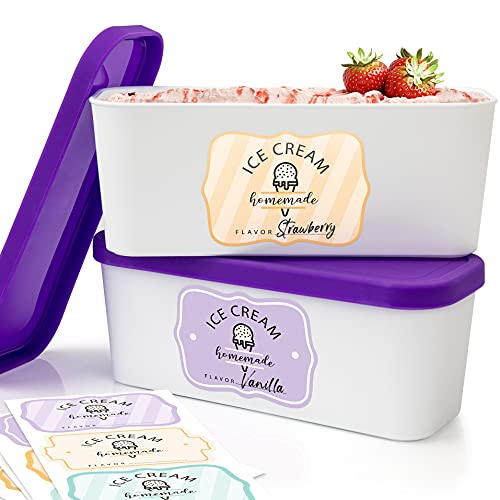
Each tub in this two-pack holds 1.6 quarts, making it the largest-capacity option here for a single batch. The long, slim shape measures 10 inches long, 4 inches wide and 3.9 inches high, unlike the shorter, taller 1-quart tubs. The maker says the lids seal tightly to help prevent leaking and freezer burn, and the containers are intended for sorbet, frozen yogurt and food storage as well as ice cream. The shape suits freezer shelves with room for a long tub. It may be less convenient if you prefer several smaller portions or flavors kept apart.
Bottom line: Pick this pair if each container should hold more than 1 quart.
Starpack Freeze the Day, 1 Qt, 2-Pack

Batch labeling sets this two-pack apart: it includes six rewritable labels and a dry-erase pen for marking flavor and date. Each tub holds 1 quart and measures 5.3 inches tall by 4.7 inches wide inside. The tubs are BPA-free polypropylene with flexible silicone lids; the maker says the airtight seal helps reduce freezer burn and ice crystals. This option suits someone who wants to track flavors or dates without adding separate labels. The set includes two tubs, so it offers fewer separate storage spaces than the four-pack.
Bottom line: Choose these tubs if labeling and dating homemade batches is a priority.
BALCI Ice Cream Containers, 1 Qt, 2-Pack

The BALCI pair is a straightforward two-tub choice, with each container holding 1 quart and measuring 5.5 inches tall by 4.7 inches wide. The maker describes the reusable tubs as BPA-free, stackable and fitted with tight-sealing silicone lids; the containers are also described as dishwasher safe. They are intended for ice cream, gelato, sorbet and other freezer storage. This set suits buyers who want two similarly sized containers and do not need included batch labels. Each tub holds less than the 1.6-quart option, which matters if you want to store a larger batch in one container.
Bottom line: Pick this set for two 1-quart tubs with a stackable design.
How to Choose Ice Cream Containers
Choose an ice cream container by matching its capacity and shape to your batch size and freezer space. A quart is 2 pints, while 1.6 quarts is 3.2 pints, so the larger tubs hold 60% more than a 1-quart tub. Measure a clear shelf before choosing a long container: the 10-inch-long option needs a different footprint from tubs roughly 5 inches tall and 4.7 inches wide. For several flavors, prioritize the number of separate tubs; for fewer, larger batches, prioritize capacity per tub. Leave a little headroom rather than filling any freezer container to the rim, since contents can expand as they freeze.
| Need | Useful comparison |
|---|---|
| Several flavors | More tubs in the set |
| Larger batch per tub | Capacity above 1 quart |
| Shallow shelf space | Compare tub height |
| Narrow shelf space | Compare tub width and length |
How to Limit Freezer Burn
Freezer burn is mainly a quality problem caused by air reaching frozen food and moisture escaping from its surface. A close-fitting lid helps limit air exchange, but wrapping the ice cream surface directly can reduce exposed air further when the container allows it. Keep the freezer at 0°F or below for safe frozen-food storage; temperature swings can soften ice cream and encourage ice crystals when it refreezes. Store tubs toward the back of the freezer rather than in the door, where opening and closing causes more temperature variation. Date each batch and use older tubs first to avoid losing track of how long they have been stored.
Capacity and Shape for Homemade Batches
Homemade ice cream makers commonly produce batches around 1 to 2 quarts, so a 1-quart tub can suit a smaller batch or split larger output between flavors. Measure usable shelf depth as well as height: a long, low container can fit differently from a compact, taller tub even when its capacity is similar. When the shelf clearance is under 4 inches, the 3.9-inch-high container is the only option here with a height under that threshold; still allow room to slide it in and lift the lid. Keep the lid shape in mind when stacking, because a level, stable surface reduces the chance of shifting tubs.
Safe Handling and Cleaning
Keep ice cream frozen at 0°F or below, and return the container to the freezer promptly after scooping; repeated softening and refreezing can degrade texture. Use a clean scoop rather than one that has touched raw ingredients, and avoid leaving the tub at room temperature while serving. Dishwasher-safe claims do not mean every lid can withstand the same heat cycle: check the care directions for the tub and lid separately, especially when they use different materials. Allow a container to warm briefly at room temperature if its lid is difficult to remove, rather than prying with a sharp knife that could damage the lid or cause a slip.
Frequently Asked Questions
How much ice cream fits in a 1-quart container?
A 1-quart container holds 2 pints, or 4 cups by volume. A 1.6-quart tub holds 3.2 pints, so it provides more room for a larger batch.
What freezer temperature should ice cream be stored at?
Keep ice cream at 0°F or below for safe frozen-food storage. A steady temperature also helps limit softening and refreezing that can worsen ice crystals.
Should homemade ice cream containers be filled to the top?
Leave some headroom instead of filling a container to its rim, because frozen contents can expand. The amount of spare space needed depends on the batch and container shape.
How can freezer burn on homemade ice cream be reduced?
Limit air exposure by closing the lid snugly and, if the container allows, pressing food-safe wrap against the ice cream surface. Store the tub toward the back of a freezer kept at 0°F or below.
Can ice cream containers go in the dishwasher?
Only use a dishwasher when the care directions for both the tub and lid allow it. Containers made from different materials may have different heat limits, so separate the parts if their care directions differ.