
Best Engine Compartment Insulation: 4 Options Compared

For general engine compartment coverage, 394-mil Insulation Mat, 16.36 sq ft is the strongest starting point because its 16.36-square-foot area is larger than 394-mil Insulation Mat, 10.8 sq ft’s 10.8 square feet. Choose a Porsche-specific pad instead if you own a compatible 911 or 912 and want a vehicle-fit part.
Engine compartment insulation can damp sound, reduce radiant heat transfer, or do both; the right type depends on where it will sit and the temperatures it will face.
We earn a commission if you buy through links on this page. As an Amazon Associate I earn from qualifying purchases. Products are compared on manufacturer specifications, not hands-on testing.
- Best overall: 394-mil Insulation Mat, 16.36 sq ft – Its 16.36-square-foot coverage exceeds the other general-purpose mat’s 10.8 square feet.
- Best for Porsche fit: Porsche 911/912 Sound Insulation Pad – It is a sound insulation pad for specified 911 and 912 model years.
- Best for smaller areas: 394-mil Insulation Mat, 10.8 sq ft – Its 10.8-square-foot coverage can suit a smaller project than the 16.36-square-foot mat.
| Product | Best for | Coverage | Thickness | Temperature range | Shop |
|---|---|---|---|---|---|
| 394-mil Insulation Mat, 16.36 sq ft | Larger coverage | 16.36 sq ft | 394 mil | -40°F to 300°F | Check Price on Amazon |
| 394-mil Insulation Mat, 10.8 sq ft | Smaller projects | 10.8 sq ft | 394 mil | -40°F to 300°F | Check Price on Amazon |
| Porsche 911/912 Sound Insulation Pad | Porsche fit | Vehicle-specific | — | — | Check Price on Amazon |
| Porsche 911 Engine Compartment Insulation | 911 fit | Vehicle-specific | — | — | Check Price on Amazon |
Engine compartment insulation options
Match the material and coverage to the vehicle, mounting area and heat exposure.
394-mil Insulation Mat, 16.36 sq ft

For a larger general-purpose project, this mat provides 16.36 square feet of coverage, more than the other general-purpose option here. Its closed-cell foam construction has a waterproof aluminum surface, and the maker says it absorbs vibration and reflects and blocks most heat. The working range is -40°F to 300°F. Consider it when you need more area for an engine cover, roof, trunk or other automotive surface. Its 394-mil thickness may be too bulky for a tight-fitting space, so measure clearance and check the surface temperature before applying it.
Bottom line: Choose this for a larger automotive area that has room for a 394-mil mat.
394-mil Insulation Mat, 10.8 sq ft

For a smaller general-purpose job, this mat covers 10.8 square feet and is listed for hood, engine, roof, door and trunk applications. It uses compressible closed-cell foam with a self-adhesive backing; the maker says it is waterproof and blocks 98% of radiant heat transfer. Its working range is -40°F to 300°F. This option avoids buying as much material as the larger mat when the measured area is modest. The 394-mil thickness still needs clearance, and its temperature range does not establish suitability beside an exhaust manifold or another hotter component.
Bottom line: Choose this when 10.8 square feet covers the intended area with room to spare.
Porsche 911/912 Sound Insulation Pad

Unlike the general-purpose mats, this is a lightweight sound insulation pad for specified classic Porsche 911 and 912 applications. Its thin plastic backing and OEM-version construction distinguish it from the thicker closed-cell mats. The fit range includes 911 models from 1965 through 1989, 912 models from 1965 through 1969, and the 1976 912E. Choose it when the vehicle is within those fit years and a purpose-fit sound pad is the goal. It is not a broad-coverage mat, and its thin backing is not a temperature rating for exposed high-heat areas.
Bottom line: Choose this when your 911 or 912 falls within the fit years.
Porsche 911 Engine Compartment Insulation
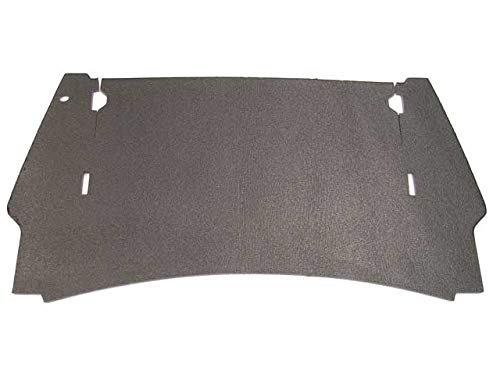
For compatible Porsche 911s, this part is specifically identified as engine compartment insulation rather than a universal sheet. Its fit covers 1965–1989 911 models, including the 1976–1977 911 S and 1986–1989 Carrera; the fit range also names the 1989 Speedster. That vehicle-specific focus makes it a closer match than a general mat when preserving the intended compartment fit matters.
Bottom line: Choose this for a compatible 911 when a vehicle-specific compartment part is the priority.
How to choose engine compartment insulation
Start with the mounting location, available clearance and heat exposure, not just the amount of material. A universal mat can cover a measured area, while a vehicle-specific pad is intended for a narrower fit. Compare the mat’s working-temperature range with the temperatures at its actual location; a 300°F rating is not a reason to place foam against an exhaust component that can exceed it. Thickness also matters: a 394-mil mat is about 0.39 inch thick, so check hood, latch and moving-part clearance before cutting or bonding it. For an exposed engine bay, use material explicitly suitable for that environment and keep insulation clear of hot exhaust parts, belts and fans.
Measure coverage and clearance before cutting
Measure the flat area you intend to cover in inches, then multiply length by width and divide by 144 for square feet. For example, a 40-by-40-inch panel is about 11.1 square feet before trimming, so a 10.8-square-foot sheet may be short once edges and openings are accounted for. Make a paper template around hinges, latches, wiring and service points before trimming. Leave moving components unobstructed and avoid covering vents or drain paths. Vehicle-specific pads can simplify contour matching, but model year alone may not capture every trim or body variation; verify the exact vehicle fit before ordering.
Engine-bay heat and sound insulation types
Closed-cell foam mats, foil-faced barriers and molded sound pads solve overlapping but different problems. Foam can damp vibration and add a thermal barrier; a reflective facing is intended to reduce radiant heat transfer when installed with the required orientation and air space. A molded or vehicle-fit pad prioritizes shape and mounting compatibility, while a sheet mat gives broader cut-to-fit coverage. Neither category is automatically suitable for every engine bay: adhesive, backing and foam can have different temperature limits. Keep combustible or adhesive-backed materials away from exhaust surfaces and check the mat’s rating against the hottest point where it will be installed.
| Need | Consider | Check first |
|---|---|---|
| Known vehicle-specific fit | Purpose-fit sound pad | Model and trim compatibility |
| Cut-to-fit larger area | 16.36-square-foot mat | Clearance and heat rating |
| Cut-to-fit smaller area | 10.8-square-foot mat | Measured coverage and heat rating |
Safe installation and common mistakes
Engine compartment insulation must stay secured and away from heat sources and moving parts. Before fitting any adhesive-backed material, clean and dry the surface as directed by its manufacturer, then press it down without covering fasteners or inspection points. Do not assume a waterproof face makes every edge or adhesive joint waterproof. A frequent mistake is choosing by sheet area alone: check thickness, cutouts and the temperature at the installation spot too. Reinspect the material after the first heat cycles and periodically thereafter; replace insulation that has loosened, sagged, cracked or shifted toward a belt, fan or exhaust component.
Frequently Asked Questions
How thick is a 394-mil insulation mat?
A 394-mil mat is about 0.39 inch thick. Measure clearance at the hood, latch and nearby moving parts before installing material of that thickness.
How much insulation coverage does a car need?
Coverage depends on the area you plan to line, so measure its length and width in inches and divide their product by 144. Add allowance for cutouts and edge trimming rather than sizing the sheet to the exact flat-area calculation.
Can sound-deadening foam go near an exhaust manifold?
Do not place foam against an exhaust manifold unless the material is explicitly rated for that temperature and location. Exhaust surfaces can exceed 300°F, which is above the working-range ceiling given for these general-purpose mats.
Does reflective insulation need an air gap?
Reflective barriers reduce radiant heat most effectively when installed with an air space facing the heat source. A foil face pressed directly against another surface may not provide the same radiant-barrier effect.
How often should engine compartment insulation be checked?
Inspect engine-bay insulation after installation and periodically during routine maintenance for loose edges, sagging or heat damage. Replace or secure any material that has shifted toward a belt, fan or exhaust part.