
Best Live Bait Aerator: 5 Portable Pumps Compared

ENGEL Rechargeable Bait Aerator suits most anglers because its maker says the rechargeable pump runs for up to 36 hours and offers three speeds plus intermittent bubbling. Choose Pawfly Type-C Rechargeable Aerator for four airflow levels and Type-C charging, or Marine Metal B-3 Bubbles Aerator if you want an aerator paired with insulated bait storage.
A live bait aerator pumps air through a hose and stone to add bubbles to a bait container; match the pump’s runtime and included accessories to your trip and setup.
We earn a commission if you buy through links on this page. As an Amazon Associate I earn from qualifying purchases. Products are compared on manufacturer specifications, not hands-on testing.
- Best overall: ENGEL Rechargeable Bait Aerator – Its maker claims up to 36 hours of runtime, with three speeds and intermittent bubbling.
- Best for airflow control: Pawfly Type-C Rechargeable Aerator – Four flow levels and normal or intermittent modes let you adjust its output.
- Best for insulated storage: Marine Metal B-3 Bubbles Aerator – It pairs a battery-powered pump with a 3-gallon insulated bait container.
| Product | Best for | Power | Runtime | Airflow settings | Shop |
|---|---|---|---|---|---|
| ENGEL Rechargeable Bait Aerator | Longer trips | Rechargeable lithium-ion | Up to 36 hours | 3 speeds; intermittent | Check Price on Amazon |
| Pawfly Type-C Rechargeable Aerator | Flow adjustment | Rechargeable lithium-ion | 24–30 hours normal; 30–36 intermittent | 4 levels; 2 modes | Check Price on Amazon |
| Beyond Braid Rechargeable Aerator | Night fishing | USB-C rechargeable | 36 hours claimed | 4 speeds | Check Price on Amazon |
| Marine Metal B-3 Bubbles Aerator | Integrated storage | D batteries | About 100 hours with 2 D batteries | Steady output | Check Price on Amazon |
| Arcpro Floating Rechargeable Aerator | Floating placement | Rechargeable, magnetic charging | Up to 14 hours | — | Check Price on Amazon |
Live Bait Aerators Compared
Compare these portable pumps by their power source, claimed runtime, controls, and included gear.
ENGEL Rechargeable Bait Aerator

ENGEL Rechargeable Bait Aerator combines a 36-hour claimed battery life with a saltwater-approved, water-resistant pump, making it a strong fit for longer trips or saltwater use. The pump includes a 32-inch silicone hose and a 1-inch weighted air stone, plus three speeds and intermittent bubbling. Its magnetic pump mechanism has no cogs or moving parts, according to the maker. The product is 5.25 inches tall and weighs 1 pound. The included hose is relatively short, so anglers using a deeper or wider container should check that its reach suits their setup before ordering.
Bottom line: Choose this for claimed long runtime and saltwater suitability.
Pawfly Type-C Rechargeable Aerator
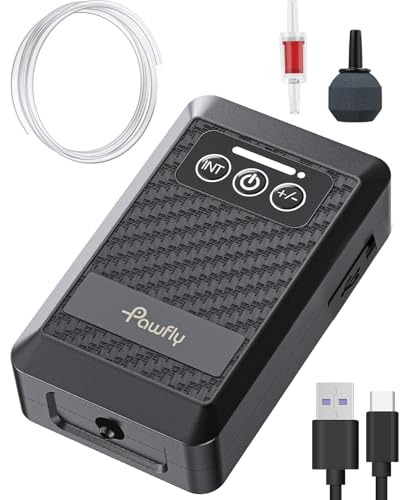
Pawfly Type-C Rechargeable Aerator is the only option here with a 5-to-20-gallon range and four airflow levels. Its built-in 2,200 mAh battery recharges through Type-C, and the maker claims 24–30 hours in normal mode or 30–36 hours in intermittent mode. Intermittent operation cycles 10 seconds on and 10 seconds off. This range and control make it a flexible pick for anglers who want to tune airflow rather than choose among only a few speeds. The runtime is shorter in continuous mode, so frequent bubbling over a long outing may call for a charging plan.
Bottom line: Choose this when adjustable airflow and Type-C charging matter most.
Beyond Braid Rechargeable Aerator

Beyond Braid Rechargeable Aerator stands out for its glow-in-the-dark housing, which is intended to make the pump easier to locate in low light. Its maker describes four speed settings—low, medium, high, and extra high—and claims 36 hours of USB-C power. An oversized weighted air stone is included to sit at the bottom of the bucket. Those features suit anglers who want multiple output levels and easier visibility after dark. The product facts do not give a bucket capacity range or runtime by speed, so check whether the pump’s fit and operating time match your particular setup and trip.
Bottom line: Choose this for low-light visibility and four speed choices.
Marine Metal B-3 Bubbles Aerator

Marine Metal B-3 Bubbles Aerator is the only choice that combines the aerator with a 3-gallon insulated bait container. The maker says the pump runs about 100 hours on two alkaline D batteries or about 50 hours on one, and gives an airflow figure of 1.0 STL per minute. The container has an extra-thick foam liner, an impact-resistant case, a rubber-booted switch, and a weighted air stone; it is intended for saltwater and freshwater use. Batteries are not included, and this integrated setup is less suited to anglers who already have a preferred bait container.
Bottom line: Choose this when you want aeration and insulated bait storage together.
Arcpro Floating Rechargeable Aerator

Arcpro Floating Rechargeable Aerator has a floating design and an IPX7 waterproof rating, which distinguish it from the other portable pumps here. The maker says its 2,000 mAh rechargeable battery provides up to 14 hours of continuous operation, and it uses magnetic charging rather than a USB-C cable. Floating placement can make the unit easier to locate in a crowded bait bucket, while the waterproof rating addresses submersion exposure. Its claimed runtime is shorter than the longer-duration options, so it is a better fit for shorter outings than for trips requiring more than 14 hours between charges.
Bottom line: Choose this for floating placement and a waterproof design on shorter outings.
How to Choose a Live Bait Aerator
Start with runtime, then match the pump’s controls and accessories to the container you use. A pump that runs continuously uses air differently from one that cycles on and off, so compare each maker’s runtime claim in the mode you expect to use. For an outing longer than the continuous runtime, choose a pump with a longer claim or plan a way to recharge it. Air stones break the pump’s output into bubbles; keep the stone submerged and the hose unkinked so air can reach the water. The stone’s position and the amount of bait in the container affect circulation, so avoid treating a runtime or gallon range as a guarantee for every load.
Match Runtime to Your Fishing Trip
Battery claims vary from up to 14 hours to as much as 36 hours, and some models report separate continuous and intermittent figures. Use the shorter applicable claim when planning a trip: if your outing is expected to exceed that number, select a longer-runtime pump or arrange recharging. A USB-C port is useful when you already carry a compatible power bank, while magnetic charging requires the matching charger. Battery capacity alone does not tell you how long a pump will run; output setting and operating mode matter too. For a bait container that stays at one location, a D-cell model may be a fit if you can carry spare batteries.
The table compares the main setup choice, not a guarantee of how long bait will remain lively.
| Need | Consider | Reason |
|---|---|---|
| Up to 14-hour outing | Arcpro Floating Rechargeable Aerator | Claimed continuous runtime reaches 14 hours |
| Longer battery claim | ENGEL Rechargeable Bait Aerator or Beyond Braid Rechargeable Aerator | Maker claims up to 36 hours |
| Integrated bait storage | Marine Metal B-3 Bubbles Aerator | Includes a 3-gallon insulated container |
Use Air Stones and Buckets Correctly
Keep the air stone submerged near the bottom of the container, where rising bubbles can circulate through more of the water. A weighted stone helps resist drifting, and the included hose must reach without pulling the pump into the water. Bubble production is not a substitute for sensible bait density: overcrowding raises oxygen demand and makes water quality harder to maintain. Warm water holds less dissolved oxygen than cool water, so warm conditions and heavy bait loads call for closer attention to aeration. Avoid blocking the pump’s air intake, and keep connections positioned as the product design requires. For the 5-to-20-gallon range on Pawfly Type-C Rechargeable Aerator, stay within that range rather than assuming one pump suits every bucket size.
Charging, Water Exposure, and Common Mistakes
Charge rechargeable pumps before leaving, and bring a compatible backup power option when the planned outing approaches the model’s runtime claim. USB-C and magnetic charging are different systems, so carry the correct cable or charger. Water-resistant and waterproof are not interchangeable descriptions: only Arcpro Floating Rechargeable Aerator has an IPX7 rating among these choices. Keep non-floating pumps secured above the waterline and inspect the hose and air stone for kinks or blockage before use. Never submerge an electrical charger or connect it near standing water. A common mistake is to select by battery capacity alone; runtime, airflow mode, bucket size, and the number of bait animals all influence whether a setup meets the need.
Frequently Asked Questions
How long should a live bait aerator run?
Run the pump while bait remains in the container, and plan around its runtime in the chosen mode. The options here claim from up to 14 hours to as much as 36 hours, so outings beyond a model’s runtime need a recharge plan or another pump.
Where should I place the air stone?
Place a weighted air stone near the bottom of the bucket so rising bubbles can circulate through the water. Make sure the hose reaches without kinking or pulling the pump into the water.
Does warmer water affect live bait aeration?
Yes, warmer water holds less dissolved oxygen than cooler water. In warm conditions, avoid overcrowding the bucket and keep the aerator running while bait is stored.
Can I use a bait aerator in saltwater?
Some models are specifically described as saltwater suitable, including ENGEL Rechargeable Bait Aerator and Marine Metal B-3 Bubbles Aerator. Rinse salt residue from equipment after use and keep charging components dry.
Is a floating aerator fully waterproof?
A floating design alone does not establish a waterproof rating. Arcpro Floating Rechargeable Aerator has an IPX7 rating, but keep charging equipment out of the water and follow the product’s operating limits.