
Best Long Lasting Ice Packs for Coolers and Lunches

For most people, Cooler Shock Mid-Size 10 x 10, 4-Pack is the best long lasting ice pack because its maker says it can keep contents cold for up to 48 hours in a size-matched cooler, and its 10-by-10-inch shape suits coolers and totes.
We earn a commission if you buy through links on this page. As an Amazon Associate I earn from qualifying purchases. Products are compared on manufacturer specifications, not hands-on testing.
- Best overall: Cooler Shock Mid-Size 10 x 10, 4-Pack – Its maker claims up to 48 hours of cold in a size-matched cooler.
- Best for large coolers: GoCJ Arizona Ice Large, 2-Pack – Each pack replaces 10 pounds of ice and measures 12 by 9 inches.
| Product | Best for | Dimensions | Cold-time claim | Ice replacement | Shop |
|---|---|---|---|---|---|
| Cooler Shock Mid-Size 10 x 10, 4-Pack | Coolers and totes | 10 x 10 x 1 in | Up to 48 hours | 5–6 lb per pack | Check Price on Amazon |
| GoCJ Arizona Ice Large, 2-Pack | Large coolers | 12 x 9 in | 18°F phase-change point | 10 lb per pack | Check Price on Amazon |
| Cooler Shock 14 x 10-Inch Reusable Pack | Wide coolers | 14 x 10 x 1.5 in | Up to 48 hours | 5–6 lb per pack | Check Price on Amazon |
Long Lasting Ice Packs Compared
Match pack dimensions and the cooling use to your cooler or lunch bag before choosing.
Cooler Shock Mid-Size 10 x 10, 4-Pack

For a reusable cooler pack with a specific cold-time claim, Cooler Shock Mid-Size 10 x 10, 4-Pack combines a 10-by-10-inch footprint with an 18°F phase-change point. The maker says a size-matched cooler can stay cold for up to 48 hours. Each pack replaces 5–6 pounds of ice and is filled once with water using the included funnel. This format suits road trips, camping and beach totes better than compact lunch bags. The limit is fit: at 10 inches square and 1 inch thick, measure the cooler interior and leave room for food and air circulation.
Bottom line: Choose this for a cooler or tote when its 10-inch square footprint fits.
GoCJ Arizona Ice Large, 2-Pack

For larger coolers, GoCJ Arizona Ice Large, 2-Pack pairs a 12-by-9-inch body with a claim to replace 10 pounds of ice per pack. Its maker gives an 18°F phase-change point, and the two packs are prefilled with cooling powder; add water once, then freeze. Deep ridges provide surface grooves in a compact rectangular footprint. The child-lock cap is a practical feature around family gear. These are not lunch-box packs: the maker explicitly warns that they will not fit lunch boxes or small coolers, so check interior dimensions first.
Bottom line: Choose these for larger coolers, not lunch bags or compact coolers.
Cooler Shock 14 x 10-Inch Reusable Pack
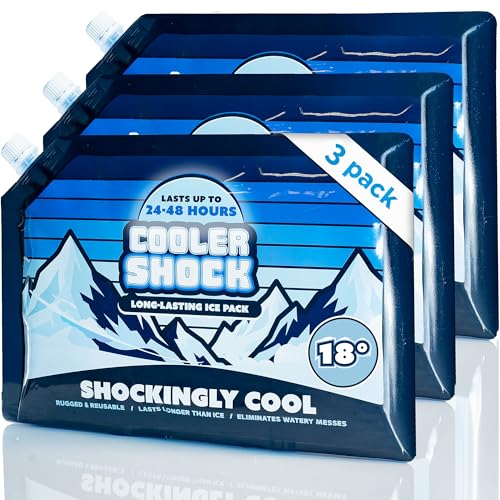
Cooler Shock 14 x 10-Inch Reusable Pack provides the broadest cooler footprint among the packs with a 48-hour claim: its maker says an 18°F phase-change point can keep a size-matched cooler cold for up to 48 hours. Each 14-by-10-by-1.5-inch pack is designed to displace 5–6 pounds of ice. It is filled once with water using the included funnel, then frozen for reuse. The wider, thicker shape suits spacious coolers and beach totes, but can crowd a small cooler; measure both the interior and available layering space before choosing it.
Bottom line: Choose this for a spacious cooler that can accommodate its 14-inch length.
How to Choose Long Lasting Ice Packs
Start with the cooler size and the length of the trip: cold packs work best when the cooler is well insulated and the frozen mass is substantial relative to the food load. A useful decision rule is to pick a pack whose longest side is shorter than the cooler’s interior, with room to layer packs above and below food. For trips requiring a specific duration, look for a duration claim tied to a cooler size, rather than relying on the phrase “long lasting.” Pack pre-chilled food, minimize lid openings, and keep the cooler out of direct sun; these habits reduce heat entering the cooler.
Cooler Pack Sizes and Layout
Pack shape changes how much usable space remains: flat slabs stack against cooler walls or over containers, while slim packs fit narrow lunch bags. A 10-by-10-inch pack has a different fit from a 14-by-10-inch slab even when both are about an inch thick, so measure the interior floor and height. For better coverage, place cold sources above and below food because cold air sinks, while keeping perishable items grouped together. Do not force a hard pack into a tight space where the cap or seam can be stressed. Freeze packs flat when their design allows it, so frozen contents spread evenly.
Ice Packs Versus Loose Ice
Reusable packs contain their coolant, avoiding meltwater that can soak wrappers, but loose ice can fill gaps around irregularly shaped food. Packs marked with an ice-replacement weight help estimate how much loose ice they displace; that number is not the same as a guaranteed cooler hold time. A practical setup uses rigid packs along the cooler sides or base and keeps food in sealed containers. For safe food storage, keep cold food at 40°F or below; an insulated cooler alone does not verify the temperature. Use a refrigerator thermometer when transporting perishables, and discard food that has been above 40°F for more than 2 hours, or 1 hour above 90°F.
Using and Reusing Refillable Packs
Refillable packs need enough freezer time to freeze through the center, not just feel cold on the outside; a full 24 hours in a home freezer is a reasonable starting point for thick packs. Leave expansion room when filling a water-based pack and close its cap securely before freezing. Avoid placing a damaged pack with food, and clean spills promptly if a seam leaks. Store packs dry after use and inspect caps, seams and corners before each trip; repeated flexing or sharp objects can damage a shell. For a day trip, pre-chill both the cooler and its contents so the packs spend their capacity keeping food cold rather than cooling warm surfaces.
Frequently Asked Questions
How long should reusable ice packs freeze before use?
Thick cooler packs commonly need about 24 hours in a home freezer to freeze through. A pack that is only partly frozen has less cooling capacity, so freeze it flat and allow extra time for large slabs.
What temperature should a cooler keep food at?
Keep perishable food at 40°F or below. Use a refrigerator thermometer because the pack’s surface temperature does not establish the temperature inside the food.
Do ice packs need to go above or below food?
Place packs both below and above food when space allows, since cold air sinks and top coverage helps offset warm air entering when the lid opens. Keep food in sealed containers to protect it from condensation or leaks.
How many ice packs should I use in a cooler?
Use enough frozen mass to surround and cover the food rather than relying on a fixed count; cooler size, insulation and trip duration change the requirement. For a long outing, leave little empty air space and limit lid openings.