
Best Low Calorie Canned Dog Food: 3 Options Compared

Hill’s Science Diet Perfect Weight Chicken & Vegetable Stew suits most adult dogs needing weight support because it is explicitly formulated for healthy weight maintenance. Choose another option if your dog needs a sensitive-stomach recipe or a reduced-calorie formula with a named ingredient such as L-carnitine.
Low-calorie canned dog food is intended to help control calories within a complete meal or as a topper; compare the recipe’s purpose with your dog’s needs and feeding plan.
We earn a commission if you buy through links on this page. As an Amazon Associate I earn from qualifying purchases. Products are compared on manufacturer specifications, not hands-on testing.
- Best overall: Hill’s Science Diet Perfect Weight Chicken & Vegetable Stew – Explicitly formulated for healthy weight maintenance in adult dogs.
- Best for fullness support: Natural Balance Fat Dogs Chicken & Salmon – Its fiber blend is intended to help dogs feel full and satiated.
- Best for meal flexibility: Nutrish Healthy Weight Turkey & Pumpkin Pâté – Can be served as a full meal, mix-in, or topper.
| Product | Best for | Can size | Primary use | Notable ingredient or feature | Shop |
|---|---|---|---|---|---|
| Hill’s Science Diet Perfect Weight Chicken & Vegetable Stew | Adult weight support | 12.5 oz | Weight maintenance | Added vitamins and amino acids | Check Price on Amazon |
| Natural Balance Fat Dogs Chicken & Salmon | Fullness support | 13 oz | Weight management | Peas, brown rice, carrots | Check Price on Amazon |
| Nutrish Healthy Weight Turkey & Pumpkin Pâté | Meal flexibility | 13 oz | Healthy weight | Turkey and pumpkin | Check Price on Amazon |
Low Calorie Canned Dog Food Options
Choose by the reason for adjusting your dog’s food, not just by the can size.
Hill’s Science Diet Perfect Weight Chicken & Vegetable Stew
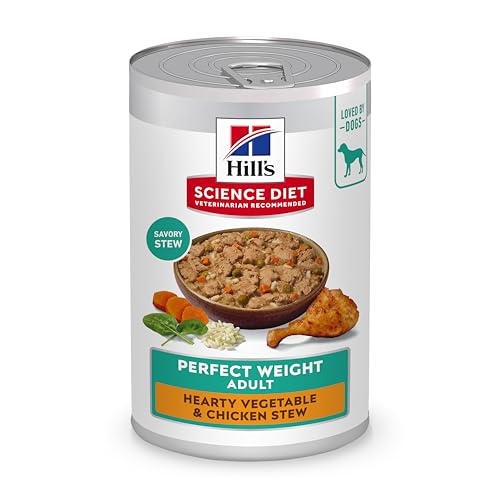
Hill’s Science Diet Perfect Weight Chicken & Vegetable Stew is the clearest match for adult weight maintenance among these options. The chicken and vegetable stew is made with natural ingredients plus added vitamins, minerals, and amino acids, and the brand says the formula is clinically proven for weight management in adult dogs. Its focus is ongoing healthy-weight support rather than a sensitive-stomach or limited-ingredient diet. The product facts do not give calories per can or a feeding amount, so compare those with your dog’s target daily intake before making it the main meal.
Bottom line: Choose this for adult dogs whose priority is a dedicated weight-maintenance recipe.
Natural Balance Fat Dogs Chicken & Salmon

Natural Balance Fat Dogs Chicken & Salmon combines a reduced-calorie weight-management purpose with a fiber blend of peas, brown rice, and carrots intended to help dogs feel full. Chicken and salmon provide the named protein sources, while the formula also includes L-carnitine, vitamins, minerals, and taurine. It is positioned for adult dogs and can be served as a meal or topper.
Bottom line: Pick this when fullness support and a reduced-calorie adult formula are priorities.
Nutrish Healthy Weight Turkey & Pumpkin Pâté

Nutrish Healthy Weight Turkey & Pumpkin Pâté stands out for serving flexibility: the adult turkey-and-pumpkin pâté can be a full meal, mix-in, or topper. Turkey is the first ingredient, and L-carnitine is included to support healthy weight and metabolism; the recipe also avoids added corn, wheat, and soy ingredients. It is presented as complete and balanced for small, medium, and large adult dogs.
Bottom line: Choose this if you want a healthy-weight recipe that can work as meal or topper.
How to choose low calorie canned dog food
Choose by calories per can and the dog’s daily target, not by words such as “weight” or “low fat” alone. A food’s calorie density is commonly shown as kcal per can or kcal per kilogram; cans with different weights are not directly comparable without that number. For weight loss, a veterinarian can set a safe calorie target based on the dog’s current condition and ideal weight. If a can’s calories are unavailable, do not infer them from the recipe name or fat percentage; confirm the calorie count and feeding amount before using it as the main ration. Keep treats and toppers inside the daily calorie allowance, since extras can erase the planned reduction.
Weight management versus low fat formulas
Weight-management food and low-fat food describe different nutritional aims. A reduced-calorie formula targets energy intake, while crude fat percentage alone does not tell you total calories because protein and carbohydrates also contribute energy. Some adult weight formulas add ingredients such as L-carnitine or fiber, but those ingredients do not replace portion measurement. A sensitive-stomach food may be useful for a digestive concern without being designed for weight reduction. The practical rule is to choose an explicitly weight-management recipe when calorie control is the priority; choose a gentle diet for a digestive plan, and compare its calories separately if weight loss is also needed.
Using canned food for meals and toppers
Canned food can serve as a complete meal or as a topper, depending on its nutritional adequacy statement and the maker’s feeding guidance. When mixing wet food with kibble, reduce the other food by the calories added rather than adding a full serving on top. A kitchen scale helps portion kibble accurately, while a measuring spoon is unreliable for small calorie adjustments because kibble density varies. Refrigerate unused opened canned food promptly and follow the package’s storage directions; discard food left out for more than two hours at room temperature. Transition a dog’s diet gradually over about seven days to reduce the chance of digestive upset.
Matching canned food to an adult dog’s needs
Life stage and health needs should narrow the choice before flavor does. Adult-maintenance foods are not automatically appropriate for puppies, whose growth diets have different nutrient requirements. Dogs with pancreatitis, kidney disease, diabetes, or a prescribed therapeutic diet need veterinary guidance before a general weight formula replaces their current food. For a household with more than one dog, measure portions separately rather than letting dogs share an open bowl. A weekly weight check under similar conditions can show whether a feeding plan is moving toward its goal; adjust the plan with a veterinarian if weight changes too quickly or not at all.
Frequently Asked Questions
How do I compare calories in canned dog food?
Compare kcal per can, then account for the can’s net weight and your dog’s daily calorie target. A larger can is not necessarily more calorie-dense, so do not compare recipes by ounces alone.
Does low-fat canned dog food mean low calorie?
No; crude fat is only one source of food energy, alongside protein and carbohydrates. Use the calorie count per can rather than fat percentage to assess a weight-loss ration.
Can I mix canned food with dry dog food?
Yes, if the combined portions fit the dog’s daily calorie allowance. Subtract the calories contributed by the canned portion from the dry-food ration instead of adding it as an extra.
How quickly should I change my dog’s food?
A gradual transition over about seven days is a common approach for otherwise healthy dogs. Mix increasing amounts of the new food with decreasing amounts of the old food, and seek veterinary advice if digestive signs persist.
Can puppies eat adult weight-management canned food?
Adult-maintenance food is not a substitute for a growth formula. Puppies need nutrition appropriate for growth, so ask a veterinarian before changing a puppy to an adult weight-management diet.