
Dayton Audio HTA100 Tubes: Models Compared

The Dayton Audio HTA100 is a hybrid tube amplifier with vacuum tubes in its preamp and a Class A/B power stage, making it the direct fit if you want HTA100 tubes and stereo amplification in one unit. Choose the higher-output HTA200 if your speaker setup calls for 100 watts per channel at 4 ohms; the other choices are bundles or an alternative brand.
We earn a commission if you buy through links on this page. As an Amazon Associate I earn from qualifying purchases. Products are compared on manufacturer specifications, not hands-on testing.
- Best overall: Dayton Audio HTA100 – It is the HTA100 itself, rated at 50 watts per channel RMS into 4 ohms.
- Best for more power: Dayton Audio HTA200 – The HTA200 doubles the HTA100’s per-channel rating to 100 watts RMS at 4 ohms.
- Best for floor speakers: Dayton Audio HTA100 and T65 Floor System – This package pairs an HTA100 with T65 floor-standing speakers.
| Product | Best for | Power per channel at 4 ohms | Inputs | Shop |
|---|---|---|---|---|
| Dayton Audio HTA100 | HTA100 buyers | 50 W RMS | USB, phono, AUX, optical, coaxial | Check Price on Amazon |
| Dayton Audio HTA200 | Higher output | 100 W RMS | USB DAC, phono, AUX, optical, coaxial | Check Price on Amazon |
| Dayton Audio HTA100 and T65 Floor System | Floor-speaker bundle | 50 W per channel | Analog, digital, phono | Check Price on Amazon |
| Juson Audio JTA100 | Alternative hybrid amp | 200 W RMS (claimed) | AUX, coaxial, phono, optical | Check Price on Amazon |
| Dayton Audio Hi-Fi Bookshelf System | Turntable bundle | 50 W per channel | USB, Bluetooth, analog, digital | Check Price on Amazon |
Dayton Audio HTA100 tube amps and related systems
Compare the standalone amplifiers with bundles that include the HTA100 and a hybrid-tube alternative.
Dayton Audio HTA100

The HTA100 is the direct choice for a standalone Dayton Audio hybrid tube amp, with a 50-watt-per-channel RMS rating at 4 ohms. Its tubes sit in the preamp circuit, while a Class A/B stage provides amplification; it also has Bluetooth 5.0, a USB DAC, phono input, optical and coaxial inputs, and AUX. A subwoofer output and headphone jack add connection options, and front-panel VU meters give it a vintage look. It suits bookshelf-speaker and home stereo setups. Choose another model if you need the HTA200’s higher per-channel rating.
Bottom line: Pick this for a standalone HTA100 with a 50-watt-per-channel rating at 4 ohms.
Dayton Audio HTA200
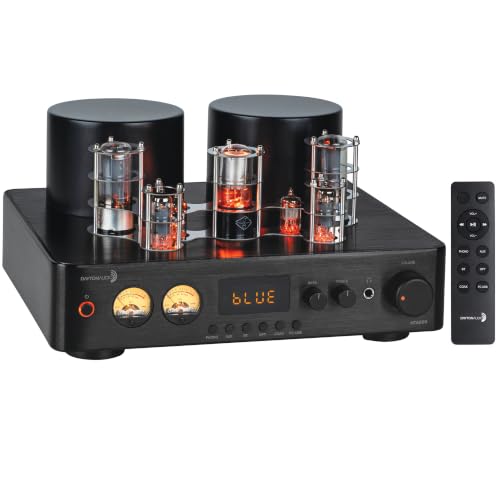
The HTA200 doubles the HTA100’s per-channel RMS rating, delivering 100 watts at 4 ohms for setups needing more amplifier output. It retains hybrid construction, with vacuum tubes in the preamp and a Class A/B amplifier, and supports Bluetooth 5.0, USB DAC, phono, AUX, optical, and coaxial connections. A remote is included, alongside a subwoofer output and headphone jack. This is the fit to consider when the HTA100’s 50 watts per channel is not enough for your intended setup. Its higher rating does not by itself guarantee louder playback; speaker sensitivity and listening distance matter too.
Bottom line: Choose this when your speaker setup calls for more rated output than the HTA100 provides.
Dayton Audio HTA100 and T65 Floor System

This package pairs the HTA100 with Dayton Audio T65 floor-standing speakers, unlike the standalone amplifiers. The amplifier contributes 50 watts per channel and Bluetooth 5.0, while the T65 speakers use two 6.5-inch woofers, a 1-inch silk-dome tweeter, and a crossover network. It suits a buyer seeking a coordinated amplifier-and-tower-speaker setup rather than an amp alone. The package’s speaker components are the key distinction, but the specifications do not identify every connection or compatibility specification for the bundle. Confirm the speaker’s impedance against the amplifier’s supported load before connecting.
Bottom line: Pick this if you want the HTA100 paired with T65 floor-standing speakers.
Juson Audio JTA100

The JTA100 is a different brand’s hybrid tube amplifier, so it is an alternative rather than a Dayton Audio HTA model. Its maker claims 200 watts RMS, and the feature set includes Bluetooth 5.0, AUX, coaxial, phono, and optical inputs, plus headphone and subwoofer outputs. A remote and a high-low headphone gain switch are also included; the maker says the headphone output can drive 16–600-ohm headphones. This may suit a buyer comparing hybrid designs beyond Dayton Audio. The 200-watt figure is not broken down per channel or by speaker impedance, so it is not directly comparable with the HTA ratings.
Bottom line: Consider this if you are open to a non-Dayton hybrid amp and its different power rating.
Dayton Audio Hi-Fi Bookshelf System

This black bookshelf system centers on the HTA100 but adds a Dayton Audio TT-1BTW belt-drive turntable with USB and Bluetooth connectivity and an Audio-Technica AT-VM95E cartridge. The amplifier provides 50 watts per channel and Bluetooth 5.0, so the package combines vinyl playback with wireless and other audio connections. It suits someone assembling a turntable-based stereo rather than shopping only for HTA100 tubes. Because the bundle also includes turntable components, it is a different purchase from the standalone amp; check that the planned speaker setup is compatible with the amplifier.
Bottom line: Choose this for an HTA100-based system that also includes a turntable.
How to choose between the HTA100 and HTA200
Start with the speaker load and output you need: the HTA100 is rated at 50 watts per channel RMS at 4 ohms, while the HTA200 is rated at 100 watts per channel at 4 ohms. A 3 dB increase in amplifier power requires about twice the power, so doubling the rating does not mean twice the perceived loudness. Speaker sensitivity, listening distance, room size, and music peaks all affect the result. For the same speakers in the same position, the HTA200 offers more power headroom; it is not automatically the right pick for every room. If your speaker impedance differs from 4 ohms, confirm the amplifier’s supported load before purchase rather than assuming the 4-ohm rating applies unchanged.
What hybrid tube amplification means
Hybrid tube amplifiers combine a tube-based preamp stage with a solid-state power amplifier; the HTA100 and HTA200 use vacuum tubes in the preamp and Class A/B power amplification. That distinction matters because “tube” does not mean the entire signal path or speaker-driving output stage is tube-based. Their tube stage is part of the preamp circuit, while the power rating describes output to speakers. Both HTA units list Bluetooth 5.0, a phono connection, a USB DAC, and optical and coaxial inputs, useful when matching sources to an amp. A built-in phono input is intended for a turntable’s phono-level signal; a turntable with a line-level output may need a different input path. Check the source’s output type before connecting.
Match an HTA100 system to speakers and sources
Choose a standalone amplifier if you already have speakers; choose a package if the included speakers or turntable are part of the setup you want. The floor-standing package pairs an HTA100 with T65 towers using two 6.5-inch woofers and a 1-inch silk-dome tweeter, while the bookshelf system adds a belt-drive turntable with USB and Bluetooth and an AT-VM95E cartridge. A simple fit rule is to select the package only if you want its named components; otherwise, the standalone HTA100 avoids duplicating gear you own. Before connecting passive speakers, match their impedance to the amplifier’s permitted load and use speaker wire with secure, non-stray strands to avoid short circuits.
Connect and care for a tube hybrid amp
Keep tube amplifiers ventilated, since vacuum tubes generate heat during operation and enclosed shelves can trap it; leave open space around vents and exposed tubes. Never touch hot tubes, and switch off and unplug the amplifier before handling components or cleaning around the tube area. A hybrid amp still has tubes to protect even though its speaker power stage is Class A/B. For source connections, use the phono input for a turntable’s phono output, and use a digital input such as optical or coaxial for a matching digital source. Keep cables away from power cords where practical to reduce hum, and verify the input selection when changing sources. Do not connect or disconnect speaker leads while the amplifier is powered.
Frequently Asked Questions
Do HTA100 tubes power the speakers directly?
No. The HTA100 uses vacuum tubes in its preamp circuit and a Class A/B power amplifier to drive speakers. Its speaker output is rated at 50 watts per channel RMS into 4 ohms.
What is the power difference between HTA100 and HTA200?
At 4 ohms, the HTA100 is rated for 50 watts per channel RMS and the HTA200 for 100 watts per channel RMS. The higher figure provides more rated headroom, but speaker sensitivity and listening distance also affect loudness.
Can a turntable connect to the HTA100 phono input?
Yes, the HTA100 has a dedicated phono input for a turntable’s phono-level output. If the turntable output is already line-level, use a suitable line input instead of adding phono amplification twice.
How much space should a tube amplifier have around it?
Leave open air around the amplifier rather than enclosing it in a tight shelf, because vacuum tubes produce heat. Keep hands away from hot tubes and power the unit off and unplug it before cleaning near them.
Does a 100-watt amp sound twice as loud as a 50-watt amp?
No. Doubling amplifier power produces about a 3 dB increase, not a doubling of perceived loudness. Speaker sensitivity, room size, and distance from the speakers also affect playback level.