
Best Lucky Fish Finder: 5 Portable Models Compared

For most anglers, LUCKY MT202-KIT Wireless Fish Finder is the best Lucky fish finder because its wireless sensor reaches up to 853 feet and its 90-degree beam covers depths from 3 to 147 feet. Choose a different model if you need a wired sensor, a deeper detection range, or a fish-attractive lamp.
A portable fish finder uses sonar to show water depth and approximate fish or underwater structure; wireless models let you cast a floating sensor away from the display.
We earn a commission if you buy through links on this page. As an Amazon Associate I earn from qualifying purchases. Products are compared on manufacturer specifications, not hands-on testing.
- Best overall: LUCKY MT202-KIT Wireless Fish Finder – Wireless operation reaches up to 853 feet, with a 90-degree beam and a carrying case.
- Best for deeper water: LUCKY FFC1108 Portable Fish Finder – Detects depths from 3 to 328 feet with a transducer attached to the boat or kayak hull.
- Best wired option: LUCKY Wired 2.4-Inch Fish Finder – Offers 26 feet of wired operation, a color screen and water-temperature readout.
| Product | Best for | Operation distance | Depth range | Sonar beam | Shop |
|---|---|---|---|---|---|
| LUCKY MT202-KIT Wireless Fish Finder | Wireless kayak fishing | 853 ft, wireless | 3–147 ft | 90° | Check Price on Amazon |
| LUCKY MT-202 Wireless Fish Finder | Long-range casting | 853 ft, wireless | 3–147 ft | 90° | Check Price on Amazon |
| LUCKY FFC1108 Portable Fish Finder | Deeper water | Hull-mounted transducer | 3–328 ft | — | Check Price on Amazon |
| LUCKY Wired 2.4-Inch Fish Finder | Wired sonar setup | 26 ft, wired | Up to 328 ft | 45° | Check Price on Amazon |
| LUCKY 147-Foot Wireless Fish Finder | Ice fishing lamp | 492 ft, wireless | Up to 147 ft | — | Check Price on Amazon |
Lucky Fish Finders Compared
Match the sensor connection and depth range to where you fish and how you plan to position the sonar.
LUCKY MT202-KIT Wireless Fish Finder

The MT202-KIT stands out with a carrying case alongside its wireless sonar sensor, making it a fit for anglers who want a portable setup. LUCKY says the sensor operates up to 853 feet from the handheld display, and its 90-degree beam detects fish and underwater structure at depths from 3 to 147 feet. That range suits many kayak, shoreline and boat outings. The depth ceiling is lower than the 328-foot wired models, so anglers targeting deeper water should compare those options before choosing.
Bottom line: Pick this kit if wireless casting and a carrying case matter more than a deeper detection ceiling.
LUCKY MT-202 Wireless Fish Finder
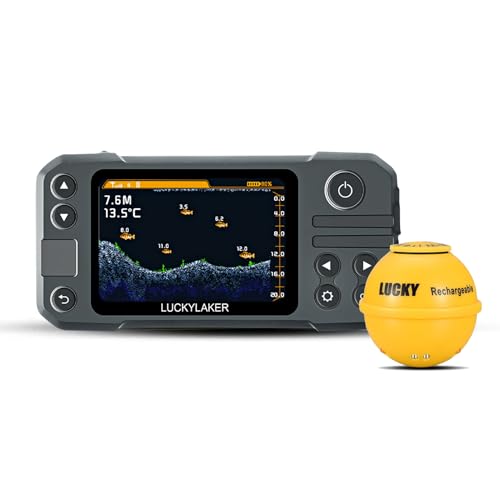
The MT-202 pairs a wireless sensor with the longest operating distance in this group, matching the kit version without its explicitly named carrying case. LUCKY says the sensor reaches up to 853 feet and scans with a 90-degree beam across depths from 3 to 147 feet. That combination is useful when the sensor needs to sit far from the handheld screen, such as when casting from shore. The depth range is narrower than the wired 328-foot models, so it is less suited to anglers prioritizing deeper readings.
Bottom line: Choose this model for wireless range when the carrying case in the kit is not a priority.
LUCKY FFC1108 Portable Fish Finder

The FFC1108 reaches farther down than the wireless models here, with a detection range of 3 to 328 feet when its transducer is completely immersed. The sensor can attach to a kayak or boat hull, so this model suits anglers who want depth readings while moving rather than casting a sensor away from the display. Its screen can show approximate fish location, bottom features such as weeds, sand and rocks, and depth in feet or meters. The transducer needs immersion, and the maker does not identify a beam angle.
Bottom line: Choose this model if deeper detection and hull-mounted sonar matter more than wireless casting.
LUCKY Wired 2.4-Inch Fish Finder
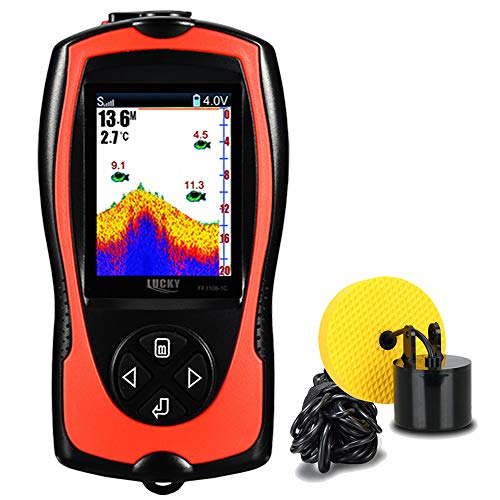
The wired 2.4-inch color-screen model adds water temperature and fish-size categories, features not identified for the other products here. LUCKY says its sensor has 26 feet of operating distance and detects to 328 feet, with a 45-degree beam at 200 kHz. The rechargeable unit is specified for about five hours of continuous operation on a full charge. It is a useful match for anglers who want those readouts in a compact wired setup; the short cable range is a drawback when the sensor needs to sit far from the display.
Bottom line: Pick this one for its temperature and fish-size readouts in a wired format.
LUCKY 147-Foot Wireless Fish Finder

The 147-foot wireless model is the only option here with a fish-attractive lamp on its sonar sensor, plus a transparent replacement cover that can help make the sensor visible in darkness. LUCKY says its wireless operating range reaches 492 feet and its depth detection reaches 147 feet. The 2.4-inch color screen can display water temperature, contour and fish size with depth. This model suits anglers who value the lamp and a shorter wireless range; its depth ceiling is lower than the two wired options.
Bottom line: Choose this model if the sensor lamp is useful for your fishing conditions.
How to Choose a Lucky Fish Finder
Choose a Lucky fish finder by matching its sensor connection and depth ceiling to your fishing location. Wireless models let you cast a floating sensor away from the display; wired models keep the sensor connected and can be positioned on a boat or kayak. The products here span 26 feet of wired operating distance to 853 feet wirelessly, while depth coverage ranges from 147 to 328 feet. A wider sonar beam covers more water beneath the sensor, but each beam’s footprint grows with depth, so approximate fish positions are not exact coordinates. If you fish deeper than 147 feet, compare the 328-foot models first; if you need the sensor far from shore, prioritize wireless range.
Wired and Wireless Sonar Compared
Wired sonar keeps the transducer connected to the display, while wireless sonar separates them so a floating sensor can be cast. Wireless distance is not the same as depth range: the former measures separation between sensor and handheld unit, and the latter measures how far below the surface sonar detects. This distinction matters because a long cast does not increase the maximum depth reading. Use the table to match the connection style to your setup, then check the depth range against your water.
| Setup | Useful when | Trade-off |
|---|---|---|
| Wired | Sensor can stay attached to the boat or kayak | Limited cable distance |
| Wireless | Sensor needs to be cast away from the display | Depth ceiling varies by model |
Understanding Sonar Beam and Depth
Sonar sends sound pulses into the water and interprets returning echoes to estimate depth and locate objects. A 90-degree beam covers a broader area than a 45-degree beam at the same depth, but beam width also means targets may be harder to pinpoint precisely. The FFC1108 and wired 2.4-inch model list detection up to 328 feet; the wireless models top out at 147 feet. These are maximum ranges, not a guarantee of equal readings in every condition. For a water depth close to a model’s ceiling, choose a unit with a higher maximum depth rather than assuming the limit is a comfortable operating target.
Positioning a Portable Fish Finder Sensor
Keep the sensor’s sonar face properly submerged and clear of obstructions for useful readings. The FFC1108 specifies complete immersion for its 3-to-328-foot detection range, while the wired model’s sensor can be positioned within its 26-foot cable distance. Wireless sensors instead float or cast away from the display, so allow room for the sensor to move without pulling it toward a boat or snagging it on structure. Avoid reading a fish icon as a precise location: sonar indicates returns within a beam, not an exact point. Before heading out, compare the water depth you expect with the model’s depth range and confirm the sensor setup suits your boat or kayak.
Frequently Asked Questions
How deep can a Lucky portable fish finder read?
The models in this group list maximum depth ranges from 147 to 328 feet. Choose a model rated above the water depth you expect rather than relying on its maximum limit.
How far can a wireless Lucky fish finder reach?
The wireless models here list operating distances of 492 or 853 feet. Operating distance is the separation between the sensor and handheld display, not the sonar’s depth range.
What does a fish finder sonar beam angle mean?
Beam angle describes the width of the sonar cone, with a 90-degree beam covering a broader area than a 45-degree beam at the same depth. A broader cone covers more water but gives less precise target positioning.
Does the Lucky FFC1108 work without immersing its sensor?
The FFC1108’s 3-to-328-foot range applies when its transducer is completely immersed. Position the sensor so it remains submerged during use.