
Highest dB Ear Plugs: 5 Ratings Compared

For a high, comparable Noise Reduction Rating, choose Mack’s Ultra Soft Foam Earplugs: it has a 33 dB NRR, tied with GOL-SIV 200-Pair Foam Ear Plugs and Mack’s Maximum Protection Foam Earplugs among the products with NRR figures. LIHOBI Reusable Silicone Ear Plugs advertises 50 dB effective reduction, but its claim is not directly comparable to an NRR rating.
Choose a different option if you prefer reusable silicone, need a larger-canal design, or want a larger foam supply. Earplugs reduce sound only when they fit and are inserted correctly; no plug blocks all sound.
We earn a commission if you buy through links on this page. As an Amazon Associate I earn from qualifying purchases. Products are compared on manufacturer specifications, not hands-on testing.
- Best overall: Mack’s Ultra Soft Foam Earplugs – Its 33 dB NRR is among the highest comparable NRR ratings here, and the pack contains 50 pairs.
- Best for reusable silicone: LIHOBI Reusable Silicone Ear Plugs – The soft silicone design is reusable, and the maker claims up to 50 dB effective reduction.
- Best for bulk supply: GOL-SIV 200-Pair Foam Ear Plugs – The pack contains 200 individually wrapped foam pairs and carries a 33 dB NRR.
| Product | Best for | Material | Pack size | Shop |
|---|---|---|---|---|
| Mack’s Ultra Soft Foam Earplugs | Soft foam fit | Foam | 50 pairs | Check Price on Amazon |
| LIHOBI Reusable Silicone Ear Plugs | Reusable silicone | Silicone | 1 pair | Check Price on Amazon |
| LYSIAN Soft Foam Ear Plugs | Dual rating figures | Foam | 60 pairs | Check Price on Amazon |
| GOL-SIV 200-Pair Foam Ear Plugs | Large pair supply | Foam | 200 pairs | Check Price on Amazon |
| Mack’s Maximum Protection Foam Earplugs | Larger ear canals | Foam | 40 pairs | Check Price on Amazon |
Highest dB Ear Plugs Compared
Compare the rating type as well as the number: NRR and SNR figures are different measures.
Mack’s Ultra Soft Foam Earplugs

Among these products, this option pairs a 33 dB NRR with 50 pairs of slow-release, low-pressure foam plugs. Mack’s says the plugs are intended for sleeping, studying, travel, concerts, work and other loud settings. The 33 dB NRR makes it comparable to other products here that also give an NRR figure; it is not a guarantee that every wearer will get 33 dB of real-world reduction. The beige color may be less conspicuous than orange or purple foam. Buyers needing a larger-canal design should compare Mack’s Maximum Protection Foam Earplugs, which is specifically described for larger canals.
Bottom line: Choose it for a soft-foam option with a 33 dB NRR and 50 pairs.
LIHOBI Reusable Silicone Ear Plugs

Unlike the foam options, this product is made of reusable silicone and comes as one pair. The maker advertises up to 50 dB effective noise reduction, while its wear note says correct use realizes 40 dB; those claims should not be treated as an NRR figure or compared directly with the NRR ratings in this group. The right- and left-marked plugs are intended for sleeping, bathing, travel, concerts and other uses. Choose this pair if reusable silicone is your priority. Buyers who want a clearly stated NRR or multiple pairs should choose a foam option instead.
Bottom line: Choose it if you prefer reusable silicone and understand its rating claim differs from NRR.
LYSIAN Soft Foam Ear Plugs

This product gives both an NRR and an SNR figure: 31 dB NRR and 38 dB SNR, so the NRR is the relevant number for comparison with other NRR entries here. The purple foam plugs expand slowly, with the maker giving a 20- to 60-second expansion time, and the pack contains 60 pairs. The maker says they are suited to sleep, study, work, travel, concerts and shooting. This is a reasonable pick when having both rating figures and a mid-sized supply matters. Its NRR is lower than the 33 dB NRR options in this group.
Bottom line: Choose it if you want 60 pairs and both NRR and SNR figures.
GOL-SIV 200-Pair Foam Ear Plugs

The largest supply here is 200 individually wrapped foam pairs, with both 33 dB NRR and 38 dB SNR figures. GOL-SIV says the plugs are disposable and expand in up to 35 seconds; the maker also claims ANSI certification. Individual wrapping can help keep unused pairs clean and portable, while the bulk pack suits frequent replacement at work or on noisy projects. Choose it when supply size matters more than reusability. Buyers seeking a lower-pressure or larger-canal fit should compare the products specifically described for those characteristics.
Bottom line: Choose it when you need a large supply of individually wrapped foam pairs.
Mack’s Maximum Protection Foam Earplugs
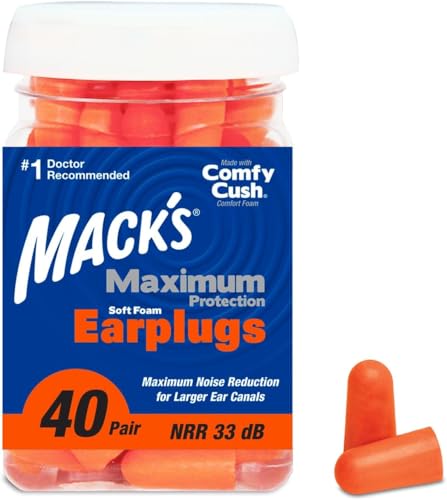
This is the option specifically described as designed for larger-sized ear canals, unlike the general-fit wording of other foam products here. It has a 33 dB NRR and uses Mack’s Comfy Cush foam. The maker says it is intended for sleeping, concerts, motorcycles, power tools and other loud settings. The pack contains 40 pairs, fewer than the 50-, 60- and 200-pair foam packs compared here. Choose it if ordinary foam plugs feel too small or bulky; for a larger supply, GOL-SIV 200-Pair Foam Ear Plugs has 200 pairs.
Bottom line: Choose it if you need a foam design described for larger ear canals.
How to Compare Ear Plug Ratings
Compare NRR with NRR, not with an SNR or an unqualified dB claim. NRR is a laboratory rating used in the United States; SNR is a separate rating system, so the figures do not create a like-for-like ranking. A higher rating does not mean the same reduction for every wearer because fit changes protection. For a rough workplace estimate under OSHA guidance, subtract 7 from the NRR and divide by 2 to estimate attenuation for A-weighted noise; actual protection can be lower if plugs are poorly fitted. In these choices, 33 dB NRR is the top comparable NRR figure, while the 50 dB effective claim uses a different basis. Use the NRR column to compare stated NRR values only.
How to Insert Foam Ear Plugs for a Seal
Roll a foam earplug into a narrow, crease-free cylinder, then reach over your head and pull the outer ear up and back to straighten the canal. Insert the plug and hold it in place while it expands; plugs in this group give expansion times from about 20 to 60 seconds. A properly seated foam plug should not protrude much, and the sound should seem more muffled when both ears are fitted. If one plug feels loose or falls out, reseat it rather than assuming its printed NRR will compensate. Clean hands matter: dirt introduced during insertion can irritate the ear. Never force a plug deeply into the canal.
When to Choose Foam or Reusable Silicone
Foam plugs compress for insertion and expand to fill the ear canal, making fit and correct insertion central to their performance. Reusable silicone is a different choice for people who want a washable style, but its advertised dB claim may use a different measure from NRR. For noisy work, match the protector to the exposure and use the workplace hearing-conservation program; OSHA’s general permissible exposure limit is 90 dBA for 8 hours, with allowable time halving for each 5 dB increase. For very loud or impulsive sound, do not rely on a single printed rating alone: ask a hearing-safety professional about fit testing or dual protection. Do not mistake reduced sound for complete silence.
Common Ear Plug Selection Mistakes
The biggest mistake is choosing the largest number without checking its rating type or how the plug fits. A 50 dB claim, 38 dB SNR and 33 dB NRR are not directly interchangeable; compare only figures using the same rating system. Another mistake is assuming one earplug style fits every ear canal. If foam plugs repeatedly loosen, try another size or style, and confirm the fit rather than forcing them in. For workplace exposure, OSHA’s 85 dBA action level over 8 hours is a reason for employers to run a hearing-conservation program; plugs do not replace required workplace controls. Replace disposable foam plugs when dirty, damaged or no longer expanding reliably.
Frequently Asked Questions
Does a 50 dB earplug rating mean 50 dB of protection?
Not necessarily. A dB claim is only directly comparable when the rating method is the same; NRR, SNR and an unspecified effective-reduction claim are different. Fit and insertion also affect real-world attenuation.
What does a 33 dB NRR mean in practice?
NRR is a laboratory rating, not a promise of 33 dB reduction for every wearer. OSHA’s rough workplace estimate subtracts 7 and divides by 2 for A-weighted sound, giving about 13 dB of estimated attenuation before considering individual fit.
How long should foam ear plugs take to expand?
Expansion time depends on the plug; products here give ranges from about 20 to 60 seconds. Hold each rolled plug in place as it expands so it can seal the canal.
Can ear plugs block all sound completely?
No. Earplugs reduce sound but do not create complete silence, and poor fit reduces their effectiveness. For hazardous workplace noise, use the employer’s hearing-protection program rather than relying only on a package rating.
When should disposable foam ear plugs be replaced?
Replace disposable foam plugs when they become dirty, damaged or stop expanding and sealing reliably. Reusable silicone plugs should be cleaned according to their maker’s care directions.