
Best Magnifier for Coins: 4 Options Compared

For most coin collectors, JARLINK 30x/60x Illuminated Loupe is the practical choice because its foldable loupe offers two magnifications, 30x and 60x, without requiring a screen. Choose a digital microscope instead if you want a larger live display, image recording, or a built-in scale; those features suit close inspection better than viewing a whole coin at once.
We earn a commission if you buy through links on this page. As an Amazon Associate I earn from qualifying purchases. Products are compared on manufacturer specifications, not hands-on testing.
- Best overall: JARLINK 30x/60x Illuminated Loupe – Its foldable dual-lens design provides 30x and 60x views with LED illumination.
- Best for a large display: Elikliv EDM4B 4.3-inch Coin Microscope – The 4.3-inch screen and 50x–1000x range support close digital inspection.
- Best for weighing coins: Elikliv Coin Microscope with Scale – It combines a 4.3-inch screen with a scale offering 0.1 g resolution up to 300 g.
| Product | Best for | Magnification | Display | Lighting | Shop |
|---|---|---|---|---|---|
| JARLINK 30x/60x Illuminated Loupe | Direct coin viewing | 30x and 60x | — | LED | Check Price on Amazon |
| Elikliv EDM4B 4.3-inch Coin Microscope | Large-screen inspection | 50x–1000x | 4.3-inch, 720p | 8 adjustable LEDs | Check Price on Amazon |
| Elikliv Coin Microscope with Scale | Weighing and viewing | — | 4.3-inch | 8+2 lights | Check Price on Amazon |
| Handheld 1000x Coin Microscope | Portable screen viewing | 1000x | 2-inch | — | Check Price on Amazon |
Magnifiers for Coins
Choose a loupe for direct viewing or a digital microscope for screen-based close inspection and added features.
JARLINK 30x/60x Illuminated Loupe

Unlike the digital microscopes here, this foldable loupe gives a direct, screen-free view through two lenses: 30x and 60x. The primary lens is 30x with a 22 mm diameter, while the supplementary lens is 60x with a 12 mm diameter; the LED light switches sides with the lens in use. It suits collectors who want a compact tool for examining a coin’s surface without setting up a screen. The limitation is its high magnification: the lens needs to be close to the coin for a clear image, and the narrow 60x view can make it harder to keep context.
Bottom line: Choose this if you want a compact loupe for direct inspection.
Elikliv EDM4B 4.3-inch Coin Microscope

The 4.3-inch display sets this digital microscope apart from the handheld option, while its 50x–1000x magnification range is intended for close surface inspection. Its eight adjustable LED lights illuminate the subject, and the black base is designed to reduce reflected light. The screen can show a live image, and the microscope is compatible with Windows and Mac for PC viewing. It suits collectors who prefer a larger screen while examining fine details. The limitation is that magnification up to 1000x is aimed at very close views, not at seeing the whole coin at once.
Bottom line: Pick this for screen-based inspection with adjustable illumination.
Elikliv Coin Microscope with Scale
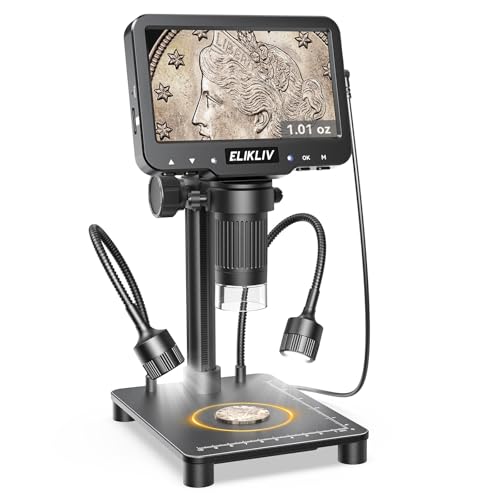
The built-in scale is the main distinction: this digital microscope combines coin viewing with weighing up to 300 g, at 0.1 g resolution, with readings in grams, ounces, or carats. It also has a 4.3-inch screen, camera and video functions, and USB PC viewing. The maker says the scale reads in 0.1 seconds; the included feature information also describes a metal base plate. This setup suits collectors who want to record a coin’s weight alongside a close visual inspection. The tradeoff is that its magnification range is not established here, so buyers prioritizing a particular zoom range should verify that before choosing it.
Bottom line: Choose this when combining close viewing and coin weighing matters.
Handheld 1000x Coin Microscope

The handheld format distinguishes this microscope from the larger-screen models: it has a 2-inch display and is described as portable, with photo and video recording and PC screen connection. Its name gives a 1000x magnification figure, and the product is positioned for coin collectors as well as other close-inspection uses. It suits someone who wants a compact digital viewer rather than a stand-mounted setup. The limitation is screen size: a 2-inch display gives less viewing area than the 4.3-inch models, so it may be less comfortable for extended inspection or sharing a view.
Bottom line: Pick this for a handheld digital viewer with recording functions.
How to choose a coin magnifier
For routine coin examination, a 5x to 10x loupe is a useful starting range; higher magnification narrows the field of view and makes it harder to judge the coin as a whole. A loupe works by placing a lens close to the surface, while a digital microscope captures and enlarges the image for a screen. Choose a loupe when portability and a direct view matter most, and choose a digital model when you want a larger display, recording, or PC viewing. A practical rule: if you need to inspect an entire coin in one view, favor a lower-power loupe over a 30x or 60x lens. Digital zoom figures do not by themselves indicate image detail; screen resolution and lighting also affect what you can see.
Loupe or digital microscope for coin details
A loupe is simpler for quick checks, while a digital microscope is better suited to screen-based close-ups. Coin grading commonly uses magnification in the 5x to 10x range; 30x and 60x views can help reveal tiny marks but show a much smaller area. Digital scopes can also provide image or video capture, but a camera view may make surface texture look different from viewing the coin directly under room light. Move the coin and light source to check whether a mark changes with the angle, since reflections can resemble scratches. For general condition assessment, begin with a whole-coin view, then use stronger magnification only to examine a specific feature.
The main tradeoffs are summarized here.
| Tool type | Useful for | Tradeoff |
|---|---|---|
| Low-power loupe, about 5x–10x | Broad surface view and portability | Less enlargement for tiny marks |
| High-power loupe, 30x–60x | Small surface features | Narrow view and close focus |
| Digital microscope | Screen viewing and image capture | Requires setup and does not replace whole-coin viewing |
Lighting and focus for coin inspection
Coin surfaces are reflective, so light angle matters as much as magnification. A low, angled light can emphasize raised details and surface marks, while direct frontal illumination may create glare that hides texture. With an illuminated loupe, bring the lens close to the coin and adjust the viewing distance gradually until the image is sharp; moving the loupe too far away can blur or invert the view. Digital microscopes need a stable coin and steady focus to avoid motion blur at high zoom. Avoid rubbing or polishing a coin to make details easier to see: cleaning can leave hairline scratches and alter the surface collectors evaluate.
Safe handling while magnifying coins
Hold a coin by its edge when possible, and work over a clean, soft surface so a slip does not send it onto a hard tabletop. Oils and grit from fingers can mark a coin’s surfaces, particularly on proof or uncirculated pieces, so avoid touching the obverse and reverse. Do not use a microscope stand or loupe as a reason to scrape, press, or clean a surface; magnification makes tiny damage more visible but does not make intervention safe. Keep strong LED illumination brief and avoid placing a hot lamp close to a coin. For valuable or delicate pieces, use a coin holder or handle the coin by its edges rather than repeatedly repositioning it.
Frequently Asked Questions
What magnification is best for examining coins?
A 5x to 10x loupe is a practical range for routine coin viewing because it preserves more of the surface in the field of view. Higher powers such as 30x or 60x help inspect small marks but show less of the coin at once.
Can a digital microscope grade a coin?
A digital microscope can enlarge and record surface features, but a screen view alone is not a substitute for assessing the coin under consistent lighting and from multiple angles. Use a broad view first, then magnify particular marks.
Why does my loupe show a blurry image?
Many loupes need to be held close to the object to focus, and the viewing distance changes with lens power. Start with the lens near the coin and move it slowly; higher-power lenses have a narrower area in focus.
How should I light a coin for magnification?
Use angled light to reveal surface texture while shifting the light source to reduce glare. Direct reflection can obscure marks, so compare the view as the angle changes rather than relying on one bright spot.
Should I clean a coin before using a magnifier?
No; cleaning can create hairline scratches or change the surface that magnification is meant to show. Hold the coin by its edge and inspect it as-is under even, angled lighting.