
Sticks to Hold Up Plants: 5 Support Options Compared

For general stem support, SupKing Adjustable Fiberglass Stakes offers fiberglass stakes in two lengths, plus connectors and movable ring buckles. Choose a different style if you need a climbing surface for aerial roots or prefer natural bamboo sticks tied to stems.
Plant stakes hold stems upright; climbing poles give vines a surface to attach to as they grow.
We earn a commission if you buy through links on this page. As an Amazon Associate I earn from qualifying purchases. Products are compared on manufacturer specifications, not hands-on testing.
- Best overall: SupKing Adjustable Fiberglass Stakes – Two stake lengths and connectors let you adjust the support as plants grow.
- Best for climbing vines: 28-Inch Bendable Coco Coir Poles – The bendable coco coir surface gives climbing plants a place for aerial roots to grip.
- Best for natural bamboo: BOVITRO 18-Inch Bamboo Sticks – The 18-inch bamboo sticks come with ties for securing stems.
| Product | Best for | Length | Material | Pack count | Shop |
|---|---|---|---|---|---|
| SupKing Adjustable Fiberglass Stakes | Adjustable stem support | 11 and 17 in | Fiberglass | 16 stakes | Check Price on Amazon |
| 28-Inch Bendable Coco Coir Poles | Climbing vines | 28 in | Coco coir | 2 poles | Check Price on Amazon |
| RIFNY 15-Inch Fiberglass Stakes | Expandable support | 15 in; extends to 36 in | Fiberglass | 6 stakes | Check Price on Amazon |
| BOVITRO 18-Inch Bamboo Sticks | Natural stem ties | 18 in | Bamboo | 20 sticks | Check Price on Amazon |
| HOMEBROS Stackable Plastic Support Stakes | Branching plant support | 11 in each | Plastic | 6 stakes | Check Price on Amazon |
Sticks to Hold Up Plants
Compare stake materials and designs to match support to a plant’s growth habit.
SupKing Adjustable Fiberglass Stakes
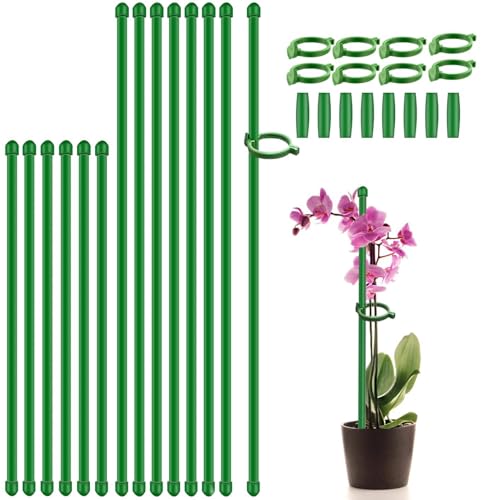
Two stake lengths and connecting pieces distinguish this set from single-length supports. The package includes eight 11-inch and eight 17-inch fiberglass stakes, 16 ring buckles, eight connectors and 20 ties. The maker says connectors can join the stakes to extend their reach, while movable buckles help secure stems. This setup suits potted plants that need upright support at different heights. The 17-inch sections may be too short for tall, mature plants unless connected; measure the needed support height before choosing.
Bottom line: Choose this set for adjustable support across small and medium potted plants.
28-Inch Bendable Coco Coir Poles

A coco coir climbing surface sets these poles apart from plain stakes that only tie a stem upright. The maker says the bendable poles hold their shape and that aerial roots can grip the coconut fiber. The two 28-inch poles suit indoor climbing plants such as Monstera, Pothos and Philodendron. Unlike a narrow stake, a pole supports a climbing habit, but the 28-inch length may not be enough for a large established vine. Check the plant’s current height and growth direction before selecting a pole.
Bottom line: Pick these poles for indoor vines that need a textured climbing surface.
RIFNY 15-Inch Fiberglass Stakes

These six fiberglass stakes are designed to extend from 1 to 3 feet with connecting tubes, giving them a broader height range than a fixed-length stake. Each pole is 0.25 inch in diameter, and the set includes movable plastic clips for securing stems. The maker says the fiberglass suits indoor and outdoor use. This option fits plants that need support increased in stages, including tomatoes, orchids and Monstera. Assembly is part of the adjustable design, so it may be less suitable if you want a single-piece stake with no connectors.
Bottom line: Choose these when you want support that can extend as a plant grows.
BOVITRO 18-Inch Bamboo Sticks

Natural bamboo makes these 18-inch sticks a different choice from fiberglass or plastic supports. The set contains 20 sticks and 20 green ties, so each stem can be secured with a separate tie as needed. The maker recommends them for tomatoes, beans, vegetables and potted plants, indoors or outdoors. They suit straightforward vertical support where a tie can hold the stem against the stick. Bamboo can be less convenient than a connector-based stake if you need to lengthen support as a plant grows; choose a taller support for plants expected to outgrow 18 inches.
Bottom line: Pick these for simple, tie-on support with natural bamboo sticks.
HOMEBROS Stackable Plastic Support Stakes

Branch-shaped arms distinguish these plastic supports from straight stakes, giving several stems or leaves places to rest. Each of the six pieces measures 11 inches and can be used alone or stacked; the package also includes 20 clips and a roll tie. The maker says the green plastic blends with foliage. This design suits climbing or broad-leaved plants that need support at multiple points. The individual sections are relatively short, so a tall plant may require stacking; check that the assembled support can reach the stems that need help.
Bottom line: Choose these for plants with several stems or leaves needing support.
How to Choose Plant Support Sticks
Match the support style to how the plant grows: a single upright stem usually needs a straight stake, while a climbing vine benefits from a textured pole or trellis. For plants that may outgrow their support, choose a connector-based or stackable design rather than a fixed-length stick. A useful rule is to select a stake that reaches at least the height of the stem section you need to secure; for vines, allow room above the current growth so the plant has a path upward. Tie stems loosely with soft ties, leaving room for thickening. Tight loops can constrict stems, and rigid ties can rub or cut into them.
Plant Stake Materials and Styles
Fiberglass and plastic stakes resist rust, while bamboo offers a natural, rigid stem support; each material suits a different setup. A straight stick works when the plant can be tied alongside it, whereas branch-shaped supports offer several resting points and coir poles provide a textured climbing surface. Coco coir poles are not the same as plain stakes: climbing plants may attach aerial roots to their fibrous surface. A loose tie can guide a vine toward a pole while roots establish. For outdoor use, push stakes into stable soil and avoid forcing them through a dense root mass. For heavy or top-heavy growth, use more than one support point instead of relying on a single slender stake.
| Plant growth habit | Support style | What to prioritize |
|---|---|---|
| Single stem | Straight stake | Reach and a loose tie |
| Climbing vine | Coir pole or trellis | Textured attachment surface |
| Several spreading stems | Branch-shaped support | Multiple resting points |
How to Place and Tie Plant Stakes
Place a stake close enough to support a stem, but angle it away from the plant’s main root crown when inserting it. A stake should be secure in the soil before stems are tied to it; wobbling support can pull on roots and stems. Use soft ties in a loose figure-eight, with one loop around the stake and one around the stem, so the support bears the load without pinching. Check ties as growth continues and loosen or reposition them if they press into the stem. For plants with several heavy branches, add support points near the branches rather than pulling every stem toward one central stick.
Common Mistakes With Plant Supports
Choosing a stake that is too short is a common mismatch: measure the height of the stem or vine section needing support, not just the pot. A single narrow stick may also fail to support several spreading stems; use branched supports or multiple stakes when growth extends in different directions. Avoid tight knots and wire directly against tender stems because movement and growth can make ties restrictive. Do not push a stake blindly into a crowded root ball; position it near the pot edge if the center is dense. Inspect outdoor stakes after wind or heavy rain, since loose soil can make an otherwise suitable support unstable.
Frequently Asked Questions
How tall should a stake be for a potted plant?
Choose a stake that reaches the stem section needing support, with extra height if the plant is still growing. Measure the plant rather than relying on pot size, and use an extendable stake if its height is likely to change.
How do you tie a plant to a support stick?
Use a soft tie in a loose figure-eight around the stake and stem. Leave room for the stem to thicken, then check the tie periodically so it does not press into the plant.
Do climbing plants need a moss or coir pole?
Climbing plants with aerial roots can benefit from a textured pole, while a straight stake is mainly for holding stems upright. Coir provides a fibrous surface; guide a vine toward it with a loose tie while it attaches.
Can bamboo stakes stay outside in the rain?
Bamboo stakes can be used outdoors, but wet soil and weather can shorten the useful life of natural materials. Check them for soft spots or looseness and replace any stick that no longer supports the plant securely.
Where should I place a stake in a plant pot?
Place the stake near the stem that needs support, avoiding the densest part of the root crown. Push it in securely without forcing it through roots, and check that the pot remains stable once the stem is tied.