
Best Motorcycle Octane Booster: 5 Options Compared

Lucas Motorcycle Octane Booster, 2 oz is the best fit for most motorcycle riders because it is explicitly marketed for motorcycles and says it is safe for oxygen sensors and catalytic converters. Riders with older motorcycles without emissions aftertreatment can consider Lucas Oil Octane Booster, 2 oz, 18-pack, while high-performance race engines may call for BOOSTane Professional, 32 oz.
Octane booster is a fuel additive intended to increase a gasoline blend’s resistance to knock; it does not replace using the fuel grade your motorcycle requires.
We earn a commission if you buy through links on this page. As an Amazon Associate I earn from qualifying purchases. Products are compared on manufacturer specifications, not hands-on testing.
- Best overall: Lucas Motorcycle Octane Booster, 2 oz – The 2-ounce Lucas booster is explicitly labeled for motorcycles and says it is safe for oxygen sensors and catalytic converters.
- Best for older engines: Lucas Oil Octane Booster, 2 oz, 18-pack – It suits fuel-injected and carbureted engines but is designed for engines without emissions aftertreatment.
- Best for race engines: BOOSTane Professional, 32 oz – Its formula is aimed at high-performance naturally aspirated or forced-induction engines.
| Product | Best for | Container size | Engine fit | Emissions-system fit | Shop |
|---|---|---|---|---|---|
| Lucas Motorcycle Octane Booster, 2 oz | General motorcycle use | 2 oz | Fuel-injected or carbureted | Oxygen sensors and catalytic converters | Check Price on Amazon |
| Lucas Oil Octane Booster, 2 oz, 18-pack | Older motorcycles | 2 oz per bottle | Fuel-injected or carbureted | Designed without aftertreatment | Check Price on Amazon |
| BOOSTane Professional, 32 oz | Race engines | 32 oz | Naturally aspirated or forced induction | — | Check Price on Amazon |
| VP Racing Octanium Unleaded, Quart | Two-cycle engines | 32 oz | Two- or four-cycle gasoline | Oxygen sensors or catalytic converters | Check Price on Amazon |
| Lucas Oil Octane Booster, 15 oz | Larger bottle | 15 oz | — | — | Check Price on Amazon |
Motorcycle Octane Boosters Compared
Compare the intended engine and emissions-system fit before choosing a fuel additive.
Lucas Motorcycle Octane Booster, 2 oz
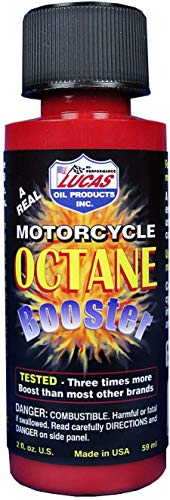
Unlike the broader-purpose additives here, this Lucas formula is explicitly labeled for motorcycle use. The 2-ounce bottle is intended for fuel-injected and carbureted engines, and the maker says it is safe for oxygen sensors and catalytic converters. That stated compatibility makes it the clearest match for riders unsure whether their bike has emissions equipment. The limitation is the small bottle size; riders treating several tanks should check the package’s dosing directions and calculate how many bottles they need before purchasing.
Bottom line: Choose this if you want a motorcycle-labeled booster with sensor and catalytic-converter compatibility.
Lucas Oil Octane Booster, 2 oz, 18-pack

Compared with the motorcycle-labeled Lucas option, this 18-pack is intended for engines and vehicles without emissions aftertreatment systems. Each bottle holds 2 ounces, and the maker says the formula works in fuel-injected and carbureted engines. That may suit older motorcycles without a catalytic converter or other aftertreatment, but it is not the safer default for a modern emissions-equipped bike. Confirm the motorcycle’s emissions hardware before using it, and use the package directions to determine the dose for the tank.
Bottom line: Pick this for a motorcycle without emissions aftertreatment, after confirming that fit.
BOOSTane Professional, 32 oz

Unlike the small motorcycle-oriented bottles, BOOSTane Professional is a 32-ounce formula aimed at high-performance naturally aspirated or forced-induction engines. The maker says it can increase octane levels up to 116 and includes anti-corrosion properties against ethanol and carbon buildup. Its racing focus makes it a possible fit for a competition motorcycle, but the engine guidance does not establish motorcycle or emissions-system compatibility. Check those two points before using it in a street bike, and do not assume a race formulation suits routine road use.
Bottom line: Choose this only when the motorcycle’s high-performance use and compatibility are confirmed.
VP Racing Octanium Unleaded, Quart

Unlike the race-engine-focused BOOSTane formula, VP Racing Octanium Unleaded explicitly covers two- or four-cycle gasoline engines and says it can be used with oxygen sensors or catalytic converters. The quart container holds 32 ounces. The maker says the additive boosts octane by up to 7 numbers, but the specifications do not establish a motorcycle-specific application or a dosing rate for a particular tank. Verify that the motorcycle’s fuel system and the package directions match before use; a general two-cycle designation alone does not confirm fit for every bike.
Bottom line: Consider this for a compatible two- or four-cycle motorcycle after checking the dosing directions.
Lucas Oil Octane Booster, 15 oz

Compared with the 2-ounce Lucas bottles, this Lucas Oil product comes in a single 15-ounce container. The specifications identify it as an octane booster but do not establish motorcycle engine or emissions-system compatibility, so it is a less certain choice for a street bike. Its larger container may be relevant when selecting by bottle size, but size alone does not establish how much to add to a motorcycle tank. Confirm compatibility and dose on the product packaging before use.
Bottom line: Choose this only if its package confirms compatibility and a suitable dose for your motorcycle.
How to Choose a Motorcycle Octane Booster
Start with the octane grade in the motorcycle owner’s manual, then use an additive only if the product suits the engine and fuel system. U.S. pump octane is usually shown as AKI, the average of research and motor octane ratings, written as (R+M)/2; racing fuel labels may use a different convention. A booster’s claim in “points” should not be compared directly with a whole-number pump grade unless the label explains the scale. For a street motorcycle with a catalytic converter or oxygen sensor, choose a product whose label explicitly addresses those parts. Higher octane alone does not create more power in an engine that is not knocking.
Motorcycle Engine and Emissions-System Fit
Match the additive to the bike’s fuel system and emissions hardware before considering bottle size. Carbureted and fuel-injected engines both use gasoline, but the additive’s compatibility claim still matters; a product described for carbureted engines is not automatically suitable for every injection system. Modern street motorcycles may have oxygen sensors and catalytic converters, while older machines may not. With an emissions-equipped bike, choose a booster that explicitly says it is compatible with those components; if the label excludes aftertreatment, do not use it in that bike. For a race-only motorcycle, confirm the intended fuel and engine application rather than assuming a racing formula fits a road bike.
How to Dose Octane Booster Safely
Use the product’s dose for the amount of gasoline in the tank; bottle size is not a dosing instruction. Motorcycle fuel tanks commonly hold only a few gallons, so an amount intended for a car tank can be excessive when transferred without scaling to the product’s directions. Pour additives in a ventilated area, keep them off skin and paint, and keep the container away from flames or sparks because gasoline and many fuel additives are flammable. Never use an additive to justify fuel below the grade required by the motorcycle maker. A booster also cannot correct mechanical knock caused by an engine fault.
Frequently Asked Questions
Does octane booster increase motorcycle horsepower?
Octane booster does not necessarily add horsepower; the benefit depends on whether the engine is limited by knock at its current fuel grade. If the motorcycle already runs the required octane without knock, a higher effective octane may make no measurable difference.
Can I use octane booster in a fuel-injected motorcycle?
Some boosters say they suit fuel-injected engines, but that does not establish compatibility with every motorcycle. For a street bike, check for explicit compatibility with its oxygen sensor and catalytic converter as well.
How much octane booster should I add to a motorcycle tank?
Use the dose printed for the volume of gasoline being treated; do not assume a full bottle is right for a motorcycle tank. Because motorcycle tanks are usually only a few gallons, confirm the label’s treatment volume before pouring.
Can octane booster replace premium motorcycle fuel?
No; use at least the octane grade required by the motorcycle maker. An additive should not be treated as a substitute for the correct base gasoline or as a remedy for persistent knock.
Is racing octane booster suitable for street motorcycles?
Not automatically; racing formulations may have a different intended application from street-bike additives. Before use, verify that the product supports the motorcycle’s engine type and any oxygen sensor or catalytic converter.