
Best Notebooks for Math: 3 Graph Paper Options

Mead 1-Subject Graph Notebook suits most math students because its graph paper has 5 squares per inch for plotting and organizing calculations. Choose Mr. Pen A5 Graph Grid Journal for a smaller A5 notebook with 160 pages, or AHGXG A4 Graph Paper Notebook when you want 8.5-by-11-inch pages; grid spacing can affect how comfortably equations and graphs fit.
We earn a commission if you buy through links on this page. As an Amazon Associate I earn from qualifying purchases. Products are compared on manufacturer specifications, not hands-on testing.
- Best overall: Mead 1-Subject Graph Notebook – Its 5-squares-per-inch grid gives a defined scale for plotting and orderly calculations.
- Best for portability: Mr. Pen A5 Graph Grid Journal – The A5 format measures 5.7 by 8.4 inches and includes 160 graph pages.
- Best for large pages: AHGXG A4 Graph Paper Notebook – Its 8.5-by-11-inch format provides more room for extended calculations and diagrams.
| Product | Best for | Grid | Paper size | Sheets/pages | Shop |
|---|---|---|---|---|---|
| Mead 1-Subject Graph Notebook | Graph plotting | 5 squares/in | 7.5 × 10.5 in torn; 8 × 10.5 in overall | 100 sheets | Check Price on Amazon |
| Mr. Pen A5 Graph Grid Journal | Portable math notes | Graph grid; spacing unspecified | 5.7 × 8.4 in | 160 pages | Check Price on Amazon |
| AHGXG A4 Graph Paper Notebook | Large writing area | Grid; spacing unspecified | 8.5 × 11 in | 55 sheets / 110 pages | Check Price on Amazon |
Math Notebooks with Graph Paper
Compare grid spacing, writing area, and page count to find a notebook that suits your calculations and diagrams.
Mead 1-Subject Graph Notebook
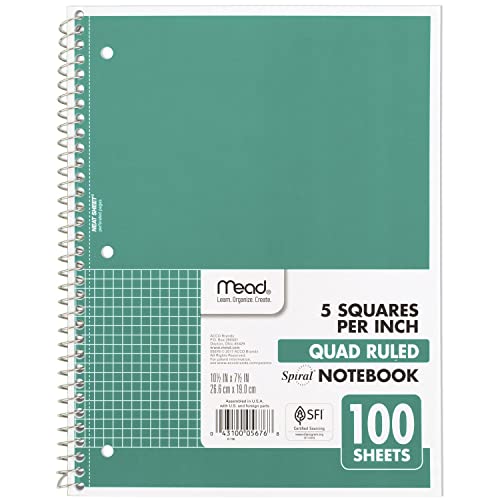
Mead 1-Subject Graph Notebook is the only option here with a grid scale: 5 squares per inch, a useful reference when plotting points or aligning calculations. It has 100 double-sided graph sheets in a spiral notebook, with perforations for clean tear-out and three-hole punching for binder storage. The torn sheet measures 7.5 by 10.5 inches; the notebook is 8 by 10.5 inches overall. This format suits classwork that may need to be filed or handed in. The tradeoff is less writing area than a full 8.5-by-11-inch sheet.
Bottom line: Pick this if you want a defined grid scale and removable, binder-ready pages.
Mr. Pen A5 Graph Grid Journal

Mr. Pen A5 Graph Grid Journal combines a compact A5 format with 160 graph pages, making it the portable choice among these notebooks. Its hardcover, pen, and divider sticky tabs provide an all-in-one set for keeping formulas, diagrams, and related notes together. The maker says the graph layout supports aligned writing and structured work; the grid spacing is not defined here, so students who need a precise scale for plotting should verify it before ordering. Its smaller pages are convenient to carry, but may feel cramped for long derivations or large coordinate graphs.
Bottom line: Choose this for portable graph paper notes and included organizing accessories.
AHGXG A4 Graph Paper Notebook

AHGXG A4 Graph Paper Notebook offers the largest writing format here, with 8.5-by-11-inch pages and 110 graph paper pages. Its 100 gsm paper is paired with an ivory color, a waterproof plastic cover, and double-wire binding that folds back and lays flat. The maker says the paper is intended to reduce ghosting and feathering across several pen types.
Bottom line: Pick this when full-size pages and thicker paper matter more than a grid scale.
How to Choose a Math Notebook
Start with the grid scale and the work you expect to do: a grid measured in squares per inch gives a predictable spacing for plotted points and diagrams, while an unspecified grid requires checking the square size if scale matters. Standard U.S. letter paper is 8.5 by 11 inches; smaller formats are easier to carry but leave less room for long equations. For routine algebra, prioritize enough page area to keep each step legible. For geometry or graphing, choose a consistent grid and leave margins for labels. A useful decision rule is to choose full-size paper if you regularly need graphs wider than 5 inches; for short problem sets and notes, a smaller notebook can be easier to manage.
Graph Paper Grid Sizes for Math
Grid spacing determines how much space each calculation or plotted unit occupies. A common fine graph paper scale is 5 squares per inch, which makes each small square 0.2 inch wide; larger squares are often formed by grouping five small squares, creating 1-inch intervals. That layout can help with axes, tables, and diagrams, but it does not set the graph’s mathematical scale: the student still chooses what each square represents. Before drawing, label both axes and mark equal intervals consistently. Use pencil for axes when the scale may change, and reserve space around the graph for units and labels. If precise plot spacing is required, verify the grid measurement rather than relying on the word “graph.”
Notebook Formats Compared for Math
Page format changes how much space you have for a worked problem and how easily the notebook travels. U.S. letter sheets measure 8.5 by 11 inches, while A5 is about 5.8 by 8.3 inches; actual products may vary slightly. A perforated sheet can be removed for submission, whereas a bound page stays with the notebook. A lay-flat binding is helpful when writing near the center fold, while a spiral can let a notebook fold back on itself. Use this guide to match the format to a common task.
| Need | Choose | Tradeoff |
|---|---|---|
| Large diagrams or extended work | Letter-size pages | More to carry |
| Compact notes on the go | A5 pages | Less room per problem |
| Removable classwork | Perforated sheets | Pages can separate from the notebook |
How to Keep Math Work Legible
Leave a blank line between problem stages and keep one equation step per line; crowding makes signs, exponents, and fractions harder to distinguish. On graph paper, use a consistent number of small squares between labeled axis intervals, and write units beside measurements rather than leaving them implicit. For fractions, draw a fraction bar long enough to cover the entire numerator or denominator. A 0.5-inch margin is a practical target for notes and corrections, especially when pages will be punched or filed. Use pencil for plots that may need revision, and avoid forcing a long solution into a small page when a larger format would keep each step readable.
Frequently Asked Questions
What grid size works well for math class?
A 5-squares-per-inch grid is a common fine layout for plotting and aligning calculations. Each small square is 0.2 inch wide, but the mathematical value assigned to each square depends on the graph’s scale.
Is graph paper useful for algebra problems?
Graph paper can help keep multi-step algebra aligned, especially when working with tables or coordinate graphs. Leave space between steps so signs, exponents, and fractions remain easy to read.
Should I choose A5 or letter-size paper for math?
Letter-size paper measures 8.5 by 11 inches and gives more room for long solutions and diagrams. A5 is about 5.8 by 8.3 inches, a more compact choice when portability matters more than writing area.
How many squares should an axis interval cover?
Choose a consistent interval that keeps the full graph within the available grid, such as five small squares per labeled step. Label the interval value and units on each axis, and use equal spacing throughout.
Does thicker notebook paper prevent ink bleed-through?
Paper weight alone does not guarantee that ink will not bleed through; ink type and paper finish also matter. If both sides of a page will be used, test the intended pen on a spare sheet first.