
Best Outdoor Faucet Splitter: 5 Models Compared

The 2WAYZ 2-way splitter suits most people because its all-metal body and individual shutoffs give two hoses independent control. Choose a three-outlet splitter if you need to run three lines, or a brass two-way model if that material is your priority.
We earn a commission if you buy through links on this page. As an Amazon Associate I earn from qualifying purchases. Products are compared on manufacturer specifications, not hands-on testing.
- Best overall: 2WAYZ 2-Way All-Metal Splitter – Two individually controlled outlets in an all-metal body with extended handles.
- Best for three hoses: LNEZCDB 3-Way Brass Splitter – Three outlets and a brass body for setups that need an extra line.
- Best for spare washers: Hourleey Brass 2-Way Splitter – Includes two spare 3/4-inch O-rings and tape with the two-way splitter.
| Product | Best for | Outlets | Body material | Size | Shop |
|---|---|---|---|---|---|
| 2WAYZ 2-Way All-Metal Splitter | Two-hose control | 2 | All-metal | 4 × 4 × 1.5 in. | Check Price on Amazon |
| LNEZCDB 3-Way Brass Splitter | Three hose lines | 3 | Brass | 6.7 × 4 × 2 in. | Check Price on Amazon |
| Brass 2-Way Full-Flow Splitter | Brass flow control | 2 | Brass | 3 × 3 × 1 in. | Check Price on Amazon |
| Hourleey Brass 2-Way Splitter | Spare sealing rings | 2 | Brass | — | Check Price on Amazon |
| Brass 2-Way Splitter with Extra Washers | Simple brass setup | 2 | Brass | 3 × 2 × 1 in. | Check Price on Amazon |
Outdoor faucet splitters
Compare outlet count, construction and size to find the splitter that matches your hose setup.
2WAYZ 2-Way All-Metal Splitter

The all-metal 2WAYZ stands out for its extended 1.6-inch handles and separate shutoff control on a two-outlet splitter. Its body measures 4 × 4 × 1.5 inches, and the maker says bolted parts and a rubber sealing ring help prevent drips. The extended spacing also leaves room to grip fittings while connecting hoses. This suits gardeners who want independent control for two lines. The limitation is capacity: a two-way adapter cannot add a third hose when a setup needs three outlets.
Bottom line: Choose this for two hoses and accessible individual shutoffs.
LNEZCDB 3-Way Brass Splitter
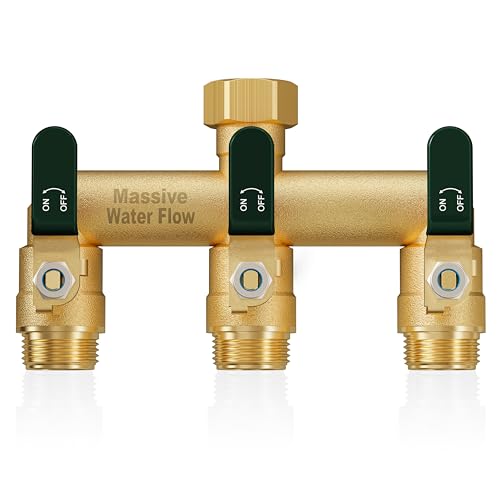
The LNEZCDB is the only three-outlet option here, making it the practical choice when one faucet must feed three hoses. Its brass body measures 6.7 × 4 × 2 inches, and the maker reports a 0.6-inch inner diameter and a tested pressure of 2.4 MPa. The added outlet may help separate a sprinkler, soaker hose and cleaning line. The larger body needs more room at the faucet than a compact two-way connector, so check surrounding clearance before selecting it.
Bottom line: Pick this when three separate hose connections matter most.
Brass 2-Way Full-Flow Splitter

The compact brass two-way splitter is differentiated by its full-flow design and large easy-turn handle. It measures 3 × 3 × 1 inches and provides individual shutoffs, according to the maker. A brass body suits buyers who prefer that material over the all-metal or rubberized construction of other options. The maker describes it as able to maintain strong flow to both outlets, but actual flow depends on the faucet and hose setup; choose another model if you need three connections.
Bottom line: Choose this for a compact brass two-outlet setup.
Hourleey Brass 2-Way Splitter

The Hourleey package stands apart by including two spare 3/4-inch O-rings and tape along with the brass two-way splitter. It fits most standard U.S. 3/4-inch garden hose connectors and has two valves for directing water to separate hoses. Its updated handles are intended to take less effort to turn, which may suit users who prefer an easier grip. Dimensions are not provided, so this is less useful when a tight space makes the connector’s size a deciding factor.
Bottom line: Pick this if spare O-rings and tape are useful to your setup.
Brass 2-Way Splitter with Extra Washers

This brass two-way splitter has a compact stated size of 3 × 2 × 1 inches and includes two extra rubber washers. Each outlet can be turned on or off individually, and the extended rubberized handle is designed for grip. The maker says the splitter fits most garden hose connectors. The first use may feel tight, so buyers who want an especially easy initial valve turn may prefer a model with a larger handle; its small footprint may help where faucet clearance is limited.
Bottom line: Choose this for a compact brass splitter with spare washers.
How to choose an outdoor faucet splitter
Choose the outlet count first: a two-way splitter serves two hoses, while a three-way model serves three. Most U.S. garden hoses use 3/4-inch GHT (garden hose thread), but verify the faucet and hose connector thread before buying; pipe threads and hose threads are not interchangeable. Then compare valve control, body material and available room around the faucet. For a tight space, favor a body with measured dimensions and leave enough space to turn each handle and attach hose couplings. A splitter adds connections, not water capacity: running multiple hoses at once can reduce flow if the faucet or supply line is limited.
Two-way versus three-way faucet splitters
A two-way adapter is enough when you need two independently controlled lines; a third outlet is useful only when you have a third hose to connect. The LNEZCDB is the three-outlet choice here; all other options have two outlets. Choose by the number of separate tasks rather than assuming that more outlets mean stronger simultaneous flow. Most outdoor faucet connections use 3/4-inch GHT, and hose washers sit inside female hose couplings to seal the connection. Seat a washer in each coupling and hand-tighten connections first; forcing a misaligned thread can damage the fitting.
| Setup need | Splitter type | Decision rule |
|---|---|---|
| Two hose lines | Two-way | Choose when two independent shutoffs are enough |
| Three hose lines | Three-way | Choose when all three connections are needed |
| Limited faucet clearance | Compact connector | Compare stated dimensions with available space |
Thread fit and leak prevention
Garden hose thread is a 3/4-inch straight thread commonly used on U.S. outdoor faucets and hose ends; a snug fit still depends on an intact washer. Check that the splitter’s inlet matches the faucet and that each outlet matches the hose coupling before connecting. A leak at the hose end often comes from a missing, flattened or misplaced washer, not a need to overtighten. Turn the faucet on slowly after assembly and inspect each joint. If water escapes, shut it off, reseat or replace the washer, and reconnect without crossing the threads.
Outdoor use and winter storage
Water left inside a pressurized splitter can freeze and expand, which can crack metal fittings and damage valves. Before a hard freeze, shut off the faucet, disconnect hoses and drain the splitter; if the faucet has an indoor shutoff, close it and open the outdoor faucet to relieve trapped water. Leave outlet valves open during storage so residual water can drain. Brass and other metal construction does not make a water-filled connector freeze-proof, and rubber washers can wear or deform over time, so inspect seals when reconnecting in spring.
Frequently Asked Questions
Will one faucet splitter run two sprinklers at once?
A two-way splitter can connect two sprinklers, but it does not increase the faucet’s water supply. If both sprinklers need high flow, run them separately or check whether the faucet and supply maintain adequate flow under simultaneous use.
How do I stop a hose splitter from leaking?
Check the washer inside each female hose coupling first; a missing or flattened washer is a common cause of leaks. Hand-start the 3/4-inch GHT threads straight, then tighten without forcing them.
Can I leave an outdoor splitter connected in winter?
Disconnect and drain the splitter before freezing weather because trapped water can expand and crack the fitting. Shut off the supply if possible and open valves to release water from the connector.
Are garden hose threads the same as pipe threads?
No; standard U.S. garden hose connections commonly use 3/4-inch GHT, a straight hose thread, while pipe threads use a different thread form. Match the faucet and hose fittings rather than forcing unlike threads together.
Why does water flow slow down with two hoses attached?
A splitter divides the available supply rather than creating more flow, so simultaneous demand can lower each hose’s output. Faucet flow, supply-line limits, hose length and nozzle or sprinkler demand all affect the result.