
Best Outdoor Paint for Rocks: 5 Sets Compared

For most rock painters, FolkArt Outdoor Gloss Acrylic, 12 Colors is the practical choice because its 12 colors come in manageable 2-ounce bottles and its formula is made for outdoor crafts. Choose a larger set such as Shuttle Art Outdoor Acrylic, 36 Colors for a wider palette, or a bulk set if you are painting many rocks; outdoor acrylic paint is water-based paint designed for craft surfaces, but stone preparation still matters.
We earn a commission if you buy through links on this page. As an Amazon Associate I earn from qualifying purchases. Products are compared on manufacturer specifications, not hands-on testing.
- Best overall: FolkArt Outdoor Gloss Acrylic, 12 Colors – Twelve 2-ounce colors suit small rock projects without requiring bulk bottles.
- Best for color variety: Shuttle Art Outdoor Acrylic, 36 Colors – Includes 36 colors, plus brushes, a palette, and a mini UV light.
- Best for bulk painting: Shuttle Art Outdoor Acrylic, 12 Bulk Colors – Twelve colors come in 8.45-ounce bottles for larger projects.
- Best for a large palette: ABEIER Outdoor Acrylic, 15 Bulk Colors – Fifteen colors are supplied in 8.45-ounce bottles.
| Product | Best for | Colors | Bottle size | Included tools | Shop |
|---|---|---|---|---|---|
| FolkArt Outdoor Gloss Acrylic, 12 Colors | Small rock projects | 12 | 2 oz | None stated | Check Price on Amazon |
| Shuttle Art Outdoor Acrylic, 36 Colors | Wide color selection | 36 | 2 oz | 10 brushes, palette | Check Price on Amazon |
| Shuttle Art Outdoor Acrylic, 12 Bulk Colors | Repeated painting | 12 | 8.45 oz | Painting knife, sponge | Check Price on Amazon |
| ABEIER Outdoor Acrylic, 15 Bulk Colors | Larger color range | 15 | 8.45 oz | — | Check Price on Amazon |
| unuaST Outdoor Acrylic, 10 Colors | Pump dispensing | 10 | 10.14 oz | Knife, sponge, pump | Check Price on Amazon |
Outdoor Paint for Rocks Compared
Compare palette size, bottle volume, and included tools to match a paint set to your rock-painting project.
FolkArt Outdoor Gloss Acrylic, 12 Colors
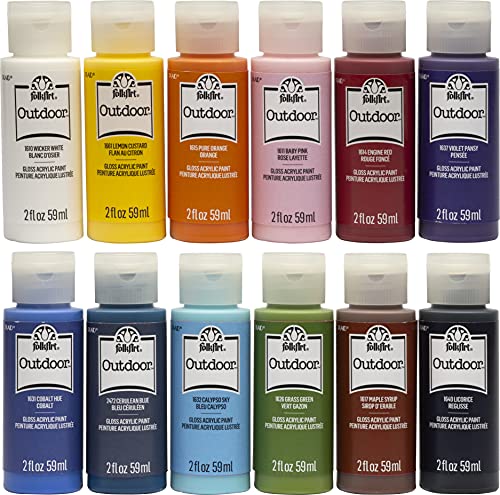
For a compact rock-painting palette, this set pairs 12 colors with 2-ounce bottles. The colors include white, yellow, pink, orange, red, violet, green, several blues, brown, and black, giving you a useful spread for hand-painted designs. FolkArt says the dried finish is weather-resistant and UV stable, and the paint cleans up with soap and water while wet. It is also described as non-toxic. The smaller bottles suit occasional projects or detail work; painters covering many large stones may prefer a bulk set to avoid running through multiple small bottles.
Bottom line: Choose this set for manageable bottle sizes and a straightforward 12-color palette.
Shuttle Art Outdoor Acrylic, 36 Colors

The widest palette here, this set has 36 colors in 2-ounce bottles, including 25 classic shades, five glow-in-the-dark shades, and six metallic finishes. It also includes 10 brushes, a palette, a mini UV light, a color wheel, and an instructional guide, so it suits painters who want a range of effects and tools in one set. Shuttle Art says the paints offer water resistance and coverage for outdoor conditions. With 72 ounces of paint across the set, storage and keeping bottle caps clean matter; painters who need only a few basic shades may find a smaller palette more practical.
Bottom line: Pick this when varied colors and included painting tools matter most.
Shuttle Art Outdoor Acrylic, 12 Bulk Colors

For repeated painting with a focused palette, this set supplies 12 colors in 8.45-ounce bottles rather than small craft-size containers. A painting knife, sponge, and color wheel are included, which can support mixing or textured craft work. Shuttle Art says the paints provide water resistance, coverage, and fade and UV resistance outdoors. The larger bottles are a better match for batches of rocks or larger garden pieces than for a single small stone; they also take more storage space and may be excessive if you paint only occasionally.
Bottom line: Choose this bulk set for multiple rocks and a 12-color palette.
ABEIER Outdoor Acrylic, 15 Bulk Colors

This bulk option combines 15 colors with 8.45-ounce bottles, giving painters a broader palette than the 12-color bulk sets. The product is intended for rocks as well as garden statues, wood, and metal. ABEIER says its paint resists water, UV exposure, scuffs, fading, peeling, and cracking. That broad performance language is the maker’s claim, not a guarantee for every stone or weather exposure. The generous bottle volume suits projects with many surfaces, while anyone painting just a few rocks may find the quantity more than needed.
Bottom line: Pick this for bulk volume with three more colors than a 12-color set.
unuaST Outdoor Acrylic, 10 Colors

A pump sets this 10-color outdoor acrylic set apart, alongside a painting knife, sponge, and color wheel. Each bottle holds 300 milliliters, about 10.14 ounces, making the set suited to projects that use substantial paint per color. The product is intended for rocks, wood, and metal; unuaST says its paints provide water resistance and coverage in outdoor conditions. The 10-color palette is narrower than the 12-, 15-, and 36-color alternatives, so painters who want many distinct hues should compare palettes before choosing. Large bottles are most useful when you expect to use the colors repeatedly.
Bottom line: Choose this if pump dispensing and large bottles suit your workflow.
How to Choose Outdoor Paint for Rocks
Choose by project scale first, then by palette: small individual stones usually need less paint than batches or large garden pieces. The sets here range from 10 to 36 colors and from 2-ounce bottles to bottles around 10 ounces, so consider both variety and how much of each color you will use. Acrylic paint works by forming a colored film as its water carrier dries; a smooth, sealed stone generally takes paint differently from a rough, porous one. For fine designs, a smaller brush and a limited palette can be easier to control than a large bottle. For repeat work, larger bottles reduce how often you switch colors. Outdoor claims are maker claims; exposure, surface condition, and application can affect how a painted rock holds up.
Preparing Rocks Before Painting
Start with a clean, fully dry rock because dirt and moisture can interfere with paint adhesion. Scrub away loose soil, rinse, and let the stone dry completely before painting; a porous or uneven surface may absorb paint and make coverage less uniform. A smooth, flat stone is easier for lettering and small illustrations, while textured stones suit broader shapes and abstract designs. Avoid painting a stone that is still damp, and test a small area if the surface has an old coating or residue. Paint in thin coats rather than applying one heavy layer; let each coat dry before adding detail. If the rock will stay outdoors, keep it out of rain while the paint dries and cures, and follow the paint maker’s directions for handling and drying.
Matching Paint Volume to a Rock Project
Use bottle size as a practical guide: a few small stones favor 2-ounce bottles, while many rocks or larger garden pieces make 8- to 10-ounce bottles more useful. This is a project-planning rule, not a coverage estimate, since rock size, surface texture, and number of coats change paint use. The 36-color set offers breadth in smaller bottles; the bulk sets trade a narrower palette for much more paint per color. If you need at least 15 distinct shades, choose a set with 15 or 36 colors rather than a 10- or 12-color option. The sets with tools also differ: one includes brushes and a palette, while other sets include a knife or sponge. Choose by the tools you will actually use rather than by accessory count alone.
Protecting Painted Rocks Outdoors
Let the paint dry fully before placing a painted rock outside; wet or tacky paint can pick up dirt and be damaged by handling. Acrylic paint forms a film, but repeated rain, abrasion, and strong sun can still affect a finished craft over time. The outdoor formulas make water-resistance or UV-resistance claims, but those claims do not establish a guaranteed service life. If you consider a clear topcoat, confirm that it is compatible with acrylic paint and suitable for the stone’s intended location; a coating can change sheen and surface feel. Keep painted rocks away from food-contact surfaces and do not use craft paint on items that touch food. For children’s projects, supervise paint use and follow the product’s safety directions.
Frequently Asked Questions
How do you prepare rocks for outdoor acrylic paint?
Scrub off dirt, rinse the rock, and let it dry completely before painting. A dry, clean surface gives paint a better chance to adhere than a damp or dusty one.
Does outdoor acrylic paint need a clear sealer on rocks?
A sealer is an optional extra layer, not a substitute for suitable paint or surface preparation. Confirm that the sealer is compatible with acrylic paint and intended for outdoor use, since coatings can change the finish.
How many coats of paint should you use on rocks?
Apply thin coats and let each coat dry before adding another; the number depends on the stone’s color, texture, and paint coverage. Rough or porous stones may need more coats for an even appearance.
Can painted rocks go outside right after painting?
Wait until the paint is fully dry and cured before placing the rock outdoors. Rain or handling while the paint is still tacky can mark the surface or disrupt the finish.