
Best Over Door Cat Climber: 4 Models Compared

4-Level Wood Door Tower suits most people who want a four-level over door cat climber and can meet its specified door fit: 1.38 to 2.16 inches thick with a gap over 3 mm. Choose another design if your door falls outside that range or you want a documented scratching post or adjustable straps.
Over-door climbers use vertical space for perches, but their fit depends on the door and how the frame is secured.
We earn a commission if you buy through links on this page. As an Amazon Associate I earn from qualifying purchases. Products are compared on manufacturer specifications, not hands-on testing.
- Best overall: 4-Level Wood Door Tower – Four levels, with a 15-pound capacity per shelf and a defined door-thickness range.
- Best for scratching: AD Furnishes 4-Level Climber – Combines four wood perches with a natural sisal-wrapped post and adjustable straps.
- Best for ladder access: 4-Tier Wooden Shelf Climber – Four platforms connect with ladders, and the design includes a tease ball.
- Best for a wide perch: 4-Level Climber with 17.7-Inch Perch – The product name specifies a 17.7-inch perch and the frame uses six suction cups.
| Product | Best for | Height | Notable feature | Shop |
|---|---|---|---|---|
| 4-Level Wood Door Tower | Defined door fit | 67.3 in | 15 lb per shelf | Check Price on Amazon |
| AD Furnishes 4-Level Climber | Scratching post | 58.9 in backboard | Sisal post | Check Price on Amazon |
| 4-Tier Wooden Shelf Climber | Ladder-connected levels | 66.93 in | Ladders and tease ball | Check Price on Amazon |
| 4-Level Climber with 17.7-Inch Perch | Wide resting perch | 63 in | 17.7 in perch | Check Price on Amazon |
Over Door Cat Climbers Compared
Compare the mounting approach, vertical footprint and climbing features before choosing a door-mounted setup.
4-Level Wood Door Tower
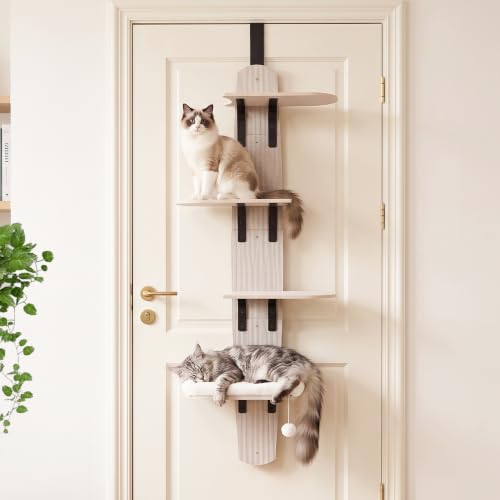
4-Level Wood Door Tower is the clearest fit choice when door measurements are known: its required thickness is 1.38 to 2.16 inches, and the door gap must exceed 3 mm. The four-tier tower measures 67.3 inches high and uses pine wood with a metal support frame. Each shelf is rated for up to 15 pounds, making that per-shelf limit an important constraint for larger cats or heavy jumping loads. Carpeted platforms provide places to perch and rest. The specifications do not give a total tower capacity, so this option suits buyers who can keep each shelf within its limit.
Bottom line: Choose this if your door meets the fit range and each shelf will stay under 15 pounds.
AD Furnishes 4-Level Climber

AD Furnishes 4-Level Climber stands out for combining a sisal-wrapped scratching post with four wood perches, rather than relying on carpeted platforms alone. Two steel hooks hang over the door, while adjustable straps with L-shaped hooks catch the bottom edge; the backboard is felt-covered and assembles from sections. This setup suits renters who want a scratch surface and multiple resting levels without drilling into a wall. The backboard is 58 7/8 inches high.
Bottom line: Pick this if a dedicated sisal scratching post matters alongside four perches.
4-Tier Wooden Shelf Climber

4-Tier Wooden Shelf Climber differentiates itself with ladders between its four platforms and a dangling tease ball, giving the levels a connected route rather than only separate perches. Its dimensions include a height of 66.93 inches, and the product is described as solid wood with sisal rope for scratching. That combination may suit a cat that uses step-by-step access and a rope surface. Buyers who need those measurements to confirm safe use should check them before selecting this climber, particularly for a larger cat.
Bottom line: Choose this if ladder-linked platforms and sisal rope are the features you want.
4-Level Climber with 17.7-Inch Perch

4-Level Climber with 17.7-Inch Perch is the option to consider when perch width is a priority: its product name specifies a 17.7-inch perch. The four-level frame also has six suction cups and climbing rope, plus adjustable hooks. Its height is 63 inches. That makes it a less certain match when door fit or weight capacity is the deciding factor; verify those before choosing it for a larger cat or a textured door.
Bottom line: Pick this when a 17.7-inch perch is more important than having a load limit.
How to Choose an Over Door Cat Climber
Start with door fit, then compare shelf capacity, route and perch dimensions. Door thickness and clearance matter because hanging hooks and lower straps need enough space to seat without obstructing the door. Measure the actual door rather than assuming a standard; product fit ranges can differ. A climber with a per-shelf limit gives a useful check, but do not treat that figure as a whole-tower rating. Cats also need a clear route between levels: ladder-connected platforms offer intermediate steps, while spaced shelves call for more jumping. For a cat above 15 pounds, do not assume a 15-pound shelf rating is adequate for active climbing; look for a higher documented limit.
Measure Door Fit Before Mounting
Measure the door thickness at the top edge and check the gap between the door and frame before selecting a hanging model. One climber here requires 1.38 to 2.16 inches of thickness and a gap over 3 mm, so even a small mismatch can rule it out. Also check whether hooks and straps can sit flat and whether the door can still open and close without shifting the structure. Suction cups depend on a clean, smooth surface, so textured or uneven finishes may prevent a reliable seal. Keep the door closed while mounting, then check for movement before letting a cat climb.
Compare Mounting and Climbing Styles
Over-door designs differ in how they stabilize and connect their levels. Hooks support the structure over the top edge; bottom straps or hooks can add restraint, while suction cups contact the door face. Ladders give cats a stepped route between platforms, and separate shelves require more confident jumping. Sisal rope or posts offer a dedicated scratch surface; felt and carpeted surfaces instead add covered perch areas. Choose the layout based on the cat’s mobility and preferred route, not just the number of levels. The table separates common design features so buyers can match the structure to their needs.
| Need | Feature to prioritize | Tradeoff to check |
|---|---|---|
| Door-specific compatibility | Published thickness and gap range | Measure before choosing |
| Step-by-step climbing | Ladders between platforms | Confirm the full structure fits the door |
| Scratching outlet | Sisal post or rope | Check its position relative to perches |
| Broad lounge area | Published perch width | Confirm the measurement applies to the usable surface |
Use and Inspect a Door-Mounted Climber
Check the mount before each climbing session and after any noticeable shift: hooks should remain seated, straps snug, and suction cups attached. A loose or swinging climber can startle a cat and increase the chance of a fall, so pause use until it is secure. Keep the surrounding floor clear of hard objects, and avoid placing the climber where a door can swing into furniture or another hazard. Observe how the cat reaches each platform during early use; a difficult jump may call for a different layout or a lower climbing option. Respect each shelf’s load limit, and do not infer a combined capacity from individual shelf ratings.
Frequently Asked Questions
How do I measure a door for an over-door cat climber?
Measure the top-edge thickness and the gap between the door and frame, then compare both with the climber’s required range. One model here calls for 1.38 to 2.16 inches of thickness and a gap greater than 3 mm.
Can a cat climber hang on a hollow-core door?
A hollow core does not by itself confirm that a door-mounted climber is suitable. Check the door’s construction and the climber’s mounting and load requirements, and do not use it if the hooks or restraints cannot sit securely.
How much weight can a cat door shelf hold?
Use the maker’s limit for each individual shelf rather than estimating from the material or total number of levels. One model here gives a maximum of 15 pounds per shelf; it does not establish a whole-tower capacity.
Are suction cups enough to secure a cat climber?
Suction cups need a clean, smooth surface to adhere properly, and a textured finish can interfere with their seal. Treat them as only one part of the mount and check that the climber remains secure before allowing climbing.
How much space should cat climbing levels have?
Choose spacing that matches the cat’s ability to step or jump comfortably; ladder connections provide intermediate access between platforms. For an older, injured or less agile cat, avoid relying on large unsupported jumps and choose a route with closer steps.