
Best Paint Markers for Wood: 5 Sets Compared

Nauets Dual-Tip Acrylic Markers, 30 Colors suits most wood craft projects because its 1 mm fine tip handles outlines while its 1–5 mm round tip covers broader areas. Choose another set if you need a flexible brush tip, or a larger palette for color variety.
Acrylic paint markers use paint carried through a marker nib, making them useful for adding lines and color to wood without a brush.
We earn a commission if you buy through links on this page. As an Amazon Associate I earn from qualifying purchases. Products are compared on manufacturer specifications, not hands-on testing.
- Best overall: Nauets Dual-Tip Acrylic Markers, 30 Colors – The 1 mm fine tip and 1–5 mm round tip combine detail work with wider coverage.
- Best for brush strokes: ARTISTRO Dual-Tip Acrylic Markers, 36 Colors – Its flexible 1–5 mm brush tip suits expressive strokes alongside 1 mm detail lines.
- Best for color range: Pagather Dual-Tip Acrylic Markers, 72 Colors – The 72-color set offers the largest palette among these options.
| Product | Best for | Color count | Fine tip | Second tip | Shop |
|---|---|---|---|---|---|
| Nauets Dual-Tip Acrylic Markers, 30 Colors | Mixed coverage | 30 | 1 mm | 1–5 mm round | Check Price on Amazon |
| ARTISTRO Dual-Tip Acrylic Markers, 36 Colors | Brush lettering | 36 | 1 mm | 1–5 mm brush | Check Price on Amazon |
| ARTISTRO Dual-Tip Acrylic Markers, 36 Colors (Dot Tip) | Dot patterns | 36 | 1 mm | 1–5 mm dot | Check Price on Amazon |
| Pagather Dual-Tip Acrylic Markers, 72 Colors | Large palette | 72 | Extra-fine | Brush | Check Price on Amazon |
| KEVIN&SASA CRAFTS Acrylic Markers, 24 Colors | Round and brush | 24 | — | Round and brush | Check Price on Amazon |
Paint markers for wood
Compare the marker tips and palettes to match a set to your wood project.
Nauets Dual-Tip Acrylic Markers, 30 Colors

For switching between narrow outlines and broader fills, this set pairs a 1 mm fine nib with a 1–5 mm round nib. Its water-based acrylic paint is ready to use without shaking or pressing the tip, according to the maker. The 30-color palette suits small signs, ornaments, or details on wood where both line widths matter. The round nib is less suited to calligraphic strokes than a flexible brush tip, so choose a brush-tip set if varied stroke character is central to the design.
Bottom line: Pick this set for projects that need both fine lines and wider round-tip marks.
ARTISTRO Dual-Tip Acrylic Markers, 36 Colors

The flexible brush tip distinguishes this set from round- and dot tip options, producing expressive strokes while the 1 mm tip handles small writing and outlines. The 36 water-based acrylic colors are intended for wood and other surfaces; coverage can vary with material and surface color, according to the maker. This is a fit for lettering or illustrations that benefit from changing stroke width. A brush tip takes a steadier hand for consistent narrow lines than a rigid fine nib, so it is not the simplest pick when precise uniform marks dominate.
Bottom line: Choose it for lettering and designs that need flexible brush strokes.
ARTISTRO Dual-Tip Acrylic Markers, 36 Colors (Dot Tip)

Decorative dots and repeated patterns distinguish this set’s 1–5 mm dot tip, paired with a 1 mm fine tip for outlining. The water-based acrylic paint is described by the maker as quick-drying, and the pre-activated cotton tips do not require pressing; the maker advises gently shaking before first use. Its 36 colors give a broad palette for wood ornaments and patterned crafts. The dot tip is less suited to sweeping strokes than a brush nib, so select a brush-tip set for calligraphy-like marks.
Bottom line: Choose it when dot patterns and precise outlines are the main tasks.
Pagather Dual-Tip Acrylic Markers, 72 Colors

The 72-color palette is the largest here, making this set useful when a wood project calls for many distinct shades. It pairs an extra-fine tip for intricate details with a brush tip for expressive strokes, and the maker describes the paint as quick-drying with coverage for wood and other craft materials. The range suits multi-color decor or several coordinated pieces. The specifications do not give a numeric fine-tip width, so buyers who need a precise line measurement should verify the tip size before choosing this set.
Bottom line: Pick it for maximum color variety and brush-style strokes.
KEVIN&SASA CRAFTS Acrylic Markers, 24 Colors
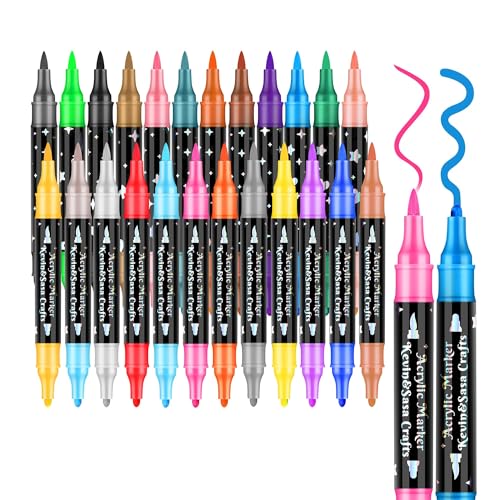
This 24-color set combines round and brush nibs, a pairing that supports both filling and expressive marks on wood. The clear nib-identification pattern can help distinguish the two ends while working. Its smaller palette than the other sets matters for projects with many distinct colors; for broad color variety, consider one of the 36- or 72-color sets instead.
Bottom line: Choose it for a straightforward round-and-brush pairing in 24 colors.
How to choose paint markers for wood
Tip shape is the first decision: fine nibs suit outlines, round nibs suit controlled fills, and brush nibs vary stroke width with pressure. A 1 mm tip is useful for small lettering, while a 1–5 mm nib spans detail and broader marks. Wood grain absorbs paint unevenly, so smooth, sealed wood generally allows cleaner lines than rough unfinished boards. For textured wood, favor a broader nib for fills and reserve fine tips for flatter areas. Color count matters most when a design uses many distinct shades; a small palette is easier to manage for simple motifs.
Before decorating a finished piece, try a small hidden area: surface color and texture can change apparent coverage, especially with opaque paint over dark wood.
Paint marker tips for wood projects
Tip geometry changes both line character and control. Fine tips are for lettering and edges; round tips make consistent marks; brush tips flex for calligraphy-like strokes; dot tips make patterned accents. A flexible brush tip can create broad strokes with pressure, but a rigid fine nib is easier to steer for uniform narrow lines. Paint markers are not interchangeable with ordinary ink markers: acrylic paint is a pigmented coating that sits on the surface rather than soaking in like dye.
Match the nib to the smallest mark the design needs, then use a wider nib for larger fills. The following table maps common tasks to the useful tip style.
| Wood project task | Useful tip | Reason |
|---|---|---|
| Small lettering or outlines | Fine | Supports narrow, controlled marks |
| Broad fill areas | Round or brush | Covers more surface per stroke |
| Decorative repeated dots | Dot | Creates rounded accents |
| Variable calligraphic strokes | Brush | Flexes with pressure |
Preparing wood before marking
Surface preparation affects line quality: dust and loose fibers can catch on a nib, while rough grain can break thin lines. Wipe away dust and work on a dry surface; a light sanding with fine paper, often 180–220 grit for craft wood, can smooth raised fibers before decorating. Test a hidden spot first because raw, dark, or textured wood may absorb paint differently from a smooth light surface. If the design needs crisp edges, plan the fine details for the smoothest area and use broader marks where grain is more visible.
Paint markers can stain clothing and nearby surfaces, and acrylic paint is difficult to remove once dry. Protect the work area, keep caps secured between colors, and avoid using markers on food-contact surfaces unless the product is explicitly rated for that use.
Keeping paint marker lines clean
Clean lines come from controlled strokes and matching tip size to the mark: use light pressure with a fine tip and avoid dragging a nib sideways across rough grain. Let each color dry before placing a neighboring color over it; fast-drying paint still needs time to set on porous wood. Layering too soon can lift or smear the first stroke. For large areas, make overlapping passes while the paint edge is still workable rather than leaving patchy gaps to touch up later.
Store markers capped and follow the maker’s prep guidance for that set. Water-based paint can dry at the nib if left uncapped, and a blocked tip may produce broken lines rather than smooth coverage.
Frequently Asked Questions
Do acrylic paint markers work on unfinished wood?
Yes, acrylic paint markers can be used on wood, but unfinished grain may absorb paint unevenly. Test a hidden area first, especially on dark or coarse wood.
What marker tip is best for writing on wood?
A fine tip is usually the easiest choice for small lettering and outlines; 1 mm tips are suited to narrow detail work. Rough grain can interrupt fine lines, so use a smoother area for small text.
Should wood be sanded before using paint markers?
Sanding can reduce raised fibers that catch on a marker nib; fine paper around 180–220 grit is commonly used for craft wood smoothing. Remove dust and test a hidden spot before decorating.
How long should paint marker ink dry on wood?
Drying time varies with paint thickness, wood porosity, and room conditions, so allow each pass to dry before adding an adjacent color. Thin strokes generally set sooner than heavy fills.
Can paint markers be used on dark wood?
They can be used on dark wood, but color coverage may look different than on a light surface. Test the chosen color on an inconspicuous area before making the visible design.