
Best Perm for Color-Treated Hair: 4 Kits Compared

Ogilvie Precisely Right Conditioning Perm is the strongest match for most people seeking a perm for color-treated hair because it is specifically labeled for color-treated, thin, and delicate hair. Choose a different option if you need a formula specifically sold as a color-treated perm or if your hair is normal rather than delicate.
A home perm uses chemical solution to reshape hair into curls or waves; color processing can leave hair more vulnerable to breakage, so matching the kit to your hair’s current condition matters.
We earn a commission if you buy through links on this page. As an Amazon Associate I earn from qualifying purchases. Products are compared on manufacturer specifications, not hands-on testing.
- Best overall: Ogilvie Precisely Right Conditioning Perm – It explicitly targets color-treated, thin, and delicate hair and includes a heat-activated formula.
- Best for a color-perm label: Zotos Texture EFX Color Perm – Its name directly identifies it as a color-treated perm.
- Best for delicate hair: Ogilvie Precisely Right Perm Kit – It is specifically marked for color-treated, thin, or delicate hair.
| Product | Best for | Hair type | Kit size | Special feature | Shop |
|---|---|---|---|---|---|
| Ogilvie Precisely Right Conditioning Perm | Thin delicate hair | Color-treated, thin, delicate | 1 application | Heat activator, drip guard | Check Price on Amazon |
| Zotos Texture EFX Color Perm | Color-treated hair | Color-treated | 1 count | — | Check Price on Amazon |
| Ogilvie Salon Styles Original Home Perm | Color-treated hair | Color-treated, thin, delicate | 2-piece kit | Drip guard, conditioners | Check Price on Amazon |
| Ogilvie Precisely Right Perm Kit | Delicate hair | Color-treated, thin, delicate | 5-piece set | — | Check Price on Amazon |
Perms for Color-Treated Hair
Start with the hair type each formula is intended for, then weigh kit format and included features.
Ogilvie Precisely Right Conditioning Perm

Ogilvie Precisely Right Conditioning Perm combines a color-treated label with suitability for thin or delicate hair, making it a more targeted match than a formula identified only by treatment status. The kit is intended for one application and its features include a heat activator and drip guard. That combination may suit someone looking for a home kit with a mess-control feature, but the maker does not establish how strongly it curls or how long results last. Hair that is highly damaged or breaking needs professional assessment before any chemical service.
Bottom line: Choose this if your color-treated hair is also thin or delicate.
Zotos Texture EFX Color Perm

Zotos Texture EFX Color Perm is the clearest match for shoppers prioritizing a product explicitly named as a color-treated perm. Its product name identifies the intended hair category, while the maker gives a single-count package and US country of origin. Unlike kits with a drip guard or heat activator, this one has no such feature in its product facts, so buyers who need a particular application aid should verify the package before ordering. It is a straightforward option when the color-treated designation is the main selection criterion.
Bottom line: Pick this when the color-treated perm label is your priority.
Ogilvie Salon Styles Original Home Perm

Ogilvie Salon Styles Original Home Perm distinguishes itself with before-and-after conditioners alongside a drip guard, while its product name targets color-treated, thin, or delicate hair. The package is identified as a 2-piece kit, and the product features describe lasting smooth curls and waves as the intended result. Those wanting conditioning pieces as part of the kit may prefer this format.
Bottom line: Choose this if included before-and-after conditioners matter to you.
Ogilvie Precisely Right Perm Kit
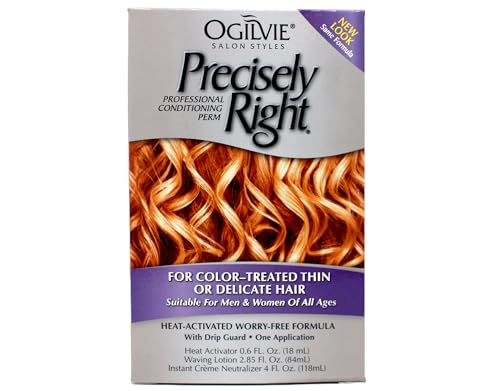
Ogilvie Precisely Right Perm Kit is a compactly described 5-piece set explicitly marked for color-treated, thin, or delicate hair. That labeling makes it relevant for shoppers comparing targeted formulas, while its kit size sets it apart from the single-count and 2-piece options. The facts do not identify an activator, drip guard, or conditioners, so buyers who specifically want those features should confirm the package contents before choosing. As with any perm, the delicate-hair designation does not establish that hair weakened by recent bleaching or breakage can safely tolerate processing.
Bottom line: Pick this when a multi-piece set for delicate hair fits your needs.
How to choose a perm for color-treated hair
Choose a formula labeled for color-treated hair, and narrow further by whether your strands are thin, delicate, or normal. Hair color and perming both involve chemical processing, so recent bleaching, repeated color services, dryness, or breakage can change the risk even when a kit carries a color-treated label. A strand test on a hidden section is a standard way to preview the hair’s reaction before a full application; do not proceed if the test section becomes gummy, unusually stretchy, or snaps. For visibly damaged or breaking hair, skip an at-home perm and ask a licensed stylist to assess it.
Perm solution type also matters: alkaline formulas generally process faster and suit resistant hair, while acid-balanced formulas are gentler and often used for fragile or color-treated hair. Verify the formula type on the package when this distinction is important.
What perm rods and curl sizes mean
Rod diameter largely sets the curl scale: smaller rods create tighter curls, while larger rods make looser waves. A practical decision rule is to choose rod size based on the finished look and your hair length, since longer hair wraps around more rod surface and can produce a looser-looking result than shorter hair on the same rod. Rods are commonly color-coded, but color codes are not universal across brands, so use diameter in inches rather than relying on rod color alone.
Wrapping tension matters as much as rod size. Hair should lie smoothly around each rod without painful scalp pulling or crimped ends; uneven sections can leave inconsistent curls. Follow the kit’s rod and sectioning guidance, and do not substitute extra processing time to compensate for a curl that looks loose while wet.
Color timing, strand testing, and safety
Do not perm hair on the same day as a color service; many stylists separate the chemical services by at least two weeks so the hair and scalp can recover. Exact timing depends on whether color was permanent, demi-permanent, or bleach, and on the hair’s condition. A strand test is especially important after lightening because bleached hair can be more porous and can overprocess faster than untreated hair.
Perm chemicals can irritate skin and eyes, so use gloves, keep solution away from the eyes, and work in a ventilated area. Never use a perm on hair that has been treated with metallic-salt color, and stop if burning or severe irritation occurs. A professional consultation is the safer choice when color history is unclear or hair is breaking.
Common mistakes with home perms
The most common mistake is treating every color-treated head as equally strong; fine, bleached, or repeatedly processed hair can react differently from a single-process color service. Another is choosing rods by the package photo rather than by finished curl size and hair length. A small rod makes a tighter curl, but tighter wrapping and excessive tension can stress fragile strands.
Keep application steps, timing, and neutralization within the kit’s directions; extending processing to force a stronger curl increases the chance of damage. Do not overlap perm solution onto previously permed lengths, since repeated chemical exposure can weaken the same section. If a test curl is weak, stop and consult a stylist instead of repeating the treatment immediately.
Frequently Asked Questions
How long should I wait after coloring before a perm?
A common salon precaution is to wait at least two weeks between a color service and a perm. Bleach, frequent color, and visible breakage can call for a longer wait or no perm at all.
Can bleached hair safely get a home perm?
Bleached hair is more porous and can overprocess faster than untreated hair, so a home perm is a high-risk choice on weakened strands. A stylist should assess it first, and a strand test that turns gummy or snaps is a reason to stop.
What rod size makes loose waves instead of tight curls?
Larger-diameter rods generally create looser waves, while smaller rods create tighter curls. Hair length and the amount wrapped around each rod also affect the finished curl scale.
How often should a permed color-treated hair be washed?
Many stylists recommend waiting about 48 hours after a perm before shampooing so the curl can settle. After that, a gentle shampoo and conditioner intended for chemically treated hair can help limit dryness.
Can perm solution be applied over previously permed hair?
Avoid overlapping perm solution onto already permed lengths because repeated chemical exposure can weaken them. Retouch applications are generally limited to new growth and are best handled by a stylist on fragile or color-treated hair.