
Best Polish for Plastic: 5 Options Compared by Use

The NOVUS Complete Plastic Care Kit suits most people because its three formulas cover routine cleaning plus fine and heavy scratch removal. For a single-step polish or targeted headlight care, choose a different formula based on the surface and the kind of correction you need.
We earn a commission if you buy through links on this page. As an Amazon Associate I earn from qualifying purchases. Products are compared on manufacturer specifications, not hands-on testing.
- Best overall: NOVUS Complete Plastic Care Kit – Three formulas address cleaning, fine scratches and heavier scratches in one kit.
- Best for headlights: Mothers PowerPlastic 4Lights – The ultra-fine polish is made for headlights and clear plastics and includes UV shields.
- Best for clear windows: Sumner Laboratories 210 Cleaner & Polish – The ammonia-free aerosol is made for acrylic and other clear panels and dries fast without streaks.
| Product | Best for | Format | Volume | Main purpose | Shop |
|---|---|---|---|---|---|
| NOVUS Complete Plastic Care Kit | Multi-step correction | 3 bottles plus towels | 8 oz each | Clean, fine and heavy scratches | Check Price on Amazon |
| Sumner Laboratories 210 Cleaner & Polish | Clear panels | Aerosol | 14 fl oz | Clean, polish and coat | Check Price on Amazon |
| NOVUS #1 Plastic Clean & Shine | Routine cleaning | Squeeze bottle | 8 oz | Clean and shine | Check Price on Amazon |
| Mothers PowerPlastic 4Lights | Headlight clarity | Polish | 8 oz | Clarify and UV shield | Check Price on Amazon |
| Griot’s Garage Plastic All-in-One | Vehicle plastics | Polish and protectant | 16 fl oz | Light correction and coating | Check Price on Amazon |
Plastic polishes compared
Match the formula to your plastic surface and whether your priority is cleaning, scratch correction or protective care.
NOVUS Complete Plastic Care Kit

The three-step lineup is the main distinction of NOVUS Complete Plastic Care Kit: it includes NOVUS #1 Plastic Clean & Shine, #2 Fine Scratch Remover and #3 Heavy Scratch Remover, each in an 8-ounce bottle, plus disposable Polish Mates towels. That range suits reusable acrylic surfaces when one product is not enough for both cleaning and different scratch levels. The maker says the system can remove scratches and abrasions from most acrylic surfaces and refresh faded plastic. The limitation is that this is a multi-product kit; someone who only needs routine cleaning may prefer a single formula.
Bottom line: Choose this if you want separate formulas for cleaning and two levels of scratch correction.
Sumner Laboratories 210 Cleaner & Polish

The ammonia-free aerosol format distinguishes Sumner Laboratories 210 Cleaner & Polish from the squeeze-bottle compounds and polish. Its 14-ounce formula is intended for acrylic, Plexiglas, Lexan, Lucite, polycarbonate, clear vinyl and isinglass, including windshields and visors. The maker says it dries fast without streaks and leaves an anti-static, anti-fog, fingerprint-resistant coating. It also targets grime, haze and residue such as crayon, marker and masking-tape adhesive. This is a cleaner-and-polish choice rather than a dedicated heavy-scratch compound, so choose another option when scratch correction is the priority.
Bottom line: Choose this for routine cleaning of clear panels and windshields.
NOVUS #1 Plastic Clean & Shine

For routine care without an abrasive compound, NOVUS #1 Plastic Clean & Shine is the single-formula choice in this group. The 8-ounce squeeze bottle is intended for plastic and acrylic, including shields, windshields, goggles and display surfaces. Its features say the formula contains no abrasives or harsh chemicals and leaves a smooth, greaseless shine with an anti-static, smudge-resistant coat. The maker also says it reduces haziness and resists fingerprints. Because it is the cleaning-and-shine step rather than a scratch-removal compound, it is not the right pick when deeper scratches need dedicated correction.
Bottom line: Choose this for regular cleaning and shine on plastic or acrylic.
Mothers PowerPlastic 4Lights

Headlight and clear-plastic care is the focus of Mothers PowerPlastic 4Lights, whose 8-ounce formula uses ultra-fine polishing action. Its features say it removes oxidation and haze, while oxidation-inhibiting polymers and UV shields help protect against sun damage and yellowing. The applications include headlight and taillight lenses, instrument panels, and hard or flexible clear plastics. That makes it a focused option for clarity and surface protection rather than a three-stage scratch-removal kit. Buyers seeking correction for heavier scratches should choose a product specifically offering a heavier scratch-removal step.
Bottom line: Choose this for oxidation and haze on headlights and clear plastic.
Griot’s Garage Plastic All-in-One
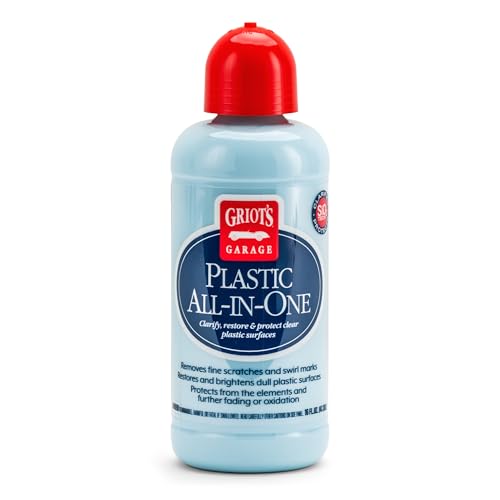
The 16-ounce size and combined polish-and-protection approach set Griot’s Garage Plastic All-in-One apart. Its features say tiny abrasives target yellowing, oxidation and light scratches, while SiO2 ceramic, resin and silane polymers create a protective layer intended to help resist yellowing, dullness, oxidation and water spots. The uses span vehicle lights, gauges, B-pillars, convertible-top windows, motorcycle windscreens and boat windows, with hand or polisher application. This option targets light correction and glossy plastic protection; it is not positioned as a heavy-scratch remover.
Bottom line: Choose this for light correction and protective care across vehicle plastics.
How to choose a plastic polish
Choose a plastic polish by the surface condition first: routine dust and fingerprints call for a cleaner, while visible abrasion calls for a scratch-removal compound. Polishing compounds use fine abrasives to level or refine the surface; a cleaner may remove grime and haze without correcting deeper scratches. A protectant can leave a coating, but it does not replace scratch correction. Match the product’s application to the plastic, especially for clear panels and windshields. For example, the options here range from a nonabrasive cleaning formula to a kit with separate fine- and heavy-scratch steps. If the plastic is cracked, deeply gouged or coated, polishing may not restore it; avoid aggressive correction until you know the surface can tolerate it.
Plastic polish types and uses
Plastic products fall into three useful groups: cleaners for routine soil, abrasive polishes for surface correction, and formulas that combine correction with a protective coating. The distinction matters because an abrasive can change a clear surface, while a cleaner is meant to lift residue rather than level scratches. A multi-step system separates scratch levels; an all-in-one product trades that separation for a single application. Use the comparison below to narrow the type by task, then confirm that the product is meant for your specific plastic surface.
| Need | Product type | Best match |
|---|---|---|
| Fingerprints and grime | Cleaner and shine formula | Nonabrasive cleaner |
| Fine surface marks | Fine abrasive polish | Scratch-removal formula |
| Oxidation plus ongoing protection | Polish with coating | All-in-one formula |
For light haze and routine cleaning, start with a cleaner; for a clearly visible scratch, choose an abrasive product explicitly intended for that level of correction.
How to polish clear plastic safely
Clean clear plastic before polishing because grit trapped under a cloth can add scratches. Use a clean, soft cloth and work a small, inconspicuous area first; this checks for a change in gloss or clarity before treating a larger surface. Keep the work area shaded and the surface cool, since direct heat can soften plastic and make polishing less predictable. Apply only the amount needed to cover a small area, then inspect under good light before repeating. Do not assume that every formula is suitable for coated lenses, tinted plastic or flexible windows. For vehicle lights, preserve the lens shape and surrounding trim, and stop if the surface becomes cloudy or develops visible distortion.
When plastic polish will not fix the problem
Polish is for surface soil, haze, oxidation or shallow marks; cracks, chips and deep gouges are different kinds of damage. A scratch that catches a fingernail is a practical signal to avoid aggressive DIY abrasion, especially on a windshield or safety shield where clear vision matters. Coatings can also change how a surface responds, so test a hidden spot before treating a coated, tinted or flexible panel. If a windshield or protective shield remains distorted after cleaning, replace or professionally assess it rather than relying on polish to restore safe visibility. Keep abrasive compounds away from neighboring painted, rubber or fabric surfaces unless the product is explicitly intended for them.
Frequently Asked Questions
Can plastic polish remove deep scratches?
Plastic polish is better suited to haze, oxidation and shallow surface marks than deep gouges. If a scratch catches a fingernail, avoid aggressive polishing on a clear windshield or shield because abrasion can leave optical distortion.
How do I know whether plastic polish is abrasive?
Check whether the formula is identified as a scratch remover or says it contains polishing abrasives; a nonabrasive cleaner is intended for soil and shine instead. Test an inconspicuous area first, since even fine abrasives can alter gloss.
Should I clean plastic before polishing it?
Yes, remove loose dirt first so grit does not get dragged across the surface by the polishing cloth. Use a clean, soft cloth and a compatible cleaner before applying an abrasive product.
Can I use plastic polish on headlights?
Use a formula whose applications include headlight lenses or clear plastics. Work on a cool lens, protect adjacent trim, and stop if the lens turns cloudy or distorted.
Does plastic polish protect against yellowing?
Some formulas include UV shields or protective polymers that the maker says help resist oxidation or yellowing; a basic cleaner may not provide that kind of coating. Verify that the product is intended for the plastic and exposure you need to address.