
Best Pond Clarifier Safe for Fish: 4 Options Compared

For most freshwater ponds, API ACCU-Clear 32 oz is the strongest fit because it clumps floating particles for filtration and treats up to 4,800 gallons per 32-ounce bottle. Choose an enzyme-based option instead if reducing organic buildup is your priority, or packets if you prefer a premeasured format.
Pond clarifiers either gather suspended particles so a filter or settling can remove them, or use enzymes to work on organic material. Always match the dose to pond volume and follow the product label; overdosing water treatments can stress fish.
We earn a commission if you buy through links on this page. As an Amazon Associate I earn from qualifying purchases. Products are compared on manufacturer specifications, not hands-on testing.
- Best overall: API ACCU-Clear 32 oz – Clumps floating particles for filter removal and treats up to 4,800 gallons.
- Best for enzyme treatment: AquaDoc Enzyme Pond Clarifier 32 oz – Uses an enzyme formula and is designed for fish and plant life.
- Best for premeasured packets: Natural Pond Water Cleaner 12 Packets – Provides 12 water-soluble packets for simple application.
| Product | Best for | Format | Application | Shop |
|---|---|---|---|---|
| API ACCU-Clear 32 oz | Filter-assisted clearing | Liquid | Weekly or as needed | Check Price on Amazon |
| AquaDoc Enzyme Pond Clarifier 32 oz | Enzyme-based care | Liquid | — | Check Price on Amazon |
| API POND SIMPLY CLEAR 16 oz | Two-week routine | Liquid | Every two weeks | Check Price on Amazon |
| Natural Pond Water Cleaner 12 Packets | Premeasured packets | Water-soluble packets | Packet application | Check Price on Amazon |
Pond Clarifiers Safe for Fish
Compare how each formula handles cloudy water and which application style matches your pond routine.
API ACCU-Clear 32 oz
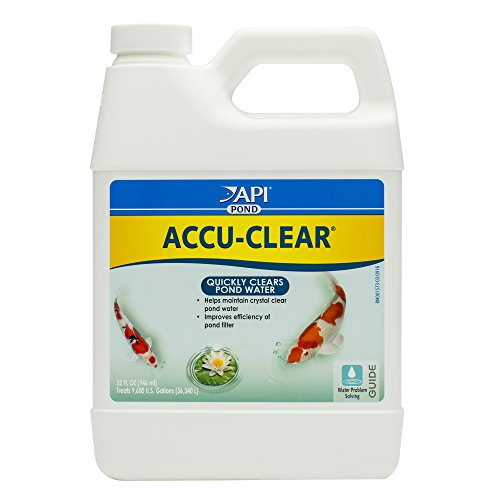
API ACCU-Clear 32 oz is the clearest choice when a pond has a working filter, because the formula gathers suspended dirt, silt, and floating particles into clusters the filter can capture. The 32-ounce bottle covers up to 4,800 gallons, and the maker says it is safe for pets and surrounding wildlife when used as directed. Use it weekly or when freshwater pond water turns cloudy. This approach depends on filtration: clumped material still needs to be removed, so it is a weaker fit if the filter is undersized, clogged, or absent.
Bottom line: Choose it for cloudy freshwater ponds with a functioning filter and a need-based or weekly routine.
AquaDoc Enzyme Pond Clarifier 32 oz

AquaDoc Enzyme Pond Clarifier 32 oz stands apart from particle-clumping formulas by using an enzyme approach for cloudy water and sludge in fish ponds. It is described as suitable for indoor and outdoor ponds, and the maker says it is designed not to affect fish or plant life. That makes it a relevant option for koi keepers who want an alternative to a conventional clarifier. The product facts do not give a treatment volume or application interval, so pond owners who need a precise dose schedule should confirm both on the container before use.
Bottom line: Choose it when an enzyme formula for fish and plant life is the priority.
API POND SIMPLY CLEAR 16 oz

API POND SIMPLY CLEAR 16 oz differs by pairing particle clumping with breakdown of dead algae, sludge, and fish waste in one solution. It is formulated for freshwater ponds, fish, plants, pets, and surrounding wildlife, and the maker recommends use every two weeks. That schedule may suit a pond owner seeking a regular maintenance product rather than applying only when cloudiness appears. The 16-ounce package has no gallon coverage figure in the product facts, so buyers dosing a particular pond volume should verify the label rate before choosing it.
Bottom line: Choose it for a freshwater pond where a two-week maintenance cadence fits.
Natural Pond Water Cleaner 12 Packets

Natural Pond Water Cleaner 12 Packets offers a packet format rather than a pourable bottle: each of the 12 water-soluble packets is premeasured and tossed directly into the water. Its formula is intended to gather fine floating particles so they settle naturally, which makes it distinct from products relying on a pond filter to capture clumps. The maker describes it as not harming fish or aquatic life.
Bottom line: Choose it if premeasured, direct-to-water packets suit your maintenance routine.
How to choose a fish-safe pond clarifier
Choose by the material causing cloudiness and by how the treatment removes it. Particle flocculants bind fine suspended matter into larger clusters; a functioning filter can then capture those clusters, while a packet that promotes settling relies on solids dropping out of the water. Enzyme treatments are aimed at organic matter such as sludge or excess nutrients rather than simply clumping mineral silt. For fish ponds, calculate pond volume before dosing: rectangular ponds use length × width × average depth × 7.48 for gallons, with all dimensions in feet. Do not choose a treatment by surface area alone if the pond is deep; match the label dose to the full water volume.
What cloudy pond water needs
Cloudiness is not one problem, so look at what is suspended before selecting a clarifier. Silt and fine dirt often call for particle aggregation plus filtration or settling; decaying leaves and fish waste point toward removing debris and managing organic load. A clarifier cannot replace mechanical filtration: clean clogged filter media and remove accumulated solids so captured material does not return to circulation. If fish gasp at the surface or water quality changes suddenly, do not treat clarity as the only issue; check dissolved oxygen and ammonia, since fish stress can be a water-quality problem rather than a visibility problem. Avoid mixing multiple water treatments unless their labels explicitly permit it.
Clarifier formats and removal methods
Liquid, enzyme, and packet formats differ in what they target and how buyers dose them. The table compares the mode of action, not a promise that one approach works in every pond.
| Approach | What it targets | Removal path |
|---|---|---|
| Particle clumping | Suspended dirt, silt, or particles | Filter capture or settling |
| Enzyme formula | Organic particles, sludge, or nutrients | Biological breakdown |
| Premeasured packet | Fine floating particles | Natural settling |
Mechanical filters commonly use coarse media first and finer media after it; a clogged fine stage can limit removal even when particles have been gathered. Skimming leaves and vacuuming pond-bottom debris reduce the material that clarifiers need to handle.
Dosing and fish safety
Use a measured pond volume and the package dose rather than estimating by pond appearance. A treatment intended for a 1,000-gallon pond can be overdosed quickly in a small ornamental pond, so estimate average depth rather than using the deepest point. Keep aeration running during treatment: warm water holds less oxygen, and fish and beneficial microbes consume oxygen as organic matter breaks down. Never pour concentrated treatment onto fish or plants, and do not combine clarifiers with algaecides or other pond chemicals unless both labels allow it. If the pond has fish, stop and verify the correct dose when the label does not clearly cover the species or water volume.
Frequently Asked Questions
How do I calculate my pond volume for dosing?
For a rectangular pond, multiply length, width, and average depth in feet, then multiply by 7.48 to estimate gallons. For a round pond, use 3.14 × radius squared × average depth, then multiply by 7.48. Estimate average depth rather than treating the deepest point as the whole pond.
Can I use clarifier in a pond with koi?
Use only a product whose label explicitly permits use with fish, and dose by the pond’s measured volume. Keep aeration operating, because warm water and organic breakdown can leave less dissolved oxygen available to koi.
How long does pond clarifier take to work?
Timing depends on the treatment method, suspended material, and filtration or settling conditions. A particle-clumping product needs time for clusters to form and then be captured or settle; remove settled debris rather than leaving it to circulate again.
Should I clean the filter after clarifying pond water?
Check and clean the filter when it captures clumped particles, because accumulated solids can restrict flow and reduce removal. Rinse biological filter media in pond water rather than chlorinated tap water to avoid damaging beneficial bacteria.
Can I add pond clarifier and algaecide together?
Do not combine the products unless both labels explicitly permit it. Algae die-off can consume oxygen as it decomposes, so maintain aeration and address debris before applying another treatment.