
Best Pop-Up Wallets: 5 Slim Card Holders Compared

Aluminum Pop-Up Wallet with Backplate suits most people because its aluminum card chamber and expandable backplate are designed to hold up to 12 cards in a 0.5-inch-thick body. Choose another option if you want a leather bifold, one or two ID windows, or a money clip alongside the pop-up chamber.
Pop-up wallets use a button or slider to raise cards in a stepped stack, while some add a cover or extra pockets for cash and identification.
We earn a commission if you buy through links on this page. As an Amazon Associate I earn from qualifying purchases. Products are compared on manufacturer specifications, not hands-on testing.
- Best overall: Aluminum Pop-Up Wallet with Backplate – Combines an aluminum pop-up chamber with an expandable backplate for up to 12 cards.
- Best for extra cards: SEMORID Pop-Up Bifold Wallet – Its 12–14-card capacity includes leather slots and a clear ID window.
- Best for two IDs: KAFELLON Pop-Up Wallet with Money Clip – Adds two ID windows and a rear money clip to its pop-up card chamber.
| Product | Best for | Card capacity | Thickness | Extra storage | Shop |
|---|---|---|---|---|---|
| Aluminum Pop-Up Wallet with Backplate | Slim card carry | Up to 12 cards | 0.5 in | Expandable backplate | Check Price on Amazon |
| Leather RFID Bifold with Pop-Up Chamber | Leather bifold | Up to 12 cards | 0.55 in | Cash slot, ID window | Check Price on Amazon |
| SEMORID Pop-Up Bifold Wallet | High card capacity | 12–14 cards | 0.78 in | ID window, cash slot | Check Price on Amazon |
| RUNBOX Magnetic Pop-Up Bifold | Magnetic closure | 11–13 cards | 0.8 in | ID window, cash compartment | Check Price on Amazon |
| KAFELLON Pop-Up Wallet with Money Clip | Two ID windows | 10–12 cards | 0.6 in | Two ID windows, money clip | Check Price on Amazon |
Best pop-up wallets
Compare card capacity, profile and added storage to match a pop-up wallet to what you carry.
Aluminum Pop-Up Wallet with Backplate

Aluminum Pop-Up Wallet with Backplate combines a pop-up aluminum chamber with an expandable metal backplate, giving it a different storage layout from the covered bifolds. The chamber holds 4–6 cards and the backplate adds room for 5–6 more; capacity depends on card thickness and embossing. Its dimensions are 3.9 × 2.5 × 0.5 inches, and the maker says its aluminum construction blocks RFID and NFC signals. This layout suits someone who wants a compact metal holder without leather pockets. The limitation is that the design offers no listed ID window or dedicated cash slot, so those features matter to buyers who carry bills or need quick visual ID access.
Bottom line: Pick this if you want an aluminum pop-up chamber with an expandable backplate.
Leather RFID Bifold with Pop-Up Chamber

Leather RFID Bifold with Pop-Up Chamber adds a water-resistant leather cover to its metal pop-up chamber, unlike the more exposed metal-first designs. Its aluminum case holds up to 6 cards, while the leather cover provides space for 3–4 more; the product name gives an overall capacity of 10–12 cards. The 0.55-inch-thick body measures 4.25 × 3.1 inches, and the maker specifies a cash slot and built-in ID window. This is a fit for someone who wants the pop-up mechanism inside a bifold-style wallet. The chamber and cover counts do not fully explain the named total capacity, so confirm the needed card count and pocket fit before choosing.
Bottom line: Choose this if a leather bifold cover and cash storage are priorities.
SEMORID Pop-Up Bifold Wallet

SEMORID Pop-Up Bifold Wallet has the highest capacity in this group, with room for 12–14 cards across its aluminum case and leather slots. The maker specifies 6–8 cards in the case and six more in the leather portion, which includes a clear ID window. A cash slot is sized for 10–15 bills, adding a specific cash-carry option beyond the other designs. Its thickness is 0.78 inches, so this choice is better suited to buyers who prioritize extra card and bill storage over the thinnest profile. The capacity and bill count depend on what you carry; a full set of cards and bills can make a wallet harder to fit comfortably in a tight pocket.
Bottom line: Pick this if you carry more cards and want a separate cash slot.
RUNBOX Magnetic Pop-Up Bifold

RUNBOX Magnetic Pop-Up Bifold combines a magnetic flip cover with a side-button pop-up chamber, making its closure the main distinction from the other wallets. It is designed to hold 11–13 cards, including one clear ID window, plus a full-length cash compartment. The product identifies 6063 aluminum and carbon fiber fabric as materials, and its dimensions are 4.2 × 2.8 × 0.8 inches. The maker says the mechanism has been tested for more than 10,000 cycles. This configuration suits someone who wants a covered bifold and a full-length place for cash. At 0.8 inches thick, it is not the thinnest option here, which may matter when front-pocket space is limited.
Bottom line: Choose this if a magnetic cover and full-length cash compartment suit your carry.
KAFELLON Pop-Up Wallet with Money Clip
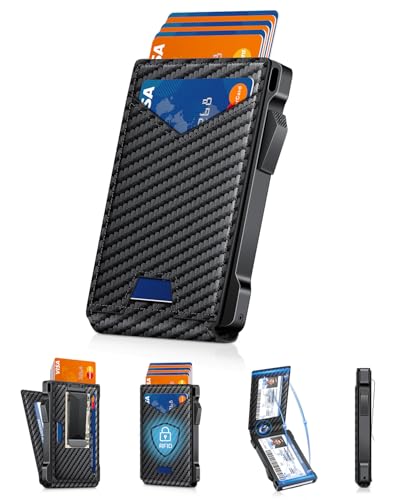
KAFELLON Pop-Up Wallet with Money Clip is the only option here with two ID windows and a rear money clip, so it fits a carry style that separates visible IDs from folded bills. Its aluminum chamber holds 6–8 cards, while the leather flap holds four, including the two ID windows; the product name gives a total capacity of 10–12 cards. The clip is designed for 10 or more bills, and the profile is 4.13 × 2.56 × 0.6 inches. This wallet suits someone who routinely needs two IDs and prefers a clip over a bill pocket.
Bottom line: Pick this if two ID windows and a rear money clip match your routine.
How to choose a pop-up wallet
Choose by the cards, cash and IDs you actually carry, not the largest headline capacity. These wallets combine a button-operated metal chamber with add-ons such as leather slots, cash pockets, ID windows or clips; those extras change both storage and bulk. Separate embossed cards from flat cards when estimating chamber fit, because raised numbers take more room. If you carry fewer than six cards, a chamber sized for 4–6 may be enough; if you need more, check how many cards the secondary pockets add. Match the wallet’s thickness to your pocket: a 0.5-inch body is a slimmer starting point than a 0.78- or 0.8-inch bifold, especially once filled. A bill slot or clip is useful only if you regularly carry cash.
| Carry need | Useful feature |
|---|---|
| Mostly cards | Pop-up chamber |
| Cards plus folded bills | Cash slot or full-length compartment |
| Two frequently shown IDs | Two ID windows |
| Cards plus clipped bills | Rear money clip |
Card capacity and pocket fit
Card capacity is an estimate, because embossed cards are thicker than flat ones and leather pockets stretch differently from a rigid metal chamber. Count the cards you plan to carry, including any ID in a window, then leave some room rather than loading every slot to its maximum. Wallet thickness also changes with contents: a 0.5-inch empty profile does not guarantee the same thickness when packed. For a front pocket with less than 1 inch of spare space, prioritize a thinner body and fewer extra layers; if you carry a larger stack, test the pocket fit before relying on the slim profile. Avoid forcing cards into a chamber or overfilling a cover, which can interfere with retrieval and closure.
Pop-up chambers, RFID blocking and contactless cards
A pop-up mechanism raises cards into a stepped stack so you can select one without pulling each card out separately. Metal chambers and leather covers are separate design choices: a chamber organizes the cards, while a cover adds pockets or a closing flap. RFID-blocking claims concern radio-frequency communication with cards, not every form of payment security; they do not replace keeping a card physically secure. A contactless card generally needs to be removed from a blocking chamber to communicate with a reader. Keep contactless cards in the intended chamber or another secure pocket, and take out only the card you are using. A separate ID window may make an ID easier to show, but check whether the window itself sits inside the metal chamber or in the cover.
Common pop-up wallet buying mistakes
The most common mistake is treating total capacity as the number of cards that fit in the metal chamber. Many hybrid wallets split storage between the chamber and leather or fabric pockets, and the chamber may hold only 4–8 cards. A second mistake is assuming every wallet has a cash pocket: some use a money clip, while others have a slot or full-length compartment. Check the outer dimensions against your pocket, not just the word “slim,” and note whether height, width and thickness are all supplied. If access to two IDs is important, choose a design that explicitly has two windows rather than expecting a single window to do both jobs. Keep sharp keys separate from exposed cards and avoid overloading the eject mechanism.
Frequently Asked Questions
How many cards fit in a pop-up wallet?
Many pop-up chambers hold about 4–8 cards, while hybrid wallets add capacity through separate slots. Embossed cards take more room, so use the chamber count rather than the combined headline capacity when planning what fits in the metal case.
Do pop-up wallets work with contactless cards?
Yes, contactless cards can be used after they are removed from an RFID-blocking metal chamber. The card needs to communicate with the payment terminal, so take it out before tapping.
Are pop-up wallets thicker when fully loaded?
Yes, added cards and bills increase the effective thickness beyond the empty-wallet measurement. Leather slots and cash compartments add layers, so compare the profile with the space available in your pocket.
Can a pop-up wallet hold folded cash?
Some do, but the storage varies by design: a wallet may use a cash slot, a full-length compartment or a money clip. Check which format suits your bills, since a clip holds bills externally rather than enclosing them.
What makes cards difficult to eject from a pop-up wallet?
An overfilled chamber or unusually thick embossed cards can make the stack harder to move. Stay within the chamber’s card capacity and avoid forcing cards into it.