
Best Puzzles for 6 Year Olds: 5 Picks Compared

Buffalo Games Pokémon Fan Favorites, 100 Piece is a strong starting pick for most six-year-olds because its 100 pieces come with a full-color poster guide to help with assembly. Choose a different puzzle if the child prefers geography, underwater art, unicorns or Minecraft, or if a larger floor puzzle suits the space better.
We earn a commission if you buy through links on this page. As an Amazon Associate I earn from qualifying purchases. Products are compared on manufacturer specifications, not hands-on testing.
- Best overall: Buffalo Games Pokémon Fan Favorites, 100 Piece – Its 100 pieces are paired with a full-color poster guide for assembly.
- Best for geography: United States Map Floor Puzzle, 70 Piece – The 70-piece map shows all 50 states, capitals, landmarks and landscapes.
- Best for Minecraft fans: Ravensburger Monster Minecraft, 100 Piece XXL – It combines Minecraft monster imagery with XXL pieces.
| Product | Best for | Piece count | Finished size | Theme or aid | Shop |
|---|---|---|---|---|---|
| Buffalo Games Pokémon Fan Favorites, 100 Piece | Guided beginners | 100 pieces | — | Pokémon; bonus poster | Check Price on Amazon |
| Ravensburger Glitter Unicorn, 100 Piece | Unicorn fans | 100 pieces | 19 x 14 in | Glitter unicorn | Check Price on Amazon |
| United States Map Floor Puzzle, 70 Piece | Geography learners | 70 pieces | 23.6 x 17 in | U.S. map; state-shaped pieces | Check Price on Amazon |
| Underwater World, 100 Piece | Underwater art | 100 pieces | 15.75 x 11 in | Underwater scene | Check Price on Amazon |
| Ravensburger Monster Minecraft, 100 Piece XXL | Minecraft fans | 100 pieces | 20 x 14 in | Minecraft monsters; XXL pieces | Check Price on Amazon |
Best puzzles for 6 year olds
Compare piece counts, completed dimensions and artwork to find a puzzle that matches the child’s interests and experience.
Buffalo Games Pokémon Fan Favorites, 100 Piece

The Pokémon scene and included full-color poster distinguish this 100-piece jigsaw from the other picks. Buffalo Games says its precision-cut pieces use a “Perfect Snap” fit, and the poster gives a child a visual reference while assembling the image. It suits a six-year-old who enjoys Pokémon and is ready for a moderate piece count with guidance. The box dimensions are not the finished puzzle size, so this is less useful when a particular completed footprint is essential; choose by theme and piece count instead.
Bottom line: Pick this for a Pokémon fan who would benefit from a picture guide.
Ravensburger Glitter Unicorn, 100 Piece
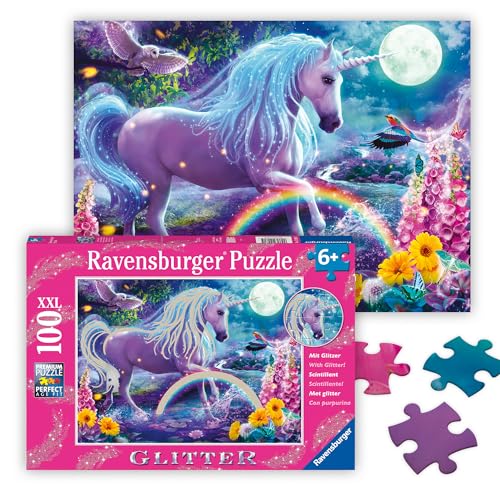
The glittery unicorn image and 19-by-14-inch finished size set this puzzle apart from the other 100-piece choices. Its theme is a natural match for a child drawn to magical artwork, and the completed dimensions provide a useful sense of the workspace needed. The product name gives an age 6+ recommendation, while its features also refer to older children; age labels are guidance rather than a measure of an individual child’s puzzle experience. Consider a different theme if the child prefers maps, Pokémon or Minecraft.
Bottom line: Choose this when unicorn art is the main draw and the 19-by-14-inch finished size fits.
United States Map Floor Puzzle, 70 Piece

The 70-piece count and large, state-shaped pieces make this U.S. map puzzle different from the standard 100-piece jigsaws. It finishes at 23.6 by 17 inches and the colorful illustration includes all 50 states, capitals, landmarks and landscapes. That makes it a fit for children interested in maps or for a family activity with room to work on the floor or a large table. The larger assembled footprint needs more open space than the smaller-format puzzles, so measure the play area first.
Bottom line: Pick this for a child interested in U.S. geography and with floor space to assemble it.
Underwater World, 100 Piece

The 15.75-by-11-inch finished size makes this 100-piece underwater scene more compact than the map and unicorn puzzles. The artwork is described as a prehistoric landscape, so it may appeal to a child who likes underwater or ancient-world imagery. The maker says the pieces have processed corners, and the product is presented for ages 4–8. Its main limitation is the 100-piece challenge for a child still building puzzle confidence; an adult can help sort pieces or begin with the edges.
Bottom line: Choose this for a child drawn to underwater imagery and a compact finished puzzle.
Ravensburger Monster Minecraft, 100 Piece XXL

XXL pieces and Minecraft monster imagery distinguish this jigsaw from the other 100-piece picks. It completes at 20 by 14 inches and features characters including creepers, skeletons and zombies. Its game-inspired picture is the key reason to choose it; children who prefer softer or non-game artwork may be better suited to another theme.
Bottom line: Pick this for a Minecraft fan who wants larger pieces and a monster scene.
How to choose a puzzle challenge for a six-year-old
For many six-year-olds, 70 to 100 pieces is a practical range to compare, but familiarity with jigsaws matters as much as age. A child new to puzzles may find a lower count or a picture guide easier to manage; a practiced child may enjoy sorting and assembling 100 pieces. Look for artwork with recognizable subjects and clear color regions, which can make it easier to group pieces before assembly. A useful rule: if the child usually finishes a 48-piece puzzle without help, try a 70-piece option; move toward 100 pieces when that feels comfortable. Age labels are estimates, not a guarantee that every child will find the same count easy.
How much space a finished puzzle needs
Measure the intended surface before opening a puzzle, because finished dimensions can be much larger than the box. The map puzzle measures 23.6 by 17 inches when assembled, while the unicorn puzzle finishes at 19 by 14 inches and the underwater design at 15.75 by 11 inches. Leave extra working room around the image for sorting loose pieces; a few inches on each side makes it easier to keep groups separate. Choose a floor puzzle when a large floor area is available, and use a table or puzzle mat if the work needs to be moved. Do not treat package measurements as the completed footprint.
Ways to make a jigsaw manageable
Start with a stable, well-lit surface and keep the box or a picture reference nearby. Sorting edge pieces first is a common approach: connect the straight borders, then group remaining pieces by color or recognizable objects. A guide poster can reduce guesswork, while distinct landmarks or characters can create smaller subassemblies. For a child who gets frustrated, work in short sessions and let them choose a small section rather than insisting on finishing at once. Keep puzzle pieces away from younger children who may mouth small objects; supervise shared play when children under three are nearby.
Frequently Asked Questions
How many puzzle pieces suit a six-year-old?
A range of about 70 to 100 pieces is a useful starting point for many six-year-olds. A child new to jigsaws may prefer fewer pieces or a picture guide, while puzzle experience can make 100 manageable.
What puzzle size fits on a small table?
Check the assembled dimensions, not the package size. For example, a 15.75-by-11-inch finished puzzle needs less table area than a 23.6-by-17-inch floor puzzle, with additional room helpful for sorting.
Should a child start with the edge pieces?
Starting with edge pieces is a common strategy because the straight borders define the puzzle’s outline. After the frame, sorting by color or recognizable objects can help organize the remaining pieces.
Are puzzle age recommendations exact?
No; age recommendations are general guidance, and puzzle experience changes how challenging a count feels. If a child finishes 48 pieces comfortably, a 70-piece puzzle is a reasonable next step to try.
How should families store an unfinished puzzle?
A puzzle mat or a flat, protected board can keep an unfinished puzzle together between sessions. Keep loose pieces out of reach of children under three, who may put small objects in their mouths.