
Dremel Bits for Aluminum: 4 Carbide Sets Compared

For most aluminum work, choose Sworker Aluminum-Cut Carbide Burrs, 10-Piece because its wide-flute cut is specifically designated for aluminum and its 1/8-inch shank matches many small rotary tools. Choose a different set if you need a larger assortment of burr shapes or a particular burr profile; secure the workpiece and wear eye protection whenever you cut metal.
We earn a commission if you buy through links on this page. As an Amazon Associate I earn from qualifying purchases. Products are compared on manufacturer specifications, not hands-on testing.
- Best overall: Sworker Aluminum-Cut Carbide Burrs, 10-Piece – Its wide-flute cut is designated for aluminum, and the 1/8-inch shank suits compatible small rotary tools.
- Best for carving: Tungsten Carbide Double-Cut Burrs, 10-Piece – The set gives 10 double-cut burrs with 1/4-inch cutting diameters and 1/8-inch shanks.
- Best for more shapes: 20-Piece Double-Cut Carbide Burr Set – The 20-piece assortment is described for aluminum and other materials and uses a 3.175 mm shank.
- Best for double-cut finish: 10-Piece Double-Cut Carbide Burrs – The 10-piece tungsten carbide set pairs a double-cut design with a 1/8-inch shank.
| Product | Best for | Set count | Shank diameter (mm) | Cut style | Shop |
|---|---|---|---|---|---|
| Tungsten Carbide Double-Cut Burrs, 10-Piece | General carving | 10 pieces | 3.175 mm | Double cut | Check Price on Amazon |
| Sworker Aluminum-Cut Carbide Burrs, 10-Piece | Aluminum shaping | 10 pieces | 3 mm | Wide flute | Check Price on Amazon |
| 20-Piece Double-Cut Carbide Burr Set | Shape variety | 20 pieces | 3.175 mm | Double cut | Check Price on Amazon |
| 10-Piece Double-Cut Carbide Burrs | Smoother cuts | 10 pieces | 3.175 mm | Double cut | Check Price on Amazon |
Dremel Bits for Aluminum
Match the cut style and shank to your tool, then choose a set based on the burr shapes and quantity you need.
Tungsten Carbide Double-Cut Burrs, 10-Piece

With 1/4-inch cutting diameters, these 10 tungsten carbide burrs suit carving and material removal where a larger cutting head is useful. The set has 1/8-inch shanks and a 45–50 mm total length; its crossed grooves are intended for materials including aluminum, wood and plastic. A three-jaw chuck is another compatible holder mentioned for the shank. The limitation is the fixed 1/4-inch cutting diameter, so buyers needing smaller heads for very fine detail should choose a different profile. Use light pressure and clear chips often to help keep aluminum from loading the cutting edges.
Bottom line: Pick this set when 1/4-inch cutting heads fit your carving or removal task.
Sworker Aluminum-Cut Carbide Burrs, 10-Piece
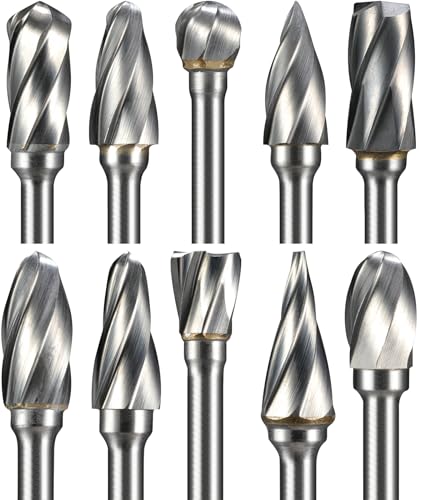
The wide-flute aluminum-cut geometry is the clearest match here for shaping aluminum with a small rotary tool. The set includes 10 tungsten carbide burrs with 3 mm shanks, compatible with tools that accept 1/8-inch bits, plus a clamshell case. The maker recommends high-speed rotary tools and says not to use low-speed drills; it also reserves heavy material removal for larger-shank burrs and 500W-or-higher tools. That limitation matters if you need to remove substantial stock: this small-shank set is positioned for detail work in tight spaces, not heavy removal.
Bottom line: Choose it for aluminum detail work when your tool accepts a 1/8-inch shank.
20-Piece Double-Cut Carbide Burr Set

The 20-piece assortment stands out for offering more burrs than the 10-piece sets, making it useful when you want a broader range of shapes for carving, grinding, engraving or deburring. Its double-cut tungsten carbide bits have 3.175 mm shanks, the same nominal size as 1/8 inch, and the maker identifies aluminum among the intended materials. High-speed rotary tools are described as optimal; a three-jaw-chuck drill is possible but not optimal. The limitation is that no particular flute style is singled out for aluminum, so buyers prioritizing aluminum-cut geometry should consider a wide-flute set instead.
Bottom line: Pick this assortment when having 20 burrs matters more than an aluminum-specific flute style.
10-Piece Double-Cut Carbide Burrs

The double-cut design is the defining feature of this 10-piece tungsten carbide set, which the maker says produces a finer finish and smaller chips than a single-cut burr. The use includes aluminum, and the set is sized for rotary tools that accept 1/8-inch shanks. This makes it a fit for controlled carving or grinding where chip size and finish matter. Its limitation is that no head diameter or total length is provided in the specifications, so buyers who need a specific reach or cutting-head size should confirm that fit before ordering.
Bottom line: Choose it when double-cut burrs and a 1/8-inch shank suit the job.
How to choose Dremel bits for aluminum
For aluminum, start with a burr whose cut geometry is intended for the material, then match its shank to the rotary tool collet. Wide-flute aluminum-cut burrs are designed to clear soft, gummy chips more readily than a general-purpose geometry. Double-cut burrs create smaller chips and can leave a finer cut than single-cut burrs. A 1/8-inch shank is a common rotary-tool size, but compatibility still depends on the tool and collet. For detail work, choose a small-shank burr; when substantial stock removal is needed, use a tool and burr specifically suited to heavier work rather than forcing a small rotary tool. Keep the workpiece secured and feed the burr steadily without leaning hard on it.
Shank fit and burr size
A 1/8-inch shank measures 3.175 mm, while a 3 mm shank is slightly smaller; verify that the collet securely grips the actual shank size. Do not assume every tool that accepts a nominal 1/8-inch bit will clamp every near-size shank equally well. Burr head diameter and reach also affect access: a larger head removes material across a wider area, while a smaller head can reach tighter features. Check the collet range and available clearance before choosing a burr. A 1/4-inch shank is for compatible larger rotary or die grinders, not a standard 1/8-inch rotary-tool collet. Never modify or force a mismatched shank into a collet.
The common choices break down by cut style and tool fit:
| Need | Choice | Fit check |
|---|---|---|
| Aluminum detail shaping | Wide-flute aluminum-cut burr | Confirm the shank fits the collet |
| Finer cut or smaller chips | Double-cut burr | Match head size to clearance |
| Heavy stock removal | Larger-shank burr and suitable tool | Confirm tool compatibility and power |
Using carbide burrs on aluminum safely
Carbide burrs cut metal by removing chips, so flying particles and a spinning tool are the main hazards: wear eye protection, secure the workpiece, and keep hands and loose clothing clear. Aluminum chips can pack into the flutes, especially when the burr is pushed too hard or allowed to dwell in one spot. Use light, steady contact and stop to clear a loaded burr rather than increasing pressure. A high-speed rotary tool is recommended for some small-shank sets, but the suitable speed depends on the tool, burr and work; do not use a low-speed drill where the burr maker advises against it. Keep the burr aligned and avoid side-loading the shank.
Keeping aluminum burrs cutting cleanly
Clean a burr when aluminum begins sticking to its flutes, since packed chips reduce cutting action and can make the tool grab. Stop the rotary tool and let it come to a complete stop before brushing debris from the cutting head. Inspect the carbide edges and shank for chips, cracks or looseness before each job; a damaged burr should not be used. Store burrs so their cutting heads do not strike one another, and keep metal chips away from the collet. Aluminum dust and chips should be collected promptly rather than left around the work area, where they can interfere with tool control or enter other equipment.
Frequently Asked Questions
Can a Dremel rotary tool cut aluminum with carbide burrs?
Yes, a compatible carbide burr can shape or deburr aluminum. Match the shank to the collet, use light contact, and wear eye protection because metal chips can be ejected.
What shank size fits a typical small rotary tool?
A 1/8-inch shank, equal to 3.175 mm, is a common small rotary-tool size. Check the collet marking and ensure it clamps the burr securely before use.
Why do aluminum burrs have wide flutes?
Wide flutes give soft aluminum chips more room to clear than a tightly packed cutting pattern. Stop and clean the flutes if chips build up instead of pressing harder.
How do I stop aluminum from clogging a carbide burr?
Use light, steady pressure and keep the burr moving so chips do not pack into one spot. Stop the tool before cleaning the flutes, and inspect the burr for damage before restarting.
Is a 1/4-inch shank burr suitable for a Dremel?
Only if the tool has a collet designed to grip a 1/4-inch shank. A standard 1/8-inch collet will not securely hold a 1/4-inch shank, so choose a correctly sized burr instead.