
Best Quartz Countertop Repair Kits for Chips and Cracks

For most light-colored quartz edge chips and cracked corners, White Quartz Edge Chip Repair Kit is the best fit because its thick white two-part epoxy filler is designed to stay on edges. Choose another option if your quartz is multicolored, you need several filler colors, or you prefer a UV-cure formula.
Quartz repair kits fill small surface damage; they do not replace a fabricator’s repair for a large crack or a broken section.
We earn a commission if you buy through links on this page. As an Amazon Associate I earn from qualifying purchases. Products are compared on manufacturer specifications, not hands-on testing.
- Best overall: White Quartz Edge Chip Repair Kit – Its thick white two-part filler is made for edge chips and cracked corners.
- Best for color options: NNRepair UV-Cure Quartz Kit – The UV-cure kit includes clear, white acrylic and dark-white colors.
- Best for multicolored stone: HIMG Clear Quartz Chip Repair Kit – The clear filler is recommended for multicolored surfaces and chips no larger than a penny.
| Product | Best for | Filler colors | Cure method | Repair guidance | Shop |
|---|---|---|---|---|---|
| White Quartz Edge Chip Repair Kit | White edge chips | White | Two-part epoxy; fast-setting per maker | Edge chips and cracked corners | Check Price on Amazon |
| NNRepair UV-Cure Quartz Kit | Three color choices | Clear, white acrylic, dark white | UV cure | Quartz and other hard surfaces | Check Price on Amazon |
| HIMG Clear Quartz Chip Repair Kit | Patterned stone chips | Clear | — | Chips no larger than a penny | Check Price on Amazon |
| UV-Cure Quartz Repair Kit, 7.5 g | Multiple filler colors | White, clear, beige/cream | UV cure; 30 seconds per maker | Chips, cracks, scratches, holes | Check Price on Amazon |
| Color-Mix Quartz and Stone Repair Kit | Custom color matching | White, black, brown, blue, maroon | 12 hours to harden per maker | Chips, holes, cracks, missing pieces | Check Price on Amazon |
Quartz Countertop Repair Kits
Match the filler and curing approach to the damage and the color of your countertop.
White Quartz Edge Chip Repair Kit

For white edge chips and cracked corners, this kit uses a thick, no-drip two-part epoxy filler rather than a UV-cure formula. The white color is intended for light, polished quartz and Corian-style surfaces, and the maker says the filler cures hard for everyday impact resistance. The 0.26-ounce kit is a focused choice for small visible damage on a front edge or corner. Its main limitation is color: buyers with dark or strongly patterned stone should choose a clear or multicolor option instead of expecting white filler to blend.
Bottom line: Choose this for a small edge chip on light-colored quartz.
NNRepair UV-Cure Quartz Kit

For a buyer who wants more than one filler color, this NNRepair kit includes clear, white acrylic, and dark white material with a UV-cure formula. The maker says the cured product is non-toxic and certified for food-preparation surfaces, and describes it as virtually odorless; use those claims only after following the cure process. The compact package measures 4.5 by 2.5 by 1.2 inches and weighs 0.154 pounds. The trade-off is that the maker gives no specific maximum chip size, so compare the damage with the kit’s instructions before starting.
Bottom line: Pick this when three color options matter more than a chip-size limit.
HIMG Clear Quartz Chip Repair Kit
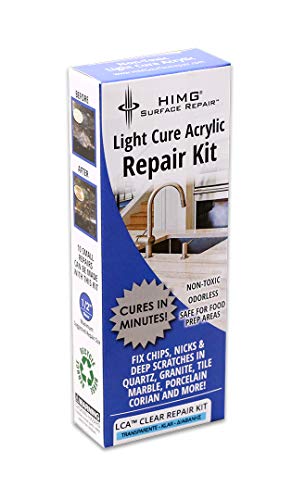
For multicolored quartz, the clear filler is the distinguishing feature of this HIMG kit; it is recommended for chips, scratches, and cracks no larger than a penny. The maker says the kit is non-toxic, odorless, and suitable for quartz, granite, marble, and several other surfaces. At 0.11 pounds, it is the lightest kit with a weight here. Its size guidance is narrow: damage larger than a penny falls outside the maker’s recommendation, and clear filler may remain visible if the repair area is not transparent or patterned as expected.
Bottom line: Choose this for a small chip on multicolored stone within the penny-size guidance.
UV-Cure Quartz Repair Kit, 7.5 g

For shoppers who need white, clear, or beige/cream filler, this 7.5-gram UV-cure kit gives three color choices and a 30-second cure. The maker says the cured compound forms a hard finish and is intended for chips, cracks, scratches, and holes across quartz and other household surfaces. The short cure window can be useful when keeping dust off a repair is a concern, but the specifications do not state a maximum damage size. Check the cure instructions and whether the compound suits the specific countertop finish before attempting a larger repair.
Bottom line: Pick this for a small repair where one of its three filler colors fits.
Color-Mix Quartz and Stone Repair Kit

For a buyer who needs to mix a color or rebuild a small missing piece, this two-part kit includes color gels and a 1:1 mixing ratio. The maker says the mixed material becomes firm and hard after 12 hours, and describes it as waterproof after curing; that longer set time differs from the quick-cure options. Its color range includes white, black, brown, blue, and maroon. A custom mix can take more care than choosing a pre-colored filler, and the colors do not promise a close match for every quartz pattern.
Bottom line: Choose this when mixing a closer shade or rebuilding a small missing fragment is the priority.
How to choose a quartz countertop repair kit
Choose first by damage location, then by surface color and filler type. Edge chips and corner losses call for a filler that stays put; White Quartz Edge Chip Repair Kit is specifically described as a thick, no-drip epoxy for those areas. Clear filler can be a better visual match on multicolored stone, while a white or beige material may suit a light solid tone. Chip size matters: HIMG Clear Quartz Chip Repair Kit is recommended only for damage no larger than a penny. For a long crack, a deep break, or a loose slab section, a DIY kit is not a substitute for a countertop professional.
Quartz is typically an engineered surface made from mineral aggregate held in resin, so a repair compound must bond to a finished, clean area. Follow the kit’s preparation and cure instructions; do not assume that all epoxy or UV formulas can be used interchangeably.
Quartz repair filler types and cure time
Repair kits commonly use two-part epoxy or a light-cured resin, and the difference affects both working time and preparation. Two-part systems require accurate mixing; one kit here specifies a 1:1 ratio and a 12-hour hardening period. UV-cure products need their specified light exposure, with one maker claiming a 30-second cure. A fast cure is not the same as an immediate return to full use, so respect the maker’s cure and use limits.
Use this comparison to narrow the type before matching color:
| Need | Filler approach | Example condition |
|---|---|---|
| Edge chip or corner | Thick epoxy | Filler should stay in place on a vertical edge |
| Multicolored stone | Clear filler | Small damage within the maker’s size guidance |
| Several light tones | Multiple pre-mixed colors | Choose the closest tone and test inconspicuously |
| Missing fragment | Mixable two-part filler | Allow for a longer cure before use |
Matching filler color to quartz
Quartz patterns often combine a base color with veins or flecks, so a plain white filler can stand out against a patterned slab. Hold the kit color beside the damaged area under the countertop’s usual lighting before mixing or applying it. Clear filler is aimed at multicolored surfaces, but it does not reproduce the stone’s veining. For a white or cream slab, a white or beige shade may blend better; choose by the repair’s visible base color rather than the cabinet or room color.
Do not overfill a chip in an attempt to hide it: excess material can leave a raised spot that needs careful leveling. A small test on an inconspicuous area helps reveal whether the cured finish looks glossier or more opaque than the surrounding polished quartz.
Safe preparation and limits for countertop repairs
Keep uncured repair compounds away from food, children, and pets, and ventilate the work area when using any resin. A maker’s food-preparation safety claim applies only after the full cure, not while the compound is being mixed or applied; observe the product’s handling directions. Wear gloves and eye protection when appropriate, and avoid sanding cured material without controlling dust.
Small chips and shallow scratches are the sensible DIY range. If a crack crosses a sink cutout, spreads through the slab, or accompanies movement or a loose section, stop and get a fabricator’s assessment because the damage can involve support or structural integrity rather than a cosmetic surface flaw.
Frequently Asked Questions
Can I repair a large crack in quartz myself?
A DIY kit is best reserved for small chips or shallow surface damage, not a crack that crosses a slab or sink cutout. A crack that grows or occurs with movement needs a fabricator’s assessment before filling.
How long should quartz repair filler cure?
Cure time depends on the formula: one two-part kit says it hardens in 12 hours, while one UV-cure kit claims a 30-second set. Follow the specific product’s full cure and return-to-use directions rather than assuming the set time means immediate use.
Can repaired quartz be used for food preparation?
Only treat a repaired area as suitable for food preparation if the maker explicitly says so after full cure. Keep uncured resin away from food and do not prepare food on it during application or curing.
How do I match a repair color to patterned quartz?
Clear filler is commonly chosen for multicolored stone, but it will not recreate the slab’s veins or flecks. Compare the cured color in the countertop’s normal lighting, and use an inconspicuous test area when possible.
Does epoxy repair filler work on countertop edges?
A thick, no-drip filler is useful for a vertical edge because thinner compounds can run before setting. Confirm that the kit is intended for edges and corners before applying it to a front face.