
Best Rabbit Ear Antennas for Indoor TV Reception

Philips SDV7114A/27 Rabbit Ears suits most people because it combines adjustable dipoles and a loop with a manufacturer-claimed range of up to 30 miles. Choose Philips SDV8201B/27 Rabbit Ears for its simpler tabletop design, or another option if you need a different mounting style or color.
Rabbit ear antennas are indoor antennas with adjustable dipoles for VHF reception, often paired with a loop for UHF.
We earn a commission if you buy through links on this page. As an Amazon Associate I earn from qualifying purchases. Products are compared on manufacturer specifications, not hands-on testing.
- Best overall: Philips SDV7114A/27 Rabbit Ears – Adjustable dipoles and a loop, plus a manufacturer-claimed range of up to 30 miles.
- Best for a GE model: GE 33675 Modern Loop Rabbit Ears – A 15-inch extendable-dipole design with a manufacturer-claimed range of up to 30 miles.
- Best for suction-cup mounting: Suction-Cup Rabbit Ears Antenna – Includes a suction-cup and double-sided tape for alternate placement.
| Product | Best for | Dipole design | Claimed range | Coax cable | Shop |
|---|---|---|---|---|---|
| Philips SDV7114A/27 Rabbit Ears | Most indoor setups | 15-inch extendable | Up to 30 miles | 4 ft. | Check Price on Amazon |
| GE 33675 Modern Loop Rabbit Ears | GE-style design | 15-inch extendable | Up to 30 miles | 4 ft. | Check Price on Amazon |
| Philips SDV8201B/27 Rabbit Ears | Simple tabletop setup | Adjustable dipoles | — | 5 ft. | Check Price on Amazon |
| Loxarenx Adjustable Rabbit Ears | White finish | Adjustable dipoles | — | — | Check Price on Amazon |
| Suction-Cup Rabbit Ears Antenna | Alternate mounting | Rabbit-ear design | — | — | Check Price on Amazon |
Rabbit Ear Antennas Compared
Compare the dipole designs, stated range and included cable before choosing an indoor antenna.
Philips SDV7114A/27 Rabbit Ears
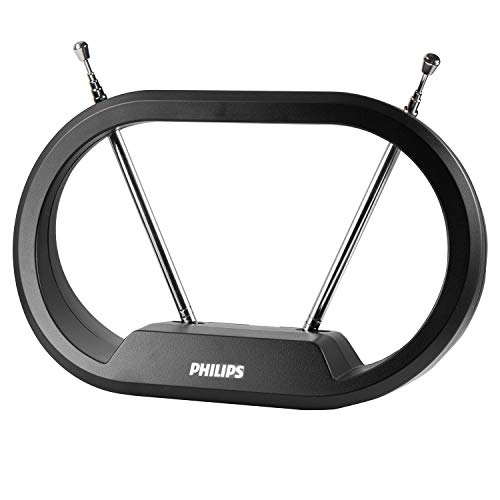
Adjustable 15-inch dipoles and a loop distinguish this Philips antenna, while the manufacturer claims reception up to 30 miles. It is a tabletop VHF/UHF model with a 4-foot coaxial cable, so it suits a TV near a shelf or other flat surface. Its range claim is not a guarantee: buildings, terrain and antenna placement affect indoor reception. Choose another model if a 4-foot cable will not reach your TV or outlet area.
Bottom line: Choose it for adjustable dipoles, a loop and a range claim.
GE 33675 Modern Loop Rabbit Ears
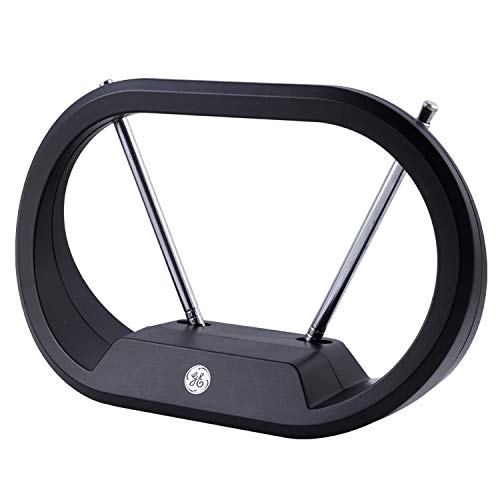
The GE model pairs a modern loop with 15-inch extendable dipoles and includes a 4-foot coaxial cable. The manufacturer claims a range of up to 30 miles for VHF and UHF broadcasts. Its tabletop format works for someone who wants a loop-and-dipole setup and prefers this model’s compact stated dimensions of 6 by 2 by 7 inches. As with other indoor antennas, walls and distance from broadcast towers can limit reception, so the range claim alone cannot predict local results.
Bottom line: Pick it if its dimensions and loop-and-dipole layout suit your space.
Philips SDV8201B/27 Rabbit Ears

This Philips antenna stands apart with a 5-foot coaxial cable, a tabletop format and a height of 8.5 inches. Its adjustable dipoles and circular loop are designed for VHF and UHF reception, without a range figure to compare against the two 30-mile claims in this group. It suits a buyer who wants Philips branding and more cable reach than the 4-foot options. The longer cable does not overcome weak signals caused by indoor obstructions or distant transmitters.
Bottom line: Choose it when the 5-foot cable and tabletop form fit your setup.
Loxarenx Adjustable Rabbit Ears

The white finish is the clearest point of distinction for this indoor rabbit-ear antenna. Its product name and features identify adjustable VHF/UHF dipoles and compatibility with smart and older TVs, so it suits buyers matching a white antenna to their room or existing television. No range or cable measurement is provided in the specifications, making direct reach comparisons difficult; prioritize it for its color and basic dipole design rather than a distance target. Indoor reception still depends on placement and local obstructions.
Bottom line: Pick it if a white antenna with adjustable dipoles is your priority.
Suction-Cup Rabbit Ears Antenna

Mounting flexibility sets this antenna apart: the product features describe a suction-cup and double-sided tape for installation, rather than only a tabletop placement. It is marketed for over-the-air HD reception and connects to a TV or digital converter box. Suction or adhesive mounting also depends on having a suitable surface where you can position the antenna.
Bottom line: Choose it when suction-cup or tape mounting suits your placement options.
How to Choose a Rabbit Ear Antenna
Start with broadcast distance and the antenna’s adjustment options, not its 4K-ready wording. Over-the-air broadcasts arrive as digital signals; an antenna does not create 4K programming, and picture resolution depends on what the station sends and the TV supports. VHF dipoles and a UHF loop address different broadcast bands, so a combined design can be useful when local stations use both. A claimed 30-mile range is a manufacturer estimate, not a dependable radius: terrain, buildings and tower direction change reception. If the nearest desired station is beyond that claim, or blocked by dense construction, an indoor rabbit-ear model may be a poor fit.
Where to Place Rabbit Ears for Reception
Placement can matter more than small differences between indoor models. Begin near a window and away from large metal objects, then point or spread the dipoles and reposition the loop while checking reception. After each move, run the TV’s channel scan again; digital tuners may not add a newly receivable station until rescanned. Keep cable routing in mind: a 4-foot lead limits how far a tabletop antenna can move from the TV, while a 5-foot lead offers one extra foot of reach. For weak or inconsistent reception, try a higher, unobstructed location before assuming the antenna is defective.
Rabbit Ears, Range Claims and Channel Scans
Rabbit-ear dipoles are adjustable rods generally used for VHF, while a loop element is commonly included for UHF. These designs are compact indoor options, not a substitute for an outdoor antenna when tower distance or obstructions overwhelm the signal. Use the table to match a model to a practical difference, then check local station availability and rescan after moving the antenna. A distance claim cannot account for terrain or building materials, and “4K ready” describes compatibility language rather than a promise that local channels broadcast in 4K.
Use this quick guide to match an antenna feature to a setup need.
| Need | Useful distinction |
|---|---|
| More cable reach | Choose a model with a 5-foot coax cable rather than a 4-foot cable |
| Adjustable reception | Look for adjustable dipoles and a loop |
| Non-tabletop positioning | Consider suction-cup or adhesive mounting, if the surface allows it |
Frequently Asked Questions
Do rabbit ear antennas receive both VHF and UHF?
Many combined models use dipoles for VHF and a loop for UHF. Check that the model names both bands if you need to receive stations on either one.
Does a 30-mile antenna range guarantee reception?
No; a 30-mile range is a manufacturer claim, not a guarantee for every home. Hills, buildings, tower direction and indoor placement can reduce reception well inside that distance.
How often should I rescan TV channels?
Rescan after moving the antenna or when you want to check for newly receivable channels. A digital tuner may need a fresh scan to detect stations that become available after repositioning.
Will a rabbit ear antenna provide 4K channels?
An antenna cannot make a station’s broadcast 4K; the station must transmit that resolution and the TV must support it. “4K ready” wording alone does not establish the resolution of local broadcasts.
Where should I put an indoor rabbit ear antenna?
Start near a window and away from large metal objects, then adjust its position and rescan. If reception remains weak, try a higher spot with fewer obstructions before changing models.