
Best Salt Pool Testers: 5 Options Compared by Testing

The LaMotte TRACER is the best salt pool tester for most pool owners because it measures salinity from 0 to 9,999 ppm with ±2% accuracy and adds conductivity, TDS and temperature readings. Choose a simpler meter for salt checks alone, or a multiparameter meter or reagent kit if you also need pH, chlorine or other water tests.
We earn a commission if you buy through links on this page. As an Amazon Associate I earn from qualifying purchases. Products are compared on manufacturer specifications, not hands-on testing.
- Best overall: LaMotte TRACER Salt Tester Kit – Covers 0 to 9,999 ppm with ±2% accuracy, automatic temperature compensation and four measurement types.
- Best for salt-only checks: eSeasonGear SALT-3050 – Focused on saltwater pools and koi ponds, with a 0 to 9,999 ppm range and IP65 waterproof rating.
- Best for complete water checks: Taylor K-2006-SALT FAS-DPD Kit – Tests nine parameters, including free and combined chlorine, pH, alkalinity and sodium chloride.
| Product | Best for | Salt range | Other measurements | Shop |
|---|---|---|---|---|
| LaMotte TRACER Salt Tester Kit | Routine pool checks | 0–9,999 ppm | TDS, conductivity, temperature | Check Price on Amazon |
| eSeasonGear SALT-3050 | Salt-only testing | 0–9,999 ppm | Temperature | Check Price on Amazon |
| Hofun 5-in-1 Salinity and pH Meter | Multi-reading checks | 0–9,999 ppm | pH, temperature, EC, TDS | Check Price on Amazon |
| ORAPXI 5-in-1 Pool Salt and pH Meter | Pool balance readings | 0–9,990 ppm | pH, TDS, EC, temperature | Check Price on Amazon |
| Taylor K-2006-SALT FAS-DPD Kit | Broad chemical testing | — | 9 water parameters | Check Price on Amazon |
Best Salt Pool Testers
Choose based on whether you need a salinity reading alone or several pool-water measurements in one routine.
LaMotte TRACER Salt Tester Kit

The LaMotte TRACER stands out for giving a stated ±2% salinity and TDS accuracy alongside automatic temperature compensation. Its pocket-sized instrument reads sodium chloride salinity from 0 to 9,999 ppm and also measures total dissolved solids, electrical conductivity and temperature. That combination suits pool owners who want more context than a salt-only number. The limitation is scope: it does not replace tests for pH, chlorine, alkalinity or other chemical balance measures, so those require separate testing.
Bottom line: Choose this for recurring salinity checks with additional conductivity and TDS readings.
eSeasonGear SALT-3050

The eSeasonGear SALT-3050 is the focused choice for saltwater pools and koi ponds, with a range of 0 to 9,999 ppm and a temperature display. It is precalibrated at 3,000 ppm sodium chloride at 77°F, and its IP65 rating makes it a waterproof-rated handheld meter. Its narrow application is also its main limitation: the manufacturer says it works only for saltwater pool and koi pond salt readings, not marine aquariums or food salt. Choose it when those boundaries match your use.
Bottom line: Pick this for straightforward pool or koi pond salt checks without broader water testing.
Hofun 5-in-1 Salinity and pH Meter
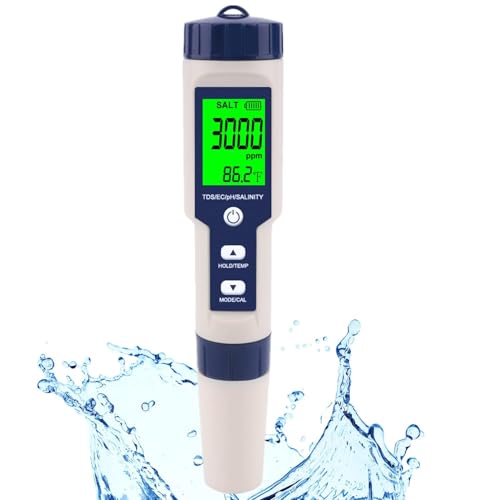
The Hofun combines salt, pH, temperature, electrical conductivity and TDS readings in one instrument, unlike the pool-focused meters that center on salinity. Its pool salt range is 0 to 9,999 ppm, and the display can show salinity in ppm, ppt or percent. The applications also extend to aquariums, hot tubs, hydroponics and drinking water.
Bottom line: Choose this if pH and other water measurements matter alongside pool salinity.
ORAPXI 5-in-1 Pool Salt and pH Meter

The ORAPXI pairs a pool salt reading with pH measurement, making it a broader option than a salinity-only tester. Its salt range is 0 to 9,990 ppm, with an additional 10 to 100 ppt range, and the pH scale runs from 0.00 to 14.00. The product recommends pool pH between 7.2 and 7.8, with the suitable target depending on pool surface type. It also measures TDS, conductivity and temperature. Buyers seeking an accuracy figure should select another option with an explicit specification.
Bottom line: Pick this to track pool pH and salt together on a multiparameter meter.
Taylor K-2006-SALT FAS-DPD Kit

The Taylor K-2006-SALT is the broadest chemical-testing option here: its reagent kit covers nine parameters, including free and combined chlorine, pH, alkalinity, calcium hardness, cyanuric acid and sodium chloride. Instead of relying on a digital salinity readout, the kit uses collected samples, a comparator and reagents. That makes it useful when salt is only one part of a full pool check. The limitation is the manual, multi-step process; buyers wanting a fast digital salt number should choose a meter instead.
Bottom line: Choose this when testing chlorine and water balance is as important as salt.
How to choose a salt pool tester
Start with the readings you need: salt alone, salt plus pH, or a broader chemical check. Salt chlorine generators commonly operate around 2,700 to 3,400 ppm, but the correct target belongs to the generator manufacturer because systems differ. A practical rule is to choose a meter whose range includes your system’s target; all four digital meters here cover at least 9,990 ppm in pool mode. Accuracy matters near the operating range: a ±2% reading at 3,000 ppm represents about 60 ppm of measurement variation. For routine maintenance, use the meter’s reading alongside the controller’s display rather than assuming the two methods are identical.
Salt tester types and what they measure
Digital meters report an electrical measurement converted to salinity, while reagent kits use a chemical reaction and visual comparison. Conductivity meters can be affected by dissolved substances besides salt, so a pool-specific calibration or method matters; temperature compensation helps account for water temperature changes. Use this comparison to match the tool to the job.
| Testing need | Useful tool type | What to check |
|---|---|---|
| Quick salt reading | Digital salinity meter | Pool range and accuracy |
| Salt plus pH | Multiparameter meter | Stated measurement modes |
| Full chemical balance | Reagent test kit | Included parameters and reagent steps |
A tester with more modes does not automatically measure more accurately; select by needed measurement and the method’s accuracy.
Pool salinity targets and readings
Most saltwater chlorine generators target roughly 2,700 to 3,400 ppm, with many systems centered near 3,200 ppm. A difference of several hundred ppm can matter, so compare a tester’s reading with the exact generator manual before adding salt. Measure water from a well-circulated area away from a return jet or salt addition point; undissolved salt can create a locally high reading. Salt readings expressed as ppt convert by multiplying by 1,000, so 3 ppt equals 3,000 ppm. Percent is another unit: 0.3% equals 3,000 ppm.
Using and maintaining a salt tester
Rinse a digital probe with clean water between samples and avoid wiping a sensing surface, which can leave residue or cause damage. Calibration intervals depend on the meter and frequency of use; check calibration before a critical adjustment and after extended storage, and use the specified calibration solution. Reagent kits need clean sample containers, correct reagent order and fresh, properly stored chemicals because old reagents can shift color results. Never add pool chemicals based on a single surprising result: retest a fresh sample first, then make adjustments in small increments and allow circulation before measuring again.
Frequently Asked Questions
What salt level should a saltwater pool have?
Many salt chlorine generators target about 2,700 to 3,400 ppm, often near 3,200 ppm. Use the range for your exact generator because recommended operating levels vary by system.
How often should I test pool salt levels?
A weekly salinity check is a practical routine for a maintained pool, with an extra test after heavy rain, a water drain-and-refill, or a large top-off. Test again after salt dissolves and the water has circulated.
Is ppm or ppt better for pool salt readings?
Either unit works if the meter is in pool range and you compare it consistently. One ppt equals 1,000 ppm, so 3,200 ppm is 3.2 ppt.
Can a salt tester measure pool chlorine?
A salinity meter does not directly measure chlorine unless chlorine testing is specifically included. Use a separate chlorine test or a reagent kit that includes free and combined chlorine.
Why does my pool salt reading change?
Rain, splash-out, backwashing and refilling can change salt concentration, while temperature and dissolved substances can affect some meter readings. Retest a circulated sample and compare it with the generator’s own display before adding salt.