
Glasses for Lying Down on Side: 3 Prism Options

For most people who want glasses for lying down on their side, Lazy Glasses 90° Prism is the clearest choice because it redirects your view by 90 degrees and fits over many prescription glasses. Choose Valuu Lazy Prism Glasses or Horizontal Lazy Glasses 90° if you prefer another prism glasses design; ordinary slim reading glasses do not redirect your view.
Prism glasses bend or redirect the line of sight so you can view a book or screen while reclined, but they do not replace vision correction unless a product specifically says otherwise.
We earn a commission if you buy through links on this page. As an Amazon Associate I earn from qualifying purchases. Products are compared on manufacturer specifications, not hands-on testing.
- Best overall: Lazy Glasses 90° Prism – Its 90-degree prism redirects your view, and the roomy frame fits over many prescription glasses.
- Best for prescription eyewear: Valuu Lazy Prism Glasses – The maker says it can be worn over ordinary glasses, including prescription glasses.
- Best for a 90-degree view: Horizontal Lazy Glasses 90° – Its optical glass prism is described as turning the view 90 degrees.
| Product | Best for | Viewing angle | Prescription eyewear fit | Shop |
|---|---|---|---|---|
| Lazy Glasses 90° Prism | Prescription eyewear | 90° | Fits over many | Check Price on Amazon |
| Valuu Lazy Prism Glasses | Over-glasses wear | — | Fits over ordinary glasses | Check Price on Amazon |
| Horizontal Lazy Glasses 90° | Clear prism viewing | 90° | — | Check Price on Amazon |
Glasses for Lying Down on Side
Compare the prism direction, optical purpose, and fit before choosing glasses for reclined reading or viewing.
Lazy Glasses 90° Prism
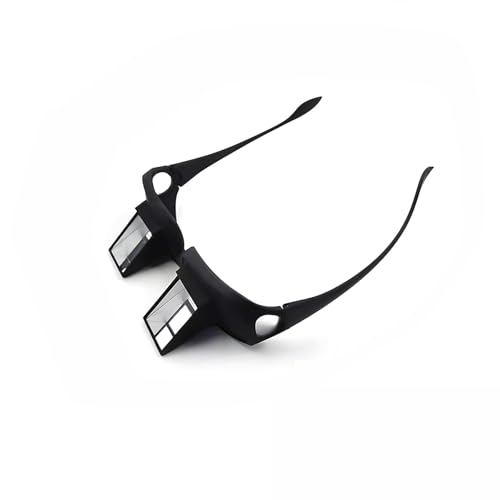
Unlike a basic prism frame, these glasses are explicitly non-magnifying and are made to fit over many everyday prescription glasses. Their 90-degree prism redirects your view toward a book, phone, e-reader, or TV while you recline. The standard-size frame is beige, and the maker positions it for reading, scrolling, and crafts such as knitting. Choose this pair if keeping your usual vision correction in place is important. Its main limitation is that the prism does not enlarge text or correct vision, so it is not a substitute for prescription lenses or magnifying readers.
Bottom line: Pick these if you need to keep many prescription glasses on underneath.
Valuu Lazy Prism Glasses
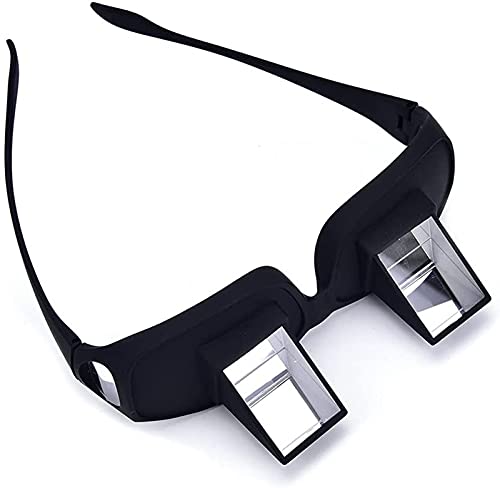
Valuu is the option here whose maker specifically says it can be worn alone or over ordinary glasses, including prescription glasses. The black unisex frame uses reflecting prism optics and is intended for reading or watching TV while lying down. Its single-pair format suits someone seeking a straightforward over-glasses prism design. The maker calls the optics high definition, but the specifications do not establish a viewing angle or magnification strength. If either measurement is essential to your setup, confirm those before ordering; this pair may not suit someone who needs an angle or non-magnifying specification.
Bottom line: Choose these when over-glasses use matters more than an angle.
Horizontal Lazy Glasses 90°

These horizontal glasses specify a 90-degree optical glass prism, unlike the pair whose viewing angle is not given. The maker describes them for reading or watching TV while lying down, as well as looking up at a phone. The black frame is made of plastic and weighs about 0.13 lb. This is a reasonable fit for someone prioritizing a right-angle view in a lightweight frame. The specifications do not establish whether the frame fits over prescription eyewear or whether the optics magnify, so buyers who need either trait should verify compatibility first.
Bottom line: Pick these if a 90-degree prism angle is your priority.
How prism glasses work for lying down
Right-angle prism glasses redirect your line of sight so you can look forward while seeing an object positioned above your face. A prism changes the path of light; it does not automatically enlarge text or provide prescription correction. Compare those functions separately: a 90-degree viewing angle describes direction, while magnification describes whether text appears larger. Prism frames are intended for a steady seated or reclined view, not walking around. Because redirected optics can change spatial cues, keep them for stationary reading or viewing and remove them before standing or moving through a room.
Choosing the right prism glasses
Start with the viewing angle and whether you need your regular glasses underneath. A 90-degree prism gives a clear directional specification; a frame that says it fits over prescription glasses addresses a separate fit need. If you rely on correction, choose an over-glasses design only if its frame physically clears your own lenses and temples. The word “prism” alone does not tell you that lenses magnify, so look for an explicit magnification claim when enlarged text is needed. Use this quick decision table:
| Need | What to prioritize |
|---|---|
| Keep prescription correction | Explicit over-glasses fit |
| Know the viewing direction | Stated 90-degree angle |
| Make small text larger | Separate magnification specification |
| Move around | Remove prism glasses first |
Fit and safety while reclining
Frame clearance matters more than a generic “universal” fit when wearing prism glasses over prescription frames. Check that the prism frame sits without pressing on your lenses, nose, or temples, and that it does not shift when you turn your head on a pillow. Use the glasses only while stationary: prism optics redirect the view and are not designed to preserve ordinary walking cues. Keep a phone, book, or screen in a stable position within the glasses’ redirected field rather than reaching while looking through the prisms. If you experience discomfort or blurred vision, stop using them and reassess the fit.
What prism glasses do not replace
Prism glasses for reclining redirect where you look; they do not inherently correct nearsightedness, farsightedness, or reading-vision needs. A non-magnifying model leaves text at its original apparent size, while an ordinary reading lens changes focus. Do not assume that a prism design is safe for driving, walking, or other tasks requiring normal depth and peripheral cues. For a prescription-specific prism need, regular ophthalmic prism lenses are a separate product category and require professional guidance. Choose these leisure frames for a fixed reading or viewing position, and use ordinary corrective eyewear for activities that require normal movement.
Frequently Asked Questions
Can prism glasses for lying down replace my prescription glasses?
No, prism glasses redirect your view but do not necessarily correct your prescription. Choose a model explicitly made to fit over prescription frames if you need your correction while reclined.
Do 90-degree lazy glasses make words look bigger?
A 90-degree angle describes the direction of the view, not magnification. A non-magnifying pair redirects your sightline without enlarging text.
Can I walk around while wearing prism glasses?
No, use prism glasses while stationary because redirected optics can alter spatial cues. Remove them before standing or walking.
How should I position a book with prism glasses?
Place the book or screen in front of your reclined position and adjust it until it appears in the redirected field. Keep it stable so you do not need to reach or move while looking through the prisms.
Can prism glasses fit over any prescription frames?
No single fit works over every frame shape. Check that the outer frame clears your prescription lenses and temples without pressure or shifting.