
Best Sit on Top Kayaks for Fishing: 4 Picks Compared

Perception Outlaw 11.5 suits most fishing kayak buyers because its 425-pound capacity and four rod holders leave room for gear and multi-rod setups. Choose a shorter, lighter kayak instead if transport and storage matter more than carrying capacity; sit-on-top kayaks have an open deck that is easy to access but leaves you exposed to splash and weather.
We earn a commission if you buy through links on this page. As an Amazon Associate I earn from qualifying purchases. Products are compared on manufacturer specifications, not hands-on testing.
- Best overall: Perception Outlaw 11.5 – Its 425-pound capacity, four rod holders and integrated tackle trays suit anglers carrying a fuller setup.
- Best for easy transport: Pelican Sentinel 100X – At 44.6 pounds and 9 feet 6 inches long, it is the lightest and shortest option here.
- Best for included paddle: Lifetime Muskie Angler 120 – It includes a paddle and has three rod holders plus two 6-inch storage compartments.
| Product | Best for | Length | Rod holders | Weight | Shop |
|---|---|---|---|---|---|
| Perception Outlaw 11.5 | Gear-heavy fishing | 11 ft 6 in | 4 | — | Check Price on Amazon |
| Pelican Sentinel 100X | Light transport | 9 ft 6 in | 4 | 44.6 lb | Check Price on Amazon |
| Pelican Catch Classic 100 | Adjustable seating | 10 ft | 2 | 57 lb | Check Price on Amazon |
| Lifetime Muskie Angler 120 | Paddle included | 10 ft | 3 | 51 lb | Check Price on Amazon |
Sit on Top Fishing Kayaks Compared
Compare length, rod-holder count and carry weight to match a kayak to your fishing gear and transport constraints.
Perception Outlaw 11.5
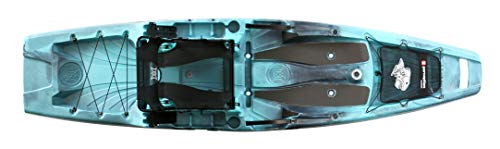
For anglers carrying a fuller load, this 11-foot-6-inch kayak stands apart with a 425-pound capacity and integrated tackle trays. The maker also describes a large rear tankwell, front storage area and fold-away frame seat, while four rod holders support a multi-rod setup. Its 35-inch width gives it a broader footprint than the other options here, though width alone does not establish stability in every water or loading condition. The longer hull may also take more room to store and transport than a kayak under 10 feet, so measure your storage space and vehicle setup before choosing it.
Bottom line: Pick this if the 425-pound capacity and built-in tackle organization matter more than compact transport.
Pelican Sentinel 100X

At 44.6 pounds and 9 feet 6 inches long, this is the easiest option here to lift and store by size and weight. Its removable ExoPak lets anglers pack gear separately and drop the compartment into the kayak at the water; the ExoPak also contains two vertical rod holders, in addition to two flush-mount holders. Extra-thick cushioning and a high, wide padded backrest are part of its seating system. The shorter hull is a practical choice for limited storage, but buyers who need a carrying-capacity figure should verify that limit before loading fishing gear and personal equipment.
Bottom line: Choose this when lighter handling and removable storage matter more than a published capacity figure.
Pelican Catch Classic 100

The adjustable seat is the distinguishing feature of this 10-foot angler kayak: its chair can be set high or low for different support positions. Two accessory rails give anglers mounting points for compatible gear, and two flush-mount rod holders sit behind the seat. A locking bow hatch adds enclosed storage, while a paddle holder keeps the paddle secured when hands are occupied. At 57 pounds, it weighs more than the Sentinel 100X, so solo lifting may be less convenient. The dimensions include conflicting measurements; use the 10-foot model length for planning and confirm the kayak’s actual width and height before a tight fit.
Bottom line: Pick this if adjustable high-or-low seating and accessory rails are priorities.
Lifetime Muskie Angler 120

This 10-foot kayak includes a paddle, which distinguishes it from the other choices in this comparison. It has two flush-mounted rod holders and one top-mounted holder, along with two 6-inch storage compartments and a paddle keeper with shock cords. The maker specifies UV-protected high-density polyethylene construction, multiple footrest positions and a skeg for tracking. At 51 pounds, it falls between the two Pelican models by carry weight. Its 31-inch width and flat bottom are design features, not a guarantee against tipping; distribute gear carefully and choose conditions appropriate to your paddling skill.
Bottom line: Choose this if an included paddle and three different rod-holder positions suit your setup.
How to Choose a Fishing Sit-On-Top Kayak
Start with carrying capacity, then compare length, storage and fishing hardware. The Outlaw 11.5 is the only option here with a 425-pound capacity, so add the paddler, clothing, water, tackle and every other load before deciding whether that limit leaves enough margin. Kayak length affects handling and storage: these choices span 9 feet 6 inches to 11 feet 6 inches. Shorter boats are generally easier to store and maneuver in tight spaces, while longer hulls often track straighter over distance. Rod holders also vary: two to four are supplied across these models. A useful rule is to measure the vehicle or storage space first; if it cannot accommodate 11 feet 6 inches, narrow the choice to the shorter models rather than assuming the kayak will fit diagonally.
Fishing accessories only help when they fit the angler’s routine. A removable compartment supports packing away from the water, while accessory rails provide mounting points but do not guarantee that a particular accessory will fit. Choose based on the gear you actually carry, not holder count alone.
Kayak Length, Width and Fit
Measure the kayak and transport route before choosing a model. The lengths range from 114 inches to 138 inches, and the widths supplied for three kayaks range from 30 to 35 inches; the Pelican Catch Classic’s source dimensions conflict with its 10-foot name, so confirm its actual width and height before a tight storage fit. A wider hull can feel more stable to some paddlers, but stability also depends on hull shape, load placement, water and movement. Keep heavy gear low and centered, and avoid leaning far over the side to reach tackle. Footrests matter for control and comfort; the Muskie Angler has multiple positions to accommodate different rider sizes. For rooftop loading, account for both kayak weight and the lift height, not length alone.
Use this comparison as a fit screen, not a substitute for the capacity limit or loading guidance for the exact kayak.
| Need | Model feature to prioritize |
|---|---|
| Shorter, lighter carry | 9 ft 6 in length and 44.6 lb weight |
| More stated load allowance | 425 lb capacity |
| Adjust seat position | High-or-low adjustable seat |
| Paddle included | Included paddle |
Rod Holders and Storage for Fishing
Match rod-holder placement to how you fish, since flush-mounted holders behind the seat, top-mounted holders and vertical holders serve different stowing positions. These kayaks offer two to four holders, but more holders do not automatically mean more usable fishing space; rods and lines can interfere with paddling or each other. Check that your preferred rod and reel clear the seat, paddle stroke and nearby gear before setting out. Storage also differs: one model has a removable compartment, another has a locking bow hatch, one includes two 6-inch compartments, and one has front and rear storage areas plus integrated tackle trays. Keep frequently used tackle reachable without twisting, and secure loose gear so it cannot shift or fall overboard.
On a sit-on-top kayak, the open deck makes access straightforward but does not protect gear from spray. Use water-resistant containers for electronics and essentials, and secure them to suitable attachment points.
Safety and Setup Before a Fishing Trip
Wear a properly sized U.S. Coast Guard-approved life jacket whenever paddling; a kayak can capsize, and a sit-on-top does not remove the risk of drowning. Cold water is dangerous even when the air feels mild, so dress for the water temperature and know how to re-enter after a capsize. Before departure, distribute the load evenly and stay within the kayak’s capacity, counting the paddler and gear together. Check local boating rules, weather, wind and water conditions, and tell someone your route and return time. Secure rods and tackle before launching, and keep the paddle tethered or in its holder when fishing only if that arrangement will not obstruct a safe exit. Practice a capsize recovery in controlled conditions before relying on the kayak offshore or in current.
Carry essential safety equipment within reach rather than buried under fishing cargo. A whistle and light may be required depending on location and time; confirm the rules where you paddle.
Frequently Asked Questions
How much weight can a fishing kayak hold?
Capacity varies by model, and the Outlaw 11.5 is the only kayak here with a figure: 425 pounds. Count the paddler and all gear toward the limit, and verify a model’s rated capacity before loading it.
Are sit-on-top kayaks good for beginners?
Many beginners find an open sit-on-top easier to enter and exit than a closed cockpit, but comfort and stability depend on hull design, conditions and paddler movement. Practice paddling and capsize recovery in calm, shallow water before going farther from shore.
What length fishing kayak is easiest to transport?
The 9-foot-6-inch Sentinel 100X is the shortest option here and weighs 44.6 pounds. Even a short kayak may be awkward to lift alone, so check the lifting height and vehicle rack setup before carrying it.
How many rod holders should a fishing kayak have?
Two holders can be enough for a simple setup, while three or four provide more stowing positions for extra rods. Placement matters as much as count: keep rods clear of your paddle stroke, seat and fishing line.
Do sit-on-top kayaks keep you dry?
No; an open sit-on-top deck leaves the paddler exposed to splash, rain and waves. Dress for water temperature, protect electronics in water-resistant storage and wear a properly sized U.S. Coast Guard-approved life jacket.