
Best Sprinkler Heads for Low Pressure: 5 Compared

Adjustable Pulsating Impact Sprinkler, 2-Pack is the strongest match for low-pressure watering because its maker says the pulsating impact mechanism is designed to maintain coverage without a high-pressure pump. Choose a different head if you need an in-ground pop-up system or your measured pressure is too low to support the distance you need.
Low pressure means the water pressure available while a sprinkler zone is running, not just the pressure at a closed hose bib.
We earn a commission if you buy through links on this page. As an Amazon Associate I earn from qualifying purchases. Products are compared on manufacturer specifications, not hands-on testing.
- Best overall: Adjustable Pulsating Impact Sprinkler, 2-Pack – Its maker specifically describes the pulsating mechanism as pressure-adaptive for low-pressure irrigation.
- Best for in-ground impact systems: Orbit Pulse Pop-Up Impact 55200 – The pop-up impact design offers adjustable coverage and range for an in-ground lateral pipe.
- Best for pressure regulation: Orbit 80314 Pressure-Regulating Pop-Up – The regulator is factory set to 30 PSI and adjustable to 40 PSI, though it cannot raise weak supply pressure.
| Product | Best for | Type | Arc | Coverage figure | Shop |
|---|---|---|---|---|---|
| Adjustable Pulsating Impact Sprinkler, 2-Pack | Low-pressure gardens | Hose-connected impact | 0–360° | Up to 60 ft | Check Price on Amazon |
| Orbit Pulse Pop-Up Impact 55200 | In-ground impact zones | Pop-up impact | 20–360° | Up to 35 ft spacing | Check Price on Amazon |
| Orbit 80314 Pressure-Regulating Pop-Up | Pressure control | Pop-up spray | Half spray | Up to 15 ft spacing | Check Price on Amazon |
| Rain Bird 1804VAN 4-Inch Pop-Up, 4-Pack | Compact spray zones | Pop-up spray | 0–360° | Up to 15 ft | Check Price on Amazon |
| Orbit 55018 Plastic Impact Head | Large open areas | Hose-connected impact | Partial–360° | Up to 90 ft diameter | Check Price on Amazon |
Sprinkler Heads for Low Pressure
Compare each head’s design and coverage claims against the pressure and layout of your irrigation zone.
Adjustable Pulsating Impact Sprinkler, 2-Pack

For low-pressure watering, this two-head pulsating impact set is the only option here whose maker specifically describes pressure-adaptive operation. The maker claims up to 60 feet of coverage without a high-pressure pump, plus a 0–360-degree pattern and adjustable flow. Each plastic head has a 1/2-inch connection and is intended to attach to most garden hoses. It suits a garden or lawn where hose placement is practical. The limitation is that the 60-foot maximum is a maker claim, not a guaranteed radius at every pressure; verify the actual running pressure and coverage you need before relying on that distance.
Bottom line: Choose this when you want a hose-connected impact head explicitly intended for low-pressure irrigation.
Orbit Pulse Pop-Up Impact 55200
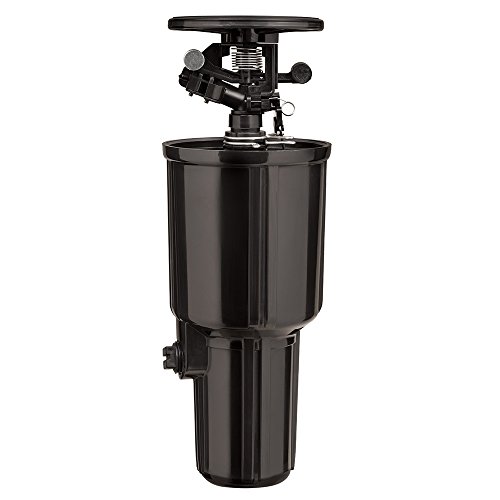
Unlike the hose-connected impact head, this model is a pop-up designed for an in-ground lateral pipe. Its 3-inch riser clears medium grass, and its pattern adjusts from 20 to 360 degrees; the maker says it works with up to 35 feet between heads. A large nozzle orifice and dual inlet ports are useful design features for buried systems. Consider it when the installation is already built around pop-up impact rotors and adjustable arcs. It is not specifically identified as a low-pressure head, so its spacing claim should not be treated as achievable on a weak supply; confirm the zone can provide the needed operating pressure.
Bottom line: Pick this for a buried impact-rotor system after confirming its pressure and spacing requirements.
Orbit 80314 Pressure-Regulating Pop-Up

This pop-up spray body stands apart by incorporating a pressure regulator and a preinstalled brass half-spray nozzle. The maker says the regulator is factory set to 30 PSI and adjustable to 40 PSI; the head is intended for spacing up to 15 feet. A filter, silt trap, stainless-steel spring, and ratcheting riser are included in its design. It suits a half-circle in-ground spray zone where controlling excess pressure and spray direction matters. A regulator reduces pressure rather than boosting it, so this is not a fix for a supply that cannot reach the nozzle’s operating needs.
Bottom line: Choose this for a half-spray in-ground zone that needs pressure regulation, not pressure boosting.
Rain Bird 1804VAN 4-Inch Pop-Up, 4-Pack

This four-pack is a variable-arc spray-head option rather than an impact rotor, with a 4-inch pop-up body and a 1/2-inch female threaded inlet. The maker gives a spray distance of up to 15 feet and an adjustable 0–360-degree pattern for corners, narrow strips, or full-circle coverage. It fits residential or professional landscaped zones using compatible threaded sprinkler fittings. Spray heads generally suit shorter distances than rotors, but the maximum is not a low-pressure guarantee; choose it only if the zone can deliver an even pattern across the required area.
Bottom line: Pick this for short-range pop-up spray coverage when the zone has adequate operating pressure.
Orbit 55018 Plastic Impact Head
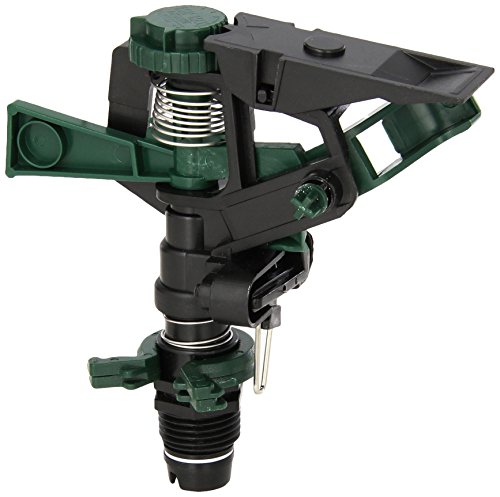
This plastic impact head focuses on broad, adjustable coverage: the maker claims up to a 90-foot diameter at full circle, with a radius adjustment from 20 to 42 feet. Its deflector shield and diffuser screw let users alter the stream and distance, while an anti-backsplash arm helps keep the pattern directed. The 1/2-inch head suits open lawn areas where a large circle is useful. Those maximum-distance claims do not establish low-pressure performance, and impact heads need sufficient flow and pressure to rotate and throw water. Do not select it solely because its maximum is larger than another head’s.
Bottom line: Choose this for adjustable impact coverage in an open area only if your running pressure supports it.
How to choose a sprinkler head for low pressure
Start by measuring dynamic pressure while the zone is running; a static reading with the water off can overstate what the head receives. Many residential spray nozzles are designed around roughly 20–30 PSI, while many rotors operate around 30–50 PSI, though the exact requirement depends on the model. Low pressure also reduces throw and can spoil uniformity, so do not size a zone from a maximum-distance claim alone. If measured running pressure is below the nozzle’s working range, select a lower-demand head or reduce the number of heads operating together. A pressure regulator only reduces pressure; it cannot create pressure that the supply does not have.
Measure pressure and plan head spacing
Measure pressure at the zone with a gauge while water flows, then account for pipe losses and elevation. Water pressure drops about 0.433 PSI for every foot of vertical rise, before friction losses from long or narrow pipe runs are counted. For even coverage, sprinkler layouts commonly use head-to-head spacing, where each head’s spray reaches the neighboring head; low pressure can shrink that reach and leave dry gaps. Use the operating radius at your actual pressure rather than a maximum. If the zone cannot reach the next head, reduce spacing or split the zone so fewer heads run at once.
The table distinguishes common head types by their usual role; the actual pressure requirement is model-specific.
| Head type | Typical use | Pressure consideration |
|---|---|---|
| Spray | Short-range beds and lawns | Often designed around 20–30 PSI |
| Impact | Adjustable arcs and broader lawn coverage | Needs enough flow and pressure to rotate and reach |
| Rotor | Longer-range in-ground coverage | Many models operate around 30–50 PSI |
Why pressure and coverage vary by system
Sprinkler performance depends on more than the head: pipe diameter, zone length, elevation, fittings, and how many heads run together all affect pressure at the nozzle. A narrow or long lateral pipe adds friction loss, while a pump or municipal supply may provide different flow under load than at rest. Match heads with similar precipitation rates in one zone; combining spray heads and rotors can apply water at different rates and create uneven watering. If the water pattern is weak at every head, inspect the supply and zone layout before replacing individual heads. If only one head underperforms, a clogged nozzle or filter may be the more local cause.
Common low-pressure sprinkler mistakes
Do not assume a pressure-regulating head solves low pressure: a regulator trims excessive inlet pressure to a target, but cannot raise a weak supply. Avoid running more heads at once than the source can support; each added nozzle shares available flow and can reduce throw. Maximum coverage figures also depend on conditions and should not be read as guaranteed head-to-head spacing. Check that the selected head type matches the installation: pop-up bodies use buried threaded connections, while hose-connected impact heads sit above ground. Before changing heads, confirm the zone’s running pressure and available flow; those two measurements help distinguish a supply problem from a head-selection problem.
Frequently Asked Questions
How do I measure sprinkler pressure while watering?
Attach a pressure gauge at the zone or hose connection and read it while the sprinkler is flowing. A closed-tap static reading can be higher than the pressure available to the head under load.
What pressure do spray sprinkler heads usually need?
Many residential spray heads are designed around 20–30 PSI, although requirements vary by nozzle and body. Below the intended pressure, the spray radius and pattern can become inadequate.
Can a pressure regulator help a low-pressure sprinkler system?
No, a regulator reduces incoming pressure rather than boosting it. The Orbit regulator in this comparison is factory set to 30 PSI and adjustable to 40 PSI, so it is useful for pressure control when supply pressure is already sufficient.
Why do sprinkler heads have weak spray at the end of a zone?
Long pipe runs, narrow pipe, elevation gain, and too many heads operating together can reduce pressure at the far end. Water pressure falls about 0.433 PSI per foot of vertical rise, in addition to friction losses.
How far apart should sprinkler heads be installed?
A common layout rule is head-to-head coverage, with each spray reaching the next head. Set spacing from the actual radius at running pressure, since weak pressure can shorten reach and leave dry patches.