
Best Surfactant for Herbicides: 3 Options Compared

Southern Ag Non-Ionic Surfactant, 16 oz suits most people because its 16-ounce nonionic formula is intended for use with most pesticides, including herbicides. Choose Liquid Harvest Non-Ionic Surfactant, 16 oz for emphasis on coverage and absorption, or ADIOS! Non-Ionic Surfactant, 8 oz when an 8-ounce bottle intended to treat 25 gallons matches your plan.
A surfactant is an additive that helps a spray spread or adhere to plant surfaces. Confirm that your specific herbicide label permits a surfactant and follow its required rate; adding one when the label disallows it can change application safety and performance.
We earn a commission if you buy through links on this page. As an Amazon Associate I earn from qualifying purchases. Products are compared on manufacturer specifications, not hands-on testing.
- Best overall: Southern Ag Non-Ionic Surfactant, 16 oz – A 16-ounce nonionic surfactant is intended for use with most pesticides.
- Best for coverage: Liquid Harvest Non-Ionic Surfactant, 16 oz – Its claims focus on spreading spray evenly, absorption and reduced runoff.
- Best for small batches: ADIOS! Non-Ionic Surfactant, 8 oz – The 8-ounce bottle is claimed to treat 25 gallons of herbicide.
| Product | Best for | Bottle size | Intended use | Shop |
|---|---|---|---|---|
| Southern Ag Non-Ionic Surfactant, 16 oz | General pesticide use | 16 oz | Most pesticides | Check Price on Amazon |
| Liquid Harvest Non-Ionic Surfactant, 16 oz | Coverage-focused spraying | 16 oz | Herbicides | Check Price on Amazon |
| ADIOS! Non-Ionic Surfactant, 8 oz | Smaller spray batches | 8 oz | Herbicides, fungicides, pesticides | Check Price on Amazon |
Herbicide Surfactants Compared
Compare bottle size and stated use, then let the herbicide label determine whether and how to add a surfactant.
Southern Ag Non-Ionic Surfactant, 16 oz

Southern Ag Non-Ionic Surfactant, 16 oz stands out for its broad intended use: the maker says this nonionic surfactant is for use with most pesticides to improve results. Its 16-ounce bottle is a straightforward choice if you need an additive for a herbicide that allows surfactants and do not need a small concentrate with a tank-volume claim. The specifications give no mixing rate, so do not infer one from the bottle size; use only the rate permitted by the herbicide label. Buyers seeking a specific coverage or batch-volume claim may prefer another option.
Bottom line: Choose it for broad pesticide use when the herbicide label allows a surfactant.
Liquid Harvest Non-Ionic Surfactant, 16 oz
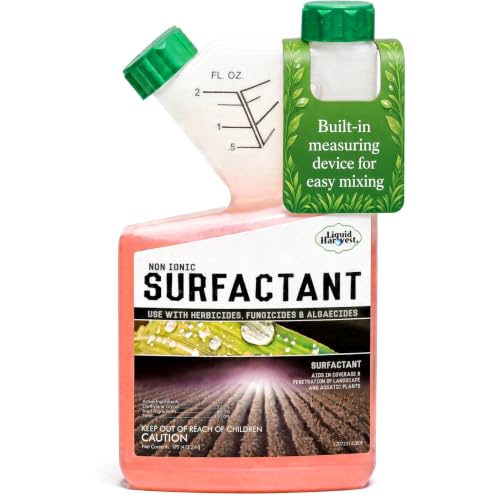
Liquid Harvest Non-Ionic Surfactant, 16 oz separates itself with claims centered on spray coverage: the maker says it helps herbicide spread evenly, improves absorption and reduces runoff. It comes in a 16-ounce bottle and is intended for herbicide use, making it a fit for buyers prioritizing those functions over a batch-size claim. Such claims do not replace the product label’s permitted rate or the herbicide’s directions. The fields do not provide a mixing rate, so this option is less convenient for anyone who needs a ready-to-use gallons-per-bottle calculation before purchase.
Bottom line: Pick it when spreading and coverage are the main priorities and the labels permit it.
ADIOS! Non-Ionic Surfactant, 8 oz
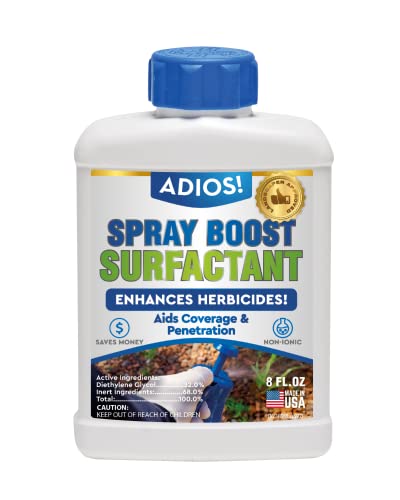
ADIOS! Non-Ionic Surfactant, 8 oz is the only option with a batch claim: the maker says an 8-ounce bottle enhances 25 gallons of herbicide. The nonionic formula is also presented for fungicides, pesticides, insecticides and defoliants, so it may suit a mixed-use spray plan when each product label permits it. The 25-gallon claim should not be treated as a universal mixing rate; labels can specify a different amount or prohibit additives. Its smaller bottle may be less suitable for someone planning repeated large-volume applications.
Bottom line: Choose it for a smaller bottle and a maker-stated 25-gallon treatment claim, subject to label rates.
How to choose a surfactant for herbicides
Start with the herbicide label: add a surfactant only when the label permits or directs it, and use the exact rate it gives. Surfactants reduce spray-solution surface tension, which can help droplets spread across waxy or narrow leaves; the right additive depends on the formulation and target weed. Nonionic surfactants are a common adjuvant class, but they are not interchangeable with crop-oil concentrates or methylated seed oils. If the label specifies one of those categories, choose that category rather than assuming any surfactant will work. A measurable rule is simple: if the herbicide label gives no permission or rate for an additive, do not add one until you verify compatibility with the manufacturer.
Mixing and application limits
Mixing rate comes from the herbicide label, not the surfactant bottle’s volume or a general rule of thumb. Rates may be expressed per gallon of spray, per acre, or as a percentage of the finished spray, so keep the units consistent and calculate the tank amount before mixing. For example, do not apply an 8-ounce-per-25-gallon claim where the herbicide label calls for a different rate. Agitate as directed and avoid spraying in wind that can carry droplets onto desirable plants. Wear the protective equipment required by both labels, and keep people and pets away from the treated area for the label’s restricted interval.
Nonionic surfactants and other adjuvants
Nonionic surfactants help wet and spread a spray without carrying the ionic charge found in some other surfactants. Crop-oil concentrates and methylated seed oils are different adjuvant classes that can increase penetration, but they may also increase the risk of crop injury in sensitive conditions. Use the category named by the herbicide label rather than substituting based on a general promise of better coverage. A useful comparison is the job each type is meant to do:
| Type | Typical role | Selection rule |
|---|---|---|
| Nonionic surfactant | Wetting and spreading spray | Use when label specifies or allows it |
| Crop-oil concentrate | Oil-based penetration aid | Use only when named on label |
| Methylated seed oil | Oil adjuvant for specified applications | Do not substitute for nonionic surfactant |
Storage and handling for spray additives
Keep surfactants in their original, closed containers and store them where children, pets and food cannot reach them. Avoid transferring concentrate into an unmarked container, since the label carries the handling and first-aid directions needed if a spill or exposure occurs. Rinse measuring tools as the label directs and never use kitchen utensils for pesticide mixing. Before combining products in a tank, check the herbicide label for compatibility and sequence; an incompatible mixture can separate or clog application equipment. Dispose of leftover spray and empty containers according to the label and local rules, not by pouring concentrate into a drain.
Frequently Asked Questions
Can I use surfactant with every herbicide?
No. Use a surfactant only when the herbicide label permits or requires it, and follow its rate. The wrong additive can affect crop safety or application performance.
How much surfactant goes in a gallon of spray?
There is no universal per-gallon rate; herbicide labels may specify an amount per gallon, per acre or as a percentage of the finished spray. Convert the label’s rate to your tank size before mixing, rather than using bottle size as the dose.
What does a nonionic surfactant do to spray?
A nonionic surfactant lowers surface tension so droplets can spread more evenly across plant surfaces. It does not make every herbicide suitable for every weed or application.
Should surfactant be added before the herbicide?
The tank-mix order depends on the herbicide formulation and label, so follow its sequence rather than using a universal order. Keep agitation running if the directions require it and check compatibility before combining products.
Can surfactant damage nearby garden plants?
Spray drift and some adjuvant combinations can injure desirable plants, particularly when the herbicide label warns about sensitive vegetation. Avoid windy conditions and keep spray off plants not named as targets.