
Ortovox Haute Route 32: Capacity and Fit Compared

For most backcountry day tours, the Ortovox Haute Route 32 is the right pick when 32 liters matches your gear load and you want front and back access to the main compartment. Choose a different capacity if your kit is especially compact or you need room for bulkier layers and equipment.
These ski-touring backpacks carry equipment for backcountry travel; the 30L S and 38L S variants are alternatives in the same family, while the Tour Rider is a different Ortovox pack.
We earn a commission if you buy through links on this page. As an Amazon Associate I earn from qualifying purchases. Products are compared on manufacturer specifications, not hands-on testing.
- Best overall: Ortovox Haute Route 32L – The 32-liter capacity suits a full day of touring without jumping to the family’s larger sizes.
- Best for compact loads: Ortovox Haute Route 30L S – Its 30-liter capacity is the smallest Haute Route option here.
- Best for bulky gear: Ortovox Haute Route 40L – The 40-liter capacity provides the most room among these packs.
| Product | Best for | Capacity | Color | Size designation | Shop |
|---|---|---|---|---|---|
| Ortovox Haute Route 32L | Full-day tours | 32 L | Black Raven | 32 Liter | Check Price on Amazon |
| Ortovox Haute Route 30L S | Compact loads | 30 L | Black Raven | 30 Liter S | Check Price on Amazon |
| Ortovox Haute Route 40L | Bulky equipment | 40 L | Faded Tangerine | One Size | Check Price on Amazon |
| Ortovox Haute Route 38L S | Larger S capacity | 38 L | Blue Nunatak | One Size S | Check Price on Amazon |
| Ortovox Tour Rider 30L | Freeride day tours | 30 L | Dirty Daisy | One Size | Check Price on Amazon |
Ortovox Haute Route 32 and Similar Ski Packs
Compare capacity and fit designation first, then match the pack to the gear you carry on a typical tour.
Ortovox Haute Route 32L

The 32-liter Haute Route is the exact match for a buyer seeking the 32L model, with front and back access to its main compartment when skis or a rope are attached. Ortovox says its O-Flex-2 back system and S-shaped stabilizer distribute weight between the hips and shoulders, and the materials are water-resistant. The 32L capacity is a useful middle ground for a day tour with layers and avalanche gear. Its dimensions do not provide a clear unit, so prioritize capacity and confirm fit against your torso measurement before choosing.
Bottom line: Pick this for a full-day tour when 32 liters fits your load.
Ortovox Haute Route 30L S

The 30L S is the smallest Haute Route option here, making it the more compact choice when a 32-liter pack would leave excess room. It shares the family’s front and back main-compartment access and O-Flex-2 back system with S-shaped stabilizer; Ortovox says the system distributes weight across hips and shoulders. The S designation distinguishes this version from the standard-size models, so compare its fit with your torso length before ordering rather than assuming the pack will fit like the 32L. Its two-liter reduction matters most when your load is consistently lean.
Bottom line: Choose this if your usual tour kit fits within 30 liters.
Ortovox Haute Route 40L

The 40L Haute Route offers the most capacity in this group, a practical difference when bulky layers or extra equipment routinely push a day-tour load beyond 32 liters. It retains front and back access to the main compartment, useful when skis or a rope are attached. Ortovox says the O-Flex-2 back system and S-shaped stabilizer distribute weight between the hips and shoulders; the pack is made with water-resistant materials. The extra volume can encourage overpacking, so choose this size for gear needs rather than capacity alone. The product is identified as one size.
Bottom line: Pick this when your regular load needs more than 32 liters.
Ortovox Haute Route 38L S

The 38L S combines a larger capacity than the 32L with the S designation, setting it apart from the standard Haute Route models. It is a fit-specific alternative for shoppers who need more room but prefer to consider the S version. The pack has the same family features: front and back main-compartment access, an O-Flex-2 back system with S-shaped stabilizer, and water-resistant materials. Ortovox says the back system distributes weight between hips and shoulders. The capacity may be more than needed for a compact day kit, and “one size” does not replace checking that the torso fit works for you.
Bottom line: Choose this for a larger load if the S fit suits your torso.
Ortovox Tour Rider 30L
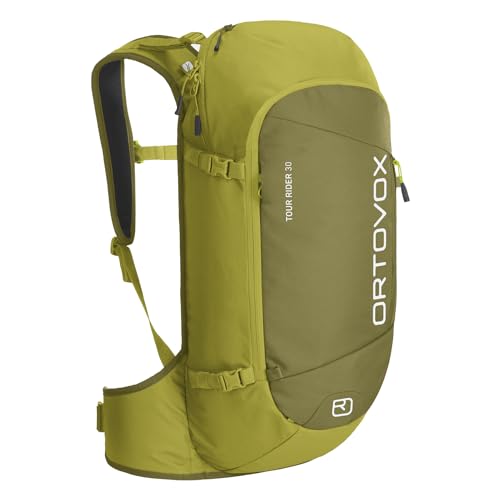
The Tour Rider is a separate Ortovox model rather than a Haute Route variant, with 30 liters for freeriding or day tours across varied terrain. Its carry setup includes a wide ski fastener and space for a shovel, probe, and avalanche equipment. Ortovox describes it as a lightweight pack and identifies it as PFC-free and Climate Neutral. That makes it relevant when freeride use and carrying those essentials matter more than matching the Haute Route design. The weight unit is unclear, so do not compare its numeric weight directly with the Haute Route figures.
Bottom line: Pick this for a 30-liter freeride-oriented touring pack.
How to Choose a Ski Touring Backpack Capacity
For most single-day ski tours, 25 to 35 liters is a useful capacity range; choose the upper end when cold-weather layers, food, or extra equipment take up more room. A 30-liter pack favors a compact load, while 38 to 40 liters leaves more space for bulkier kit or longer outings. Capacity alone does not show how a pack will carry, so lay out your usual load before deciding. A simple rule: if your packed essentials nearly fill a 30-liter bag at home, consider a 32-liter or larger pack rather than compressing critical gear. Keep the load stable and close to your back, with heavier items near the shoulder blades.
For ski touring, the pack also needs a carry layout that works with your skis, shovel, and probe. Do not trade secure equipment access for unused volume.
How Ski Backpack Fit and Sizing Work
Torso length, not height alone, is the main measurement for backpack fit: measure from the prominent vertebra at the base of the neck to the top of the hip bones. A hip belt should sit over the iliac crest and transfer load to the hips, while shoulder straps follow the shoulders without a large gap. “S” in a pack name commonly signals a shorter-fit version, but body proportions and brand sizing still matter; compare torso measurements with the manufacturer’s fit guidance. Pack the weight you expect to carry and adjust the belt and shoulder straps before judging comfort. A pack that feels right empty may shift under a loaded carry.
For these models, verify torso fit before ordering, especially when comparing the S-designated versions with the other sizes.
What to Carry in a Backcountry Ski Pack
A backcountry ski pack should make avalanche rescue equipment quickly reachable and keep the load organized. Carry a beacon on your body under an outer layer, not buried inside the backpack; keep the shovel and probe in their designated compartments so they can be retrieved without unpacking clothing. A pack’s ski or rope attachment can affect which access panel is easiest to open, so practice reaching the main compartment with the pack configured as you plan to tour. Never treat a backpack as a substitute for avalanche training, a functioning beacon, or a partner rescue plan.
This need-to-choice guide helps match pack volume to typical outing demands; gear, weather, and trip length can change the load.
| Touring need | Capacity direction | Why |
|---|---|---|
| Compact day kit | About 30 L | Less room for unnecessary extras |
| Typical full-day kit | About 32 L | Balances layers and essential equipment |
| Bulky layers or added gear | 38–40 L | More room for larger loads |
Frequently Asked Questions
How many liters should a ski touring backpack hold?
A 25- to 35-liter pack suits many single-day tours, with 30 to 32 liters covering a common middle ground. Choose closer to 38 or 40 liters when bulky layers or extra equipment regularly fill a smaller pack.
Where should I carry my avalanche beacon?
Wear the beacon on your body under an outer layer, not inside your backpack. Keep the shovel and probe accessible in the pack’s designated carry area so they do not get buried under clothing.
How do I measure my torso for a ski pack?
Measure from the prominent vertebra at the base of your neck to the top of your hip bones. Compare that torso length with the pack’s sizing guidance; height alone is not enough to determine fit.
Can I carry skis on a touring backpack?
Many ski touring packs use ski carry attachments, but the exact attachment style and capacity vary by model. Practice attaching your skis and opening the pack while they are mounted so essential gear remains accessible.
Is a water-resistant ski backpack waterproof?
Water-resistant materials can shed some moisture, but water resistance is not the same as a waterproof pack. Use dry bags for gear that must stay dry during wet snow or prolonged exposure.