
Best Ultrasonic Contact Lens Cleaner Options Compared

Ocuvia Ultrasonic Cleaner suits most people because it specifies 105 kHz ultrasonic cleaning, UVC and an automatic 3-minute cycle. Choose another model if you want multiple timer settings, a visible detachable case or a compact unit with dimensions.
Ultrasonic contact lens cleaners use sound waves to help loosen deposits, but they do not replace the cleaning, rinsing and disinfection steps required for your lenses and solution.
We earn a commission if you buy through links on this page. As an Amazon Associate I earn from qualifying purchases. Products are compared on manufacturer specifications, not hands-on testing.
- Best overall: Ocuvia Ultrasonic Cleaner – Combines a specified 105 kHz ultrasonic cycle, UVC and a 3-minute automatic run.
- Best for timer choices: Vastsoon Ultrasonic Cleaner, Pink – Offers three cleaning modes: 180, 300 and 600 seconds.
- Best for travel dimensions: Portable Ultrasonic Cleaner, Blue, 3.4-Inch – Gives compact dimensions of 3.4 × 3.49 × 1.3 inches.
| Product | Best for | Cleaning cycle | Added feature | Dimensions | Shop |
|---|---|---|---|---|---|
| Ocuvia Ultrasonic Cleaner | Automatic cleaning | 3 minutes | 105 kHz ultrasonic; 270 nm UVC | — | Check Price on Amazon |
| Vastsoon Ultrasonic Cleaner, Pink | Flexible timers | 180, 300 or 600 seconds | UV-assisted; detachable case | — | Check Price on Amazon |
| Portable Ultrasonic Cleaner, Blue, 3.4-Inch | Compact dimensions | 3 or 5 minutes | Rechargeable; soak case | 3.4 × 3.49 × 1.3 in | Check Price on Amazon |
| QITQUNS 3-in-1 Ultrasonic Cleaner | Storage and handling | 3 modes | Temporary storage; applicator | — | Check Price on Amazon |
| Portable Ultrasonic Cleaner, Blue, Compact | Simple travel kit | — | Mirror tweezers; replaceable case | Compact | Check Price on Amazon |
Ultrasonic Contact Lens Cleaners Compared
Compare the cycle, extra features and size to find a cleaner that fits your routine and lens-care instructions.
Ocuvia Ultrasonic Cleaner

Ocuvia Ultrasonic Cleaner is the clearest match for buyers who want a specified ultrasonic frequency and a short automatic cycle. The maker says its 105 kHz cleaning helps remove everyday deposits and protein buildup, while 270 nm UVC is intended to inactivate microorganisms. It is designed for compatible soft, RGP and Ortho-K lenses and uses recommended multipurpose contact lens solution. The cycle takes about 3 minutes with minimal handling. The trade-off is that the maker names particular lens types; people using another lens type should confirm compatibility with their eye-care professional before use.
Bottom line: Choose this if its lens compatibility and automatic 3-minute cycle match your routine.
Vastsoon Ultrasonic Cleaner, Pink

Vastsoon Ultrasonic Cleaner, Pink stands apart with three timer choices and a detachable visible case. The maker says the unit combines ultrasonic cleaning with UV-assisted care; the selectable modes run for 180, 300 or 600 seconds, and the machine has one-button operation and auto-shutoff. Its kit also includes four solution cases, an applicator and removal tools, which may suit someone organizing a travel or home setup. The product describes overnight soaking as an option. Its functions do not replace the lens maker’s prescribed disinfection routine, so choose it only if its cleaning method fits those instructions.
Bottom line: Pick this if selectable cycle lengths and a detachable case matter most.
Portable Ultrasonic Cleaner, Blue, 3.4-Inch
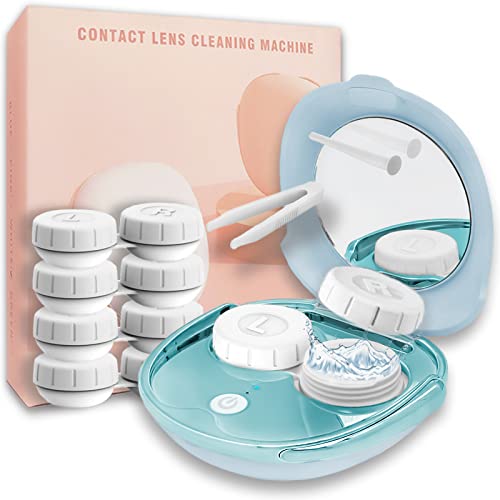
Portable Ultrasonic Cleaner, Blue, 3.4-Inch is the option with specific compact dimensions: 3.4 × 3.49 × 1.3 inches. The maker says its ultrasonic sound waves help remove tear-protein deposits and that lenses can soak in solution overnight. It has one-button operation, rechargeable power and a 3- or 5-minute cleaning cycle with automatic shutdown. The product is described for soft, colored, hard, RGP and OK lenses. The trade-off is that no frequency or UV feature is identified here, so buyers prioritizing either should compare another option and verify lens compatibility with their prescribed care system.
Bottom line: Choose this if compact stated dimensions and a solution-soak case suit your needs.
QITQUNS 3-in-1 Ultrasonic Cleaner

QITQUNS 3-in-1 Ultrasonic Cleaner combines cleaning, temporary lens storage and applicator-assisted handling in one portable design. The maker identifies three cleaning modes and says the ultrasonic process helps loosen everyday dirt and oil; it also directs users to follow the complete cleaning, rinsing and disinfection instructions from lens and solution manufacturers. The name advertises 65,000 Hz, while its maker gives 60,000 Hz, so the frequency is not a reliable basis for choosing this model. Its advantage is the combined storage and handling setup; its limitation is that cycle durations are not consistently clear.
Bottom line: Pick this for its combined temporary storage and applicator-assisted handling.
Portable Ultrasonic Cleaner, Blue, Compact

Portable Ultrasonic Cleaner, Blue, Compact is a compact blue option whose product name identifies it as a portable ultrasonic cleaner and whose included items are a contact lens box, mirror, tweezers, remover tool and replaceable case. That accessory-focused setup may suit someone who wants lens-handling tools together for travel. The product does not give a cycle duration or ultrasonic frequency, so it is harder to compare its operation with timed models. Check that the cleaning method and case arrangement are compatible with your lens-care instructions before choosing it; accessories are not a substitute for proper disinfection.
Bottom line: Choose this if a compact accessory kit matters more than a specified cycle.
How to choose an ultrasonic contact lens cleaner
Choose by lens compatibility and care routine first, then compare cycle time and accessories. Contact lenses still need the cleaning, rinsing and disinfection steps specified for the lens and solution; ultrasonic action alone is not a substitute. Fresh disinfecting solution is essential: never top off old solution or use tap water, bottled water or saliva on lenses or their case. A short automatic cycle can reduce handling, while longer selectable cycles offer timing flexibility but do not prove better disinfection. If the product does not clearly identify a cycle or lens type, prioritize a model that does and confirm the routine with your eye-care professional.
This guide summarizes how the features differ:
| Need | Look for |
|---|---|
| Automatic timed run | Specified cycle duration |
| Choice of duration | Multiple timer settings |
| Handling or storage | Included case or applicator |
| Travel packing | Stated dimensions and portable design |
Lens compatibility and safe cleaning
Use a powered cleaner only if its maker says it supports your lens type and its process fits your prescribed care system. Soft lenses, rigid gas permeable lenses and Ortho-K lenses can have different care requirements; a generic “contact lens” label does not settle compatibility. Follow the solution label’s rub, rinse and disinfection directions, and use fresh solution each time you store lenses. Water exposure is a preventable risk because water can carry organisms that cause serious eye infections. If you have pain, redness or blurred vision, remove the lenses and contact an eye-care professional rather than extending a cleaning cycle.
Cleaning cycle, UV claims and limits
Cycle duration and additional technologies are useful comparison points, but neither an ultrasonic frequency nor a UV feature alone establishes that a lens is disinfected. One model specifies a 3-minute cycle and 105 kHz; another offers 180-, 300- and 600-second modes, so buyers can compare operation without assuming that longer means safer. UV-assisted or UVC features should be treated as additional functions, not a replacement for solution-based disinfection unless the lens and solution instructions explicitly permit it. A practical decision rule: if your lens-care instructions require a particular soak time or disinfection product that a cleaner cannot accommodate, do not switch routines to fit the device.
Case care and common mistakes
Replace a contact lens case at least every 3 months, and clean and air-dry it according to your care instructions between uses. A detachable or replaceable case can make maintenance easier, but it still needs regular cleaning and replacement. Do not reuse old solution, rinse a case with tap water or keep a case wet in a closed container; these habits can encourage contamination. Keep lenses away from water during showering and swimming, and remove them before water activities unless an eye-care professional gives different advice. Buyers often mistake a timer ending for a complete lens-care routine; complete the solution manufacturer’s required steps every time.
Frequently Asked Questions
Can an ultrasonic cleaner replace contact lens solution?
No; ultrasonic cleaning does not by itself replace the prescribed cleaning, rinsing and disinfection routine. Use only the solution and steps compatible with your lenses.
Can I use tap water on contact lenses?
No; keep tap, bottled and distilled water away from contact lenses and their cases. Water can carry organisms that cause serious eye infections.
How often should I replace a contact lens case?
Replace the case at least every 3 months. Clean and air-dry it as directed between uses, and use fresh solution rather than topping off old solution.
Are UV contact lens cleaners a substitute for disinfection?
Do not assume that UV makes a lens-care routine complete. Follow the disinfection method specified for your lenses and solution, even when a cleaner also has UV features.
Can every contact lens go in an ultrasonic cleaner?
No; compatibility depends on lens type and the device’s instructions. Confirm that the cleaner supports your specific soft, RGP or Ortho-K lenses before changing your routine.