
Plant Root Grow Box: 5 Air Layering Kits Compared

For a plant root grow box that covers the widest branch range, choose SupKing Small + Medium Air Layering Kit, which includes small and medium pods for branches from 0.1 to 0.47 inch. Choose a different option if you need a specific pod size, more pods, or a half-transparent box rather than a clear one.
We earn a commission if you buy through links on this page. As an Amazon Associate I earn from qualifying purchases. Products are compared on manufacturer specifications, not hands-on testing.
- Best overall: SupKing Small + Medium Air Layering Kit – The kit includes two pod sizes and states a branch-fit range of 0.1 to 0.47 inch.
- Best for narrow branches: Supking Small Air Layering Pods – The small pods fit branches from 0.15 to 0.35 inch.
- Best for larger batches: Lazzineer Small Root Growing Box, 20-Pack – The kit includes 20 small rooting boxes.
| Product | Best for | Pack count | Branch fit | Shop |
|---|---|---|---|---|
| SupKing Small + Medium Air Layering Kit | Flexible branch sizes | 8 pods | 0.1–0.47 in | Check Price on Amazon |
| Supking Small Air Layering Pods | Narrow branches | 8 pods | 0.15–0.35 in | Check Price on Amazon |
| Lazzineer Small Root Growing Box, 20-Pack | Many small layers | 20 boxes | — | Check Price on Amazon |
| PAMAZY Medium Root Growing Box | Moisture monitoring | 9 boxes | — | Check Price on Amazon |
| MIIIM Medium Air Layering Kit, 10-Pack | Visible root growth | 10 balls | — | Check Price on Amazon |
Plant Root Grow Boxes for Air Layering
Compare pod sizes, kit contents and stated branch-fit ranges to find a box suited to the branch you plan to layer.
SupKing Small + Medium Air Layering Kit

The two-size assortment and included light-shielding film distinguish this kit from the single-size options. It contains four small and four medium clear rooting balls, matching film pieces, and 32 cable ties. The branch-fit range is 0.1 to 0.47 inch, making the kit useful when you plan to layer branches of different thicknesses. The maker says the film is intended to block light while still allowing observation when removed. Because the kit has only eight pods, it may not suit a project that needs a larger quantity of one size.
Bottom line: Pick this if you want two pod sizes and a fit range that spans 0.1 to 0.47 inch.
Supking Small Air Layering Pods

The defined narrow-branch range is the key distinction here: these eight small transparent pods fit branches from 0.15 to 0.35 inch, and the kit adds 30 cable ties. The maker describes the pods as reusable PP and says they can be used for air layering on indoor or outdoor plants. This focused size range is a practical choice when you already know the branch diameter and want to avoid a mixed-size kit. It is less suitable for branches outside the range, so measure the branch where the pod will close before choosing.
Bottom line: Choose this for branches measured between 0.15 and 0.35 inch.
Lazzineer Small Root Growing Box, 20-Pack

The 20-box quantity sets this option apart for anyone preparing many small air layers at once. The boxes are described as transparent and reusable, and the maker explains a process of peeling a ring of bark, adding moist soil, and securing the box over the exposed area. That makes this kit relevant for repeat propagation projects involving trees, roses, or other plants.
Bottom line: Pick this when you need a 20-piece batch of small rooting boxes.
PAMAZY Medium Root Growing Box

The half-transparent, half-black shell differentiates these nine medium boxes from fully clear pods: the transparent portion provides a viewing window while the dark portion shades the rooting area. The maker also highlights drain holes and an oval shape. The dimensions are 4.92 inches high, 2.95 inches long, and 3.45 inches wide. This design may suit a gardener who wants to inspect moisture and roots without leaving the entire pod clear. No branch-diameter range is provided, so check the fit around your selected branch before relying on the medium size alone.
Bottom line: Choose this if a viewing window and partially shaded pod are your priority.
MIIIM Medium Air Layering Kit, 10-Pack
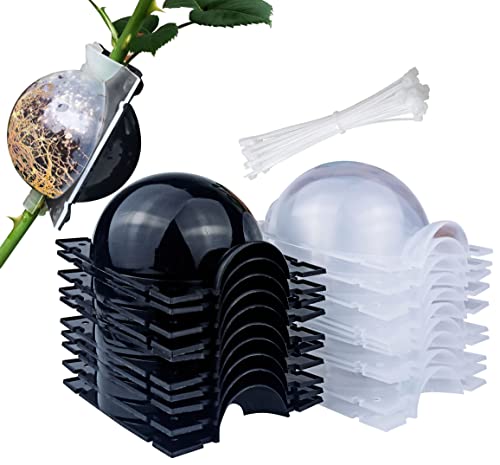
The clear medium rooting balls make this kit distinct for watching moisture and root development without opening the pod. The 10-piece set includes zip ties, corner buckles, and bottom sheets to hold each ball in place; each measures 3.94 inches high by 3.94 inches long by 3.15 inches wide. The maker says results can take from a few weeks to six months depending on plant species. The kit is reusable, but its medium size does not come with a branch-fit range, so it is a less certain match if you need a precise diameter limit.
Bottom line: Pick this if clear viewing and the included fixing components matter most.
How to choose a plant root grow box
Choose an air layering box by branch diameter first, then by visibility and quantity. Measure the branch at the intended rooting point; a range such as 0.15–0.35 inch is more useful than a size label like small. Clear walls make it easier to check moisture and root emergence without opening the pod, while a dark covering blocks light from the rooting medium. Air layering works by encouraging roots on a branch before it is cut from the parent plant. Common rooting media include damp sphagnum moss; keep it moist rather than waterlogged, since excess water limits air in the medium. A pod that closes securely around the branch is essential, so allow for bark and medium rather than choosing by branch diameter alone.
How air layering makes roots
Air layering produces roots on an attached stem, so the branch continues receiving water from the parent while roots form. The usual process is to remove a narrow ring of bark, scrape away the slippery cambium layer, pack damp sphagnum around the wound, and seal the medium in a pod or wrap. Roots often take several weeks to appear, but woody species can take months; plant type, season, warmth, and moisture all affect timing. Do not sever the branch just because the medium looks damp: wait until you can see a substantial root cluster through the pod. Use a clean, sharp knife for bark removal, cut away from your body, and keep hands clear of the blade.
Clear, shaded and mixed-size pods compared
Clear pods favor inspection, shaded pods favor a darker rooting environment, and mixed-size kits accommodate more than one branch diameter. No single shell design removes the need to match the pod to the stem and seal the medium well. Use this quick comparison to narrow the type before checking the branch fit and kit contents.
| Pod type | Useful when | Trade-off |
|---|---|---|
| Clear | You want to observe moisture or roots | More of the rooting area is exposed to light |
| Half-transparent | You want a viewing area with some shading | May not provide a branch range |
| Mixed-size | You plan to layer branches of different thicknesses | Fewer pods of each size |
For a branch under 0.35 inch, a kit whose range includes that diameter can simplify selection; for thicker stems, do not assume a medium label guarantees a fit.
Moisture, timing and common mistakes
Air layering medium should stay evenly damp, not saturated; squeeze excess water from sphagnum before packing it around the wound. Check the pod periodically for drying or standing water, using a transparent section if the design has one. A loose closure can let the medium dry, while overwatering can leave too little air around developing roots. Another common mistake is cutting the branch off too early: wait for visible roots to fill a meaningful portion of the medium, then separate the rooted branch below the root mass and pot it carefully. Rooting time varies by species, so a delay of several weeks is not by itself a sign that the layer has failed.
Frequently Asked Questions
What should I put inside an air layering pod?
Damp sphagnum moss is a common air layering medium because it holds moisture while leaving air around the wound. Moisten it evenly and squeeze out excess water before sealing the pod.
How long does air layering take to root?
Many air layers take several weeks, while some woody plants can need months. Species, season, temperature, and steady medium moisture all affect the time to visible roots.
When should I cut an air-layered branch off?
Wait until roots are clearly visible in the medium rather than cutting after a fixed number of days. A substantial cluster gives the branch a better chance of supporting itself after separation.
How do I keep an air layering pod from drying out?
Use a snug closure and inspect the medium regularly for even dampness. Direct sun and hot, dry conditions can increase drying, so check more often during warm weather.
Can any branch be used for air layering?
A healthy, reasonably mature branch is the usual choice, but diameter matters because the pod must close around it. Measure the branch at the rooting point and choose a box with a range that includes that measurement.