
Best Venture Golf Balls: RD-5 and RS-1 Compared

The Venture Golf RD-1 suits most golfers seeking straighter tee shots because its Surlyn cover is designed for low spin and its arrows aid alignment. Choose a different ball if you want a softer greenside feel or a urethane cover; the other Venture model’s features are not provided, so compare it only by its green color.
We earn a commission if you buy through links on this page. As an Amazon Associate I earn from qualifying purchases. Products are compared on manufacturer specifications, not hands-on testing.
- Best overall: Venture Golf RD-1 – Its 2-piece, 90-compression design pairs a low-spin Surlyn cover with target-alignment arrows.
- Best for soft feel: Callaway Supersoft (2025) – Its hybrid cover and HyperElastic SoftFast core are designed for a soft feel alongside speed.
- Best for greenside spin: Titleist Pro V1 – A soft urethane cover is designed to provide greenside spin.
| Product | Best for | Color | Cover | Layers | Shop |
|---|---|---|---|---|---|
| Venture Golf RD-1 | Straighter tee shots | Green | Surlyn | 2-piece | Check Price on Amazon |
| Venture Golf RS-1 | Green color | Green | — | — | Check Price on Amazon |
| Callaway Supersoft (2025) | Soft feel | White | Hybrid cover | — | Check Price on Amazon |
| TaylorMade Distance+ | Distance alignment | White | Ionomer | Two-layer | Check Price on Amazon |
| Titleist Pro V1 | Greenside control | White | Urethane elastomer | — | Check Price on Amazon |
Venture golf balls and alternatives
Compare the Venture models by the specifications, then consider alternatives for different feel and control priorities.
Venture Golf RD-1

The RD-1 is the only Venture model here with play specifications: a Surlyn cover, two-piece construction, and alignment arrows. Venture says its high-speed core is designed to increase ball speed, while the cover is intended to lower spin off the tee. The green color may also matter to golfers who prefer a ball that stands out. This design suits players prioritizing tee-shot direction and distance; golfers seeking a softer greenside feel or more spin around the green may prefer a different design.
Bottom line: Choose this if tee-shot alignment and a low-spin design are your priorities.
Venture Golf RS-1
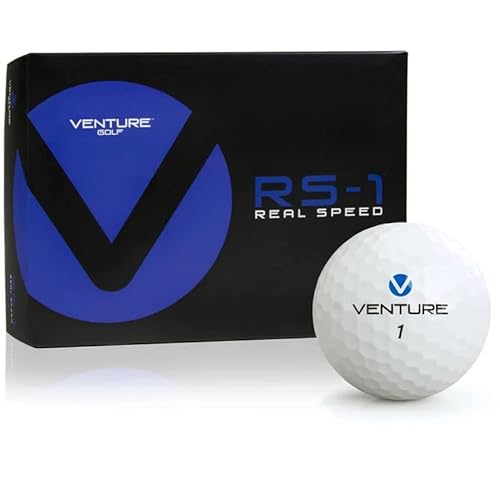
That makes color the only grounded basis for comparing it here, rather than ball flight, feel, or construction. Golf balls can differ in layer count, cover material, and compression, all of which shape how they perform. It may suit a golfer set on this Venture model or color, but anyone choosing by playing characteristics should confirm the RS-1’s cover and construction before buying.
Bottom line: Pick this when green color is the priority and you can confirm its play specifications.
Callaway Supersoft (2025)

The Supersoft shifts the focus from the RD-1’s specified Surlyn cover to a hybrid cover designed to balance distance, softness, and durability. Callaway says its HyperElastic SoftFast core is engineered for faster driver and iron speed with a soft greenside feel, and its cover system is intended to add control on approach and short-game shots. The white color is a contrast to the green Venture options.
Bottom line: Choose this if soft feel and short-game control matter most.
TaylorMade Distance+

The Distance+ adds a distinct plus alignment aid and a two-layer, ionomer-covered build. TaylorMade says its REACT Speed Core is designed for high-velocity performance, while the Extended Flight Dimple Pattern is intended to help the ball stay airborne longer through wind. The ball’s profile also includes mid-launch and mid/high spin.
Bottom line: Choose this if a plus alignment mark and distance-oriented design fit your priorities.
Titleist Pro V1

The Pro V1 stands apart with a soft urethane elastomer cover and a design emphasis on greenside spin and shot control. Titleist says its faster high-gradient core delivers more speed and iron and wedge spin, while a high-flex casing layer reduces long-game spin. Its 388 tetrahedral dimples are designed for penetrating, consistent flight.
Bottom line: Choose this if greenside spin and shot control outweigh a low-spin tee-shot focus.
How to choose Venture golf balls
Start with the shot you want to shape: a low-spin cover is generally aimed at reducing sidespin off the tee, while a softer urethane cover is used to support more greenside spin. Core and cover work together, so a ball’s compression number alone does not predict whether it will fit your swing. For alignment, look at whether the marking is a simple line, an arrow, or a larger graphic you can aim consistently. The RD-1 is the only Venture model here with construction, cover, compression, and alignment characteristics; the RS-1’s feature data only identifies its color. If you need to compare flight or feel, confirm RS-1 play specifications before choosing it.
Golf ball covers and feel
Surlyn and ionomer covers are commonly used on durable distance-focused balls, while urethane covers are common on premium balls built for greenside spin and control. Cover alone does not determine feel: core design, cover thickness, and a ball’s overall construction also matter. A two-piece ball typically pairs a large core with an outer cover, aiming for straightforward distance and durability; multi-layer designs can tune driver spin and wedge response separately. The RD-1 is specified as two-piece with a Surlyn cover, while Distance+ has two layers and an ionomer cover and Pro V1 has a urethane elastomer cover. Compare the intended shot response rather than assuming similar colors or labels mean similar performance.
Which golf ball fits your playing priority
Use the dominant need in your game to narrow the choice, then weigh the tradeoff rather than expecting one ball to maximize every trait. A ball designed to reduce long-game spin can help manage tee shots but may not offer the greenside response a golfer wants. A soft-feel ball can favor touch without making the same low-spin claim off the tee. The category guide below separates the product priorities from a broader construction rule of thumb.
| Priority | Design cue | Tradeoff to weigh |
|---|---|---|
| Lower-spin tee flight | Surlyn cover; RD-1 | May not emphasize greenside spin |
| Soft feel and approach control | Hybrid cover; Supersoft | Different emphasis than low-spin tee play |
| Greenside spin | Urethane cover; Pro V1 | Different emphasis than distance-focused design |
| Longer airborne flight | Extended Flight dimples; Distance+ | Does not establish a compression match |
Golf ball alignment and selection mistakes
Alignment marks help aim the ball, but they cannot correct a misaligned stance or clubface; line the mark up with the intended start line before setting your feet. A common mistake is choosing only by a label such as distance or soft feel, even though swing speed, launch, and short-game priorities also affect the result. Compare a ball’s construction, cover, compression when available, and actual markings together. Do not assume a green color means the RS-1 shares the RD-1’s construction or performance. For a measurable decision rule, if tee shots consistently curve more than you want, prioritize a ball designed to lower long-game spin; if approach shots stopping quickly are the greater need, prioritize a cover designed for greenside spin.
Frequently Asked Questions
What does 90 compression mean for a golf ball?
Compression is a measure of how much a ball deforms under load, but manufacturers do not use one universal rating scale. A 90 figure alone is not a reliable swing-speed cutoff; compare feel and ball flight rather than treating it as a precise fitting rule.
How often should I replace golf balls?
Replace a ball when a cut, deep scuff, or crack is visible, since damage can alter flight and feel. Surface discoloration alone is less important than a cover defect that catches a fingernail or exposes underlying material.
Do low-spin golf balls help with a slice?
A lower-spin design may reduce some sidespin, but it will not fix a slice caused by an open clubface or an out-to-in swing path. If a tee shot curves substantially, a fitting or swing adjustment addresses the cause more directly than changing balls.
Are two-piece golf balls good for beginners?
Two-piece balls are commonly designed around distance and durability, which can suit newer golfers who lose balls or prioritize straightforward tee-shot performance. A golfer who needs more greenside spin may prefer a cover and construction designed for short-game control.
What is the difference between Surlyn and urethane covers?
Surlyn covers are commonly associated with durable, lower-spin distance balls, while urethane is commonly used when greenside spin and feel are priorities. Cover material is only one design factor, so core and layer construction also affect the ball’s response.