
Best Waffle Fry Cutter: 3 Options Compared

Börner Wave-Waffle XXL suits most people who want a dedicated waffle fry cutter because it makes 12 mm waffle cuts and 15 mm wave cuts. Choose Swissmar Börner PowerLine Waffle Cutter for a standard wave-waffle slicer or Gramercy Adjustable Mandoline Waffle Slicer if adjustable thickness and other slice styles matter more.
We earn a commission if you buy through links on this page. As an Amazon Associate I earn from qualifying purchases. Products are compared on manufacturer specifications, not hands-on testing.
- Best overall: Börner Wave-Waffle XXL – Makes 12 mm waffle cuts and 15 mm wave cuts for extra-thick fries.
- Best for a simple waffle cut: Swissmar Börner PowerLine Waffle Cutter – A dedicated wave-waffle slicer with an extended handle and German stainless steel blades.
- Best for adjustable slicing: Gramercy Adjustable Mandoline Waffle Slicer – Has 24 slice settings, including waffle cuts, and folds flat for storage.
| Product | Best for | Waffle cut | Other cuts | Dimensions | Shop |
|---|---|---|---|---|---|
| Börner Wave-Waffle XXL | Extra-thick lattice fries | 12 mm | 15 mm wave cuts | 13.4 × 5.0 in | Check Price on Amazon |
| Swissmar Börner PowerLine Waffle Cutter | Dedicated waffle slicing | Waffle cuts | Wave-waffle cuts | 13.4 × 5.0 in | Check Price on Amazon |
| Gramercy Adjustable Mandoline Waffle Slicer | Multiple slice styles | Waffle setting | Up to 9 mm; julienne | 16 × 5.5 × 5.5 in | Check Price on Amazon |
Waffle Fry Cutters
Compare the cut styles and adjustment options to find a cutter that matches your usual prep.
Börner Wave-Waffle XXL

Börner Wave-Waffle XXL is the choice for thicker lattice fries: its waffle setting cuts 12 mm, while the wave setting makes 15 mm cuts. The maker says it works with potatoes and other firm fruits and vegetables, so it can also handle wavy carrot or apple cuts. At 13.4 × 5 inches, it has a larger footprint than a handheld crinkle cutter. Choose it when that bold cut is the goal; skip it if you need one tool to adjust among many thicknesses, since the features describe fixed wave and waffle cut sizes.
Bottom line: Pick this if you want extra-thick lattice cuts rather than adjustable slice thickness.
Swissmar Börner PowerLine Waffle Cutter
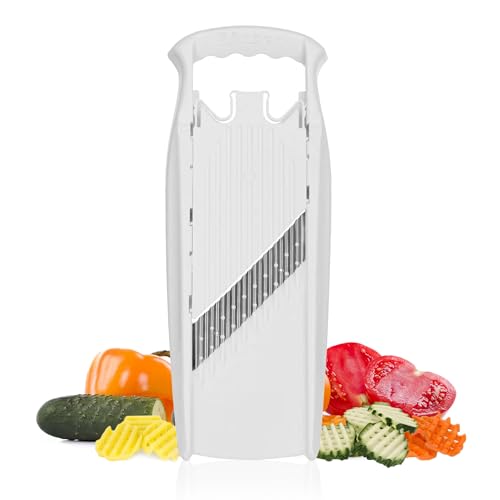
Swissmar Börner PowerLine Waffle Cutter focuses on wave-waffle cuts, with an extended handle and German stainless steel blades. The maker says it cuts potatoes, carrots, zucchini, apples, pears, and other hard fruits, making it useful beyond fries for garnishes and side dishes. It measures 13.4 × 5 inches and weighs 0.3 pounds. The key trade-off is safety setup: the Börner Safety Holder is sold separately, so buyers who want a hand guard should account for that before choosing this slicer. Its described cutting style is less versatile than an adjustable mandoline with multiple settings.
Bottom line: Choose this for a dedicated wave-waffle tool if you already have a compatible safety holder.
Gramercy Adjustable Mandoline Waffle Slicer

Gramercy Adjustable Mandoline Waffle Slicer stands apart by combining a waffle-fry setting with 24 slice settings, including two julienne sizes at 4.5 mm and 9 mm. The maker says the dial changes settings without touching blades; the package also includes one pair of cut-resistant gloves. Its dimensions are about 16 × 5.5 × 5.5 inches, and it folds flat for drawer storage. The limitation is that its maximum slice thickness is 9 mm, so it is not the pick for the thicker 12 mm waffle cut made by Börner Wave-Waffle XXL. Use the included gloves and keep the base stable during slicing.
Bottom line: Pick this if adjustable slicing options matter more than the thickest lattice cuts.
How to choose a waffle fry cutter
Choose by cut thickness and adjustment range first: fixed waffle cutters suit repeatable lattice fries, while mandolines suit cooks who also need straight slices or julienne. Waffle fries get their lattice pattern by cutting a potato, rotating it about 90 degrees, then cutting again; consistent rotation and even pressure help keep the grid uniform. For a one-purpose cutter, compare the waffle thickness rather than assuming all wave blades make lattice cuts. For varied prep, count the actual slice settings and check whether a separate hand guard is part of the setup. A cutter that lacks a clear waffle setting may make ridged slices but not the crosshatched shape expected from waffle fries.
Keep the potato flat against the cutting surface and stop before fingers approach the blade; use a holder or cut-resistant glove where appropriate.
Fixed waffle cutters and adjustable mandolines
Fixed waffle cutters prioritize a particular ridged or lattice cut, while an adjustable mandoline combines that task with other thicknesses and cuts. This distinction matters more than a long accessory list if fries are the main use. A fixed cutter may have a simpler setup, but the cut is limited to its designed geometry; an adjustable unit offers more options but requires setting selection and careful handling. The table compares the choices by cut style and footprint, not by an assumption that every wave cutter creates lattice fries.
| Type | Useful when | Trade-off |
|---|---|---|
| Fixed wave-waffle cutter | Repeatable lattice or wave cuts | Limited cut options |
| Adjustable mandoline | Waffle cuts plus varied slice thicknesses | More settings to manage |
For fries over 9 mm thick, choose a cutter whose waffle setting explicitly reaches that thickness; for mixed prep, prioritize adjustment range and a safe hand position.
Preparing potatoes for crisp waffle fries
Dry potato surfaces matter for browning: rinse or soak cut potatoes to remove surface starch if desired, then dry them thoroughly before frying or roasting. Wet pieces can cause hot oil to spit, so lower food carefully and avoid adding water to hot oil. Cut pieces as evenly as practical so thinner edges do not brown far ahead of thicker centers. A waffle cutter creates the shape, but cooking method, potato variety, oil temperature, and piece size affect crispness. For deep frying, use a heavy pot with ample headroom and never fill it more than halfway with oil; keep water and crowded batches away from the hot oil.
Frequently Asked Questions
How do you make a potato into a waffle fry?
Cut a slice, rotate the potato about 90 degrees, then make the next cut to create the crosshatch. Keep the potato steady and use a holder or suitable hand protection as it gets smaller.
Do all crinkle cutters make waffle fries?
No. A crinkle cutter makes ridged slices, while a waffle fry needs cuts in two crossing directions. Choose a tool with a dedicated waffle setting or wave-waffle design.
How thick should homemade waffle fries be?
There is no single required thickness; a thicker cut cooks differently from a thin one and may need more cooking time. For a cut above 9 mm, select a cutter whose waffle setting explicitly supports that thickness.
Should potatoes be soaked before making waffle fries?
Soaking cut potatoes can remove some surface starch, but dry them thoroughly before cooking. Wet potatoes can make hot oil spit, so take care when transferring them to a fryer or pan.
Are mandoline slicers safe for cutting potatoes?
Mandolines have exposed sharp blades, so keep fingers away from the cutting path and use a hand guard or cut-resistant glove. Work on a stable surface and stop when the remaining piece is too small to hold securely.