
Best Walking Pad Under 200: 5 Models Compared

Walking Pad with 10% Incline suits the widest range of walking routines in this group because its speed range reaches 6.2 mph and it has a 10% incline. Choose Compact 6 km/h Walking Pad or Compact LED Walking Pad instead for a simpler, compact under-desk setup, or Walking Pad with Handles if side handles and a 4-degree incline matter more.
A walking pad is a compact motorized treadmill made primarily for indoor walking, often under a desk or in a small room.
We earn a commission if you buy through links on this page. As an Amazon Associate I earn from qualifying purchases. Products are compared on manufacturer specifications, not hands-on testing.
- Best overall: Walking Pad with 10% Incline – Its 0.6–6.2 mph range and 10% incline allow walking and faster sessions.
- Best for side support: Walking Pad with Handles – It has handles, a 4-degree incline and a display that tracks speed, time, distance and calories.
- Best for low storage: Compact 6 km/h Walking Pad – Its 4-inch profile is slimmer than the heights of the other models.
| Product | Best for | Speed range | Incline | Capacity | Shop |
|---|---|---|---|---|---|
| Walking Pad with 10% Incline | Versatile workouts | 0.6–6.2 mph | 10% | 330 lb | Check Price on Amazon |
| Walking Pad with Handles | Added support | 0.6–3.8 mph | 4 degrees | — | Check Price on Amazon |
| Superun 6% Incline Walking Treadmill | Incline walking | 0.6–3.8 mph | 6% | 300 lb | Check Price on Amazon |
| Compact 6 km/h Walking Pad | Slim storage | 1–6 km/h | — | 264 lb | Check Price on Amazon |
| Compact LED Walking Pad | Simple controls | 0.6–4.0 mph | — | — | Check Price on Amazon |
Walking Pads Compared
Compare the operating range, incline and stated weight limit to find a model that fits your routine and space.
Walking Pad with 10% Incline

Walking Pad with 10% Incline spans the broadest speed range in this group and adds a 10% incline, making it adaptable for switching between desk walking and faster sessions. It includes an app, built-in speaker, remote control and 12 HIIT programs. The maker describes three speed modes: working, walking and running. At 45.67 inches long and 19.09 inches wide, it needs space beyond the belt footprint for safe mounting and clearance. Its maximum 6.2 mph setting is faster than a typical under-desk walking pace, so it suits buyers wanting more than gentle walking; it is less suitable if a flat, simple pad is the priority.
Bottom line: Choose this if you want incline and a wider speed range in one pad.
Walking Pad with Handles

Walking Pad with Handles is the handle-equipped choice, with an adjustable 4-degree incline and a centered LED display. The display tracks duration, distance, speed and calories, while its speed range tops out at 3.8 mph. Its dimensions are 45.53 inches long and 21.17 inches wide, so allow room around the unit rather than planning only for its length. The handles can provide a place to steady yourself, but they do not replace careful mounting or attention to the moving belt. This model suits buyers who want hand support and incline; its larger footprint matters in tight desk or storage spaces.
Bottom line: Choose this if side handles and a display matter more than a slim footprint.
Superun 6% Incline Walking Treadmill
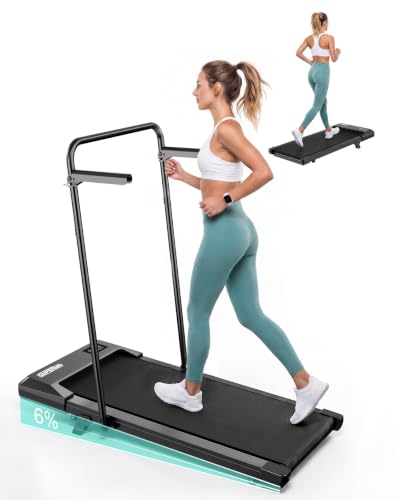
Superun 6% Incline Walking Treadmill combines a 6% incline with a 300-pound capacity and a top speed of 3.8 mph, making it a fit for incline-focused walking rather than running. The maker claims a noise level below 45 dB and describes support along both sides of the walking area. Its dimensions are 42.52 inches long by 24.49 inches wide, a wider footprint than several other options here. That width may be a drawback when storage or desk clearance is tight. Choose it for the incline and side support, but compare the available floor space before settling on this wider pad.
Bottom line: Choose this for a moderate incline and a 300-pound capacity.
Compact 6 km/h Walking Pad

Compact 6 km/h Walking Pad has the slimmest height at 4 inches and measures 40 inches long by 19 inches wide, so it is the clearest choice when storage height is a priority. It weighs about 37.5 pounds and has a 264-pound maximum capacity. The maker describes a 2.5 HP motor and quiet operation. Its speed range is given in kilometers per hour, unlike the other models, and tops out at about 3.7 mph; that makes it less suited to buyers seeking faster walking or running. Measure the space under furniture before choosing it.
Bottom line: Choose this when a low profile and compact storage are your priorities.
Compact LED Walking Pad

Compact LED Walking Pad keeps the controls straightforward: its LED display shows time, speed, distance and calories, and an included remote adjusts speed or pauses the belt. It reaches 4.0 mph, slightly higher than the 3.8 mph ceiling on Walking Pad with Handles and Superun 6% Incline Walking Treadmill, while its anti-slip belt and cushioning system are designed for everyday walking. Its dimensions are 41 inches long, 19.2 inches wide and 4.1 inches high. Buyers who need a specific weight limit should confirm that figure before choosing it. This option suits those who value simple remote operation over incline features.
Bottom line: Choose this for remote control and a simple display without incline.
How to Choose a Walking Pad
Choose a walking pad by matching its speed range and footprint to how and where you plan to walk. Desk walking is commonly done around 1 to 2 mph; faster walking needs more room to mount, dismount and recover balance. A top speed above 4 mph is useful only if you intend to walk briskly and have clearance behind and beside the belt. Compare the maximum user capacity with your body weight, leaving a margin rather than selecting a limit that barely fits. Measure the storage opening and the walking area separately: a pad can fit under a bed yet still be too wide for comfortable placement beside a desk. Desk walking around 1 to 2 mph is a useful starting point for many users.
Walking Pad Size and Desk Fit
Measure the usable floor area before choosing a walking pad; these models span about 40 to 45.7 inches in length and 19 to 24.5 inches in width. Leave clear floor around the machine for mounting and stepping off, and avoid placing the belt where a chair leg or desk support can intrude. For under-desk use, check that the desk height lets you walk upright with relaxed shoulders and natural arm movement. A 4-inch pad may fit beneath low furniture, but measure the narrowest clearance point, including legs or crossbars. Foldable handles can change the stored shape, so account for the handle height and any needed folding space rather than relying on the running deck dimensions alone.
Incline and Speed Range Differences
Incline changes walking effort without requiring a faster belt, while a higher top speed suits brisker walking or brief running intervals. The models with inclines here offer 4 degrees, 6% or 10%; degrees and percent are different ways of expressing slope and should not be compared as identical numbers. A flat pad is simpler for steady desk walking, while incline is more useful when you want a hill-like session. Begin at a low speed and low incline, then adjust only when your balance and available space allow it. The table summarizes the main choice by intended use.
| Need | Feature to prioritize |
|---|---|
| Steady desk walking | Low starting speed and a flat deck |
| Uphill walking | Adjustable incline |
| Faster sessions | Higher top speed and extra clear floor |
Walking Pad Safety and Maintenance
Use a walking pad on a level, stable floor and keep loose cords, rugs and pets away from the moving belt. Start and stop at a low speed, and never step onto a belt already moving quickly; a fall can happen before a hand reaches a support. For desk use, keep hands on the work surface only if posture remains stable, and do not let typing distract you from footing. Walking belts and decks need periodic cleaning and lubrication, but the interval and lubricant vary by model; check the manual for the specified product and schedule. Unplug the unit before cleaning or reaching near the belt. Stop using a pad if it shifts, makes an unusual sound or the belt slips, then inspect it before another session.
Frequently Asked Questions
What speed is best for walking under a desk?
Many people begin around 1 to 2 mph for desk walking, a pace that leaves room to type without hurried steps. Reduce speed if your posture changes or you cannot walk steadily while working.
How much clearance does a walking pad need?
The required clearance depends on the model, but leave open floor around the deck so you can mount and step off without hitting furniture. Measure the full usable area, not just the pad’s length and width.
Can you run on a walking pad?
Some models reach running speeds, but a high top speed alone does not establish that a pad is suitable for running. Check the maker’s intended use and ensure the belt length, capacity and surrounding clearance fit your stride and pace.
How often should a walking pad belt be lubricated?
Lubrication intervals vary by walking pad and use, so follow the interval and lubricant specified in that model’s manual. Unplug the machine before maintenance and avoid applying lubricant to the walking surface.
Is incline measured in degrees or percent?
Incline may be expressed in degrees or percent grade, and the two figures are not interchangeable. Compare models using the same unit or convert the slope before treating two incline values as equivalent.
What weight capacity should a walking pad have?
Choose a capacity above the heaviest person who will use the pad, with a margin rather than matching the limit exactly. A higher capacity does not replace checking the deck size and the maker’s intended use.