
Best Walking Sticks for Bad Knees: 3 Canes Compared

REHAND Adjustable Folding Cane suits most people looking for a walking stick for bad knees because its height adjusts in 1-inch steps across a user-height range of 5 to 6 feet 5 inches. Choose KingPavonini Self-Standing Cane instead if you want a self-standing cane, or Medline Aluminum Offset Cane for a traditional offset cane with a foam handle and wrist strap.
A cane transfers some load through the hand and arm while adding a point of support; it does not diagnose or treat knee pain. Anyone unsure how much support to use should ask a clinician or physical therapist to check fit and walking technique.
We earn a commission if you buy through links on this page. As an Amazon Associate I earn from qualifying purchases. Products are compared on manufacturer specifications, not hands-on testing.
- Best overall: REHAND Adjustable Folding Cane – Eight height settings in 1-inch increments cover users from 5 to 6 feet 5 inches.
- Best for standing storage: KingPavonini Self-Standing Cane – Its 4.5-inch pivoting base and self-standing design let it stand without being held.
- Best for a wrist strap: Medline Aluminum Offset Cane – The adjustable offset cane has a foam handle and strap to keep it close by.
| Product | Best for | Height range | Base | Weight | Shop |
|---|---|---|---|---|---|
| REHAND Adjustable Folding Cane | Adjustable fit | 31–38 in. | All-terrain tip | — | Check Price on Amazon |
| KingPavonini Self-Standing Cane | Freestanding storage | Adjustable; range — | 4.5 in. | 0.99 lb | Check Price on Amazon |
| Medline Aluminum Offset Cane | Foam grip | 29–38 in. | Rubber pad | 1.05 lb | Check Price on Amazon |
Walking Sticks for Bad Knees
Compare cane fit, grip style, and base design before choosing the support that matches your balance and daily routine.
REHAND Adjustable Folding Cane
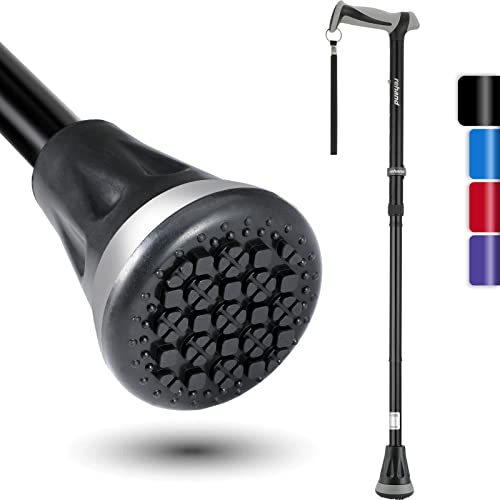
REHAND Adjustable Folding Cane stands out for its eight height settings, which change in 1-inch increments, and its wider, longer handle. The maker gives a user-height range of 5 to 6 feet 5 inches and an adjustment range of 31 to 38 inches. The handle combines hard PP with soft TPR, and the cane folds for storage with a travel bag. This can suit someone who wants a more adjustable fit and a larger palm contact area. Its single cane design is not a pair of trekking poles, so it is not the right choice for two-sided hiking support.
Bottom line: Pick this if a broad adjustment range and wider handle are your priorities.
KingPavonini Self-Standing Cane

KingPavonini Self-Standing Cane differs with a 4.5-inch pivoting base designed to let the cane stand on its own, plus a 360-degree rotating flex base. Its adjustable, foldable shaft and ergonomic ABS handle with soft TPR make it a choice for someone who often needs to set a cane down between steps. The maker gives the cane a 350-pound capacity. The larger base is a distinct tradeoff compared with a traditional single-tip cane; if you need a narrow tip for tight spaces, check that the base clears your usual walking route.
Bottom line: Choose this if you value a cane that can stand independently when set down.
Medline Aluminum Offset Cane

Medline Aluminum Offset Cane is the straightforward offset-handle option, with an aluminum shaft, foam grip, wrist strap, and a rubber bottom pad. Its height adjusts from 29 to 38 inches, making it the only compared cane with a specified lower adjustment point below 30 inches. The maker gives a 300-pound capacity, and its weight is 1.05 pounds. This design suits someone who wants a familiar offset handle and strap rather than a broad ergonomic grip or freestanding base. It does not fold according to the specifications, so it may be less convenient to pack than a folding cane.
Bottom line: Pick this for its offset handle, foam grip, and 29-inch minimum height.
How to Choose a Walking Stick for Knee Support
Choose a cane based on balance needs, height fit, and the hand that can comfortably bear weight. A single-point cane is generally for light support; a quad cane offers a broader base for added stability but can be slower to move. Set the cane on the opposite side of the affected knee so the cane and leg advance together. A useful starting fit is a handle at wrist-crease height when standing upright in usual shoes, with a slight elbow bend of about 15 to 30 degrees while holding it. If you need to lean heavily on a cane or feel unsteady, a clinician or physical therapist can assess whether a walker or another aid is safer.
How to Set Cane Height and Walk Safely
Set an adjustable cane so its handle is near the wrist crease when standing tall with arms relaxed; the elbow should bend slightly, roughly 15 to 30 degrees. Recheck the setting in the shoes you wear most, since footwear and posture affect the fit. For knee discomfort on one side, hold the cane on the opposite side and move it forward with the affected leg, then step through with the stronger leg. Keep the tip close enough to your body to avoid reaching far ahead, which can pull you off balance. Inspect the rubber tip regularly: replace it if the tread is smooth, cracked, or no longer grips the floor.
Cane Base and Handle Types Compared
Single-tip canes are usually easier to place in narrow spaces, while multi-point bases can stand more readily and offer a wider footprint. A wider base is not automatically better: it may catch on rugs, door thresholds, or crowded walkways, and it needs to be fully planted before taking weight. Handle shape also changes comfort. Offset handles keep the hand above the shaft for a familiar grip, while contoured or wider handles spread contact across more of the palm. The table summarizes the practical choice; prioritize the base and grip that you can place securely every step.
| Need | Consider | Tradeoff |
|---|---|---|
| Narrow paths | Single-tip cane | Less self-standing stability |
| Wider standing base | Multi-point cane | More room needed to place it |
| Hand comfort | Wider or padded grip | Fit depends on hand size |
Frequently Asked Questions
Which side should hold a cane for knee pain?
Hold a cane on the side opposite the painful or weaker knee. Move the cane forward with that leg, then step through with the other leg to create a wider support pattern.
How high should a walking cane be?
A cane handle should line up near the wrist crease when you stand upright with arms relaxed in your usual shoes. A slight elbow bend of about 15 to 30 degrees while gripping the handle is a useful fit check.
When should a cane rubber tip be replaced?
Replace a cane tip when its tread is smooth, cracked, or no longer grips the floor. Check it more often if the cane is used daily on rough or wet surfaces.
Can a cane help with one sore knee?
A cane can add a point of support and help shift some load through the arm when used on the opposite side of the sore knee. If you need to put heavy weight through it or still feel unstable, seek an assessment for a more suitable mobility aid.