
Best Wall Mount for Resistance Bands: 5 Options Compared

The adjustable aluminum dual-rail mount with 78 locking positions suits most people because its extended adjustment range makes it easier to set anchor height for varied exercises. Choose a fixed anchor set instead if you want multiple permanent attachment points rather than a sliding track.
We earn a commission if you buy through links on this page. As an Amazon Associate I earn from qualifying purchases. Products are compared on manufacturer specifications, not hands-on testing.
- Best overall: Adjustable Aluminum Dual-Rail Anchor – Its two rails provide 80 inches of combined track and 78 locking positions for varied anchor heights.
- Best for fixed points: hoeslaw Three-Pack Steel Anchors – Three stainless steel anchors provide separate wall or ceiling attachment locations.
- Best for included bands: Aluminum Anchor System with Five Bands – The system includes five resistance bands alongside its two-rail mount.
| Product | Best for | Track or anchor setup | Capacity | Shop |
|---|---|---|---|---|
| Adjustable Aluminum Dual-Rail Anchor | Frequent height changes | 80 in, 78 positions | 600 lb | Check Price on Amazon |
| Myosource Space Saver Gym Rail | Tubing band workouts | 37 in rail | — | Check Price on Amazon |
| hoeslaw Three-Pack Steel Anchors | Multiple fixed points | 3 fixed anchors | 330 lb pull | Check Price on Amazon |
| Aluminum Anchor System with Five Bands | Starter band system | Two-rail, 78.4 in | 500 lb | Check Price on Amazon |
| KOMOHOM Automatic-Locking Dual Track | Rehab positioning | 80 in, 70 positions | 400+ lb per anchor | Check Price on Amazon |
Wall Mounts for Resistance Bands Compared
Compare adjustable tracks and fixed anchors by how many attachment positions you need and what comes in the set.
Adjustable Aluminum Dual-Rail Anchor

This mount stands out for its 78 locking positions across two rails with 80 inches of combined length. The sliding anchor is designed to lock in place, and the aluminum system is rated for 600 pounds. Its long adjustment range suits workouts that move between high, middle, and low attachment points without installing several fixed anchors. The product calls for screws to enter perpendicular to the wall so the rail stays flat. The system is hardware-dependent, so the load rating does not replace choosing a suitable wall structure and installing it securely.
Bottom line: Choose this if you want one track system with many height settings.
Myosource Space Saver Gym Rail

This rail is distinguished by a stainless steel adjustable hook and railcar reinforced with nylon and fiberglass, rather than a specified load rating or multiple separate anchors. It accommodates most elastic tubing bands and includes a mounting bracket and ten 2-inch screws. The 37-inch rail suits users who want a single adjustable wall station for upper-, lower-, and total-body exercises at home, in a garage, or an office. The setup excludes resistance bands, so it is less complete for someone starting without bands. Verify that the mounting surface and screw placement suit the intended pulling direction.
Bottom line: Pick this for a single rail built around elastic tubing bands.
hoeslaw Three-Pack Steel Anchors

Unlike a sliding track, this set gives three separate stainless steel anchor-and-hook points, each intended for wall or ceiling mounting. The anchors have a 330-pound pull capacity and a matte finish; bands can pass through the anchor or clip to the safety hook. The separate points let a user set up different heights or angles without repositioning a railcar, making this a fit for a room where several permanent stations are useful. The tradeoff is that height is determined by installation rather than adjusted during a workout, and the facts do not identify mounting hardware.
Bottom line: Choose these if you want three permanent attachment points.
Aluminum Anchor System with Five Bands
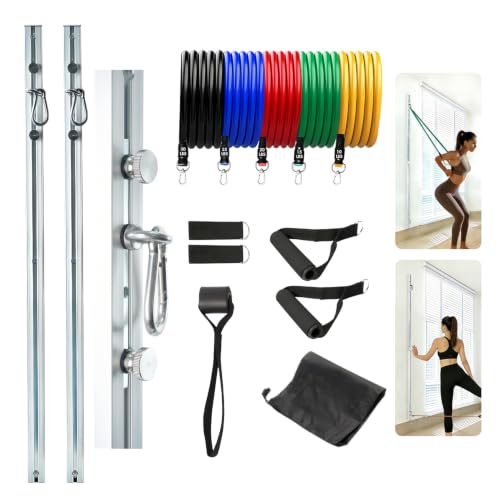
This is the only option here that explicitly includes five resistance bands, pairing them with a two-rail aluminum wall system measuring 78.4 inches. The mount is rated to 500 pounds and is positioned for more than 100 exercises, including strength training, HIIT, and warm-ups. It fits someone who wants bands and an adjustable wall setup together rather than sourcing bands separately. Its capacity is lower than the 600-pound rating of Adjustable Aluminum Dual-Rail Anchor, and the product advises fixing it to a solid wall or stud, tightening the lock knob, and checking that the eye bolt is fully threaded before each set.
Bottom line: Pick this if having five bands included matters more than maximum stated capacity.
KOMOHOM Automatic-Locking Dual Track
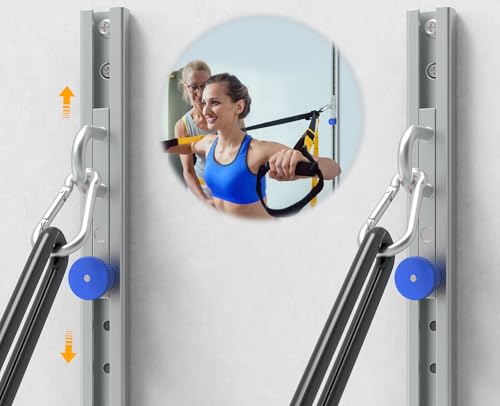
This dual-track setup is configured as two 40-inch tracks stacked vertically, with 70 locking positions and independently adjustable tracks. Its maker describes the galvanized carbon steel dual-anchor design as exceeding 400 pounds of pulling force per anchor in any direction. Independent height settings are the key distinction for users who need the two sides set at different levels, including for rehab-style movements. The rated figure is per anchor, not a single combined-system figure, so do not treat the two-anchor setup as an 800-pound system. Confirm the mounting surface and fasteners can support the intended use.
Bottom line: Choose this when independently adjustable track heights are useful.
How to choose a resistance band wall mount
Choose a sliding track if you change anchor height often, and choose fixed anchors if you want several permanent points. The adjustable products here offer 70 or 78 locking positions, while the three-anchor set puts the decision into where you mount each point. A pull capacity is not a substitute for sound installation: a band pulls outward and can apply leverage to fasteners, so mount into a suitable solid wall structure and use the intended hardware. For an adjustable system, check the actual usable rail length and position spacing against the movements you plan to do. A longer track helps with vertical range, but it does not automatically mean more resistance or a stronger installation.
Use the included-band count as a separate decision factor: only one of these systems explicitly comes with five bands. Many band sets use color-coded resistance levels, but colors are not standardized across brands, so compare the printed resistance range rather than color alone.
Adjustable tracks versus fixed band anchors
Adjustable tracks move the attachment point along a rail; fixed anchors stay at the location chosen during installation. A rail makes it practical to shift between high, mid-height, and low positions without drilling a new point for each exercise. Separate anchors make more sense when you want several stations around a room or want a ceiling point. The table summarizes the practical choice.
| Setup | Best use | Main tradeoff |
|---|---|---|
| Adjustable track | Frequent height changes | Needs a suitable continuous mounting surface |
| Multiple fixed anchors | Several permanent angles | Height changes require moving to another anchor |
Band tubing can abrade where it contacts a sharp edge, so inspect the anchor opening and band sheath before each workout. Replace a band with cracks, cuts, or exposed inner material rather than using it under tension.
Mounting height, wall structure, and safety
Mount the anchor to framing or another solid structure appropriate to the hardware, not just drywall. A band under tension can recoil toward the user if an anchor or damaged band fails; keep faces out of the direct line of pull and inspect bands for wear before loading them. Follow the product-specific installation guidance, including the perpendicular screw direction called for by Adjustable Aluminum Dual-Rail Anchor and the solid-wall-or-stud and eye-bolt checks called for by Aluminum Anchor System with Five Bands.
Start with light tension and a controlled range of motion when learning a new anchor position, because a longer stretch increases band tension. Keep the band path clear of sharp corners, doors, and other objects that can cut or pinch tubing. Do not use a pull-capacity number as an exercise load target: it describes an anchor rating, not a safe resistance prescription for a particular user or movement.
Resistance band wall mount setup mistakes
The most common setup mistake is choosing a mount by capacity alone while overlooking wall structure, fasteners, or the direction the band will pull. Another is buying a rail without checking whether its length and adjustment points cover the intended low and high movements. Measure the available wall area before choosing a track; the two-rail options here use roughly 78 to 80 inches of combined rail length.
Do not assume a product includes bands: only Aluminum Anchor System with Five Bands explicitly includes five, while Myosource Space Saver Gym Rail explicitly says bands are not included. Check the attachment type too; hoeslaw Three-Pack Steel Anchors offers both a pass-through anchor and a hook, while rail systems use a movable attachment. Keep clear of the band’s recoil path, and retire damaged tubing rather than attempting a repair.
Frequently Asked Questions
How high should I mount a resistance band anchor?
Mount the anchor at the height required by your exercises, using high points for pulldown-style motions and lower points for leg or rowing movements. A track with many positions makes those changes possible without relocating the mount; fixed anchors require planning those heights before installation.
Can resistance band mounts go on drywall alone?
Do not rely on drywall alone for a loaded band anchor; use a suitable solid wall structure and compatible fasteners. A band pulls away from the wall, so a weak fixing can fail and release the band toward the user.
How do I choose between a track and wall hooks?
Choose a track if you expect to change the anchor height during workouts, especially when it has dozens of locking positions. Choose separate fixed anchors if you prefer multiple permanent points or need a ceiling location.
How often should I inspect resistance bands?
Inspect bands before each workout for cuts, cracking, thinning, or exposed inner material. Replace damaged tubing because stretching can worsen a small defect and cause recoil.
Do wall mounts include resistance bands?
Not necessarily: these systems differ in what they include, and Aluminum Anchor System with Five Bands is the one that explicitly includes five bands. Confirm whether the set includes the bands you need before assembling a workout plan.