
Bluetooth Amps for Motorcycles: 4 Options Compared

Rockville PS40 Bluetooth Micro Amplifier is the strongest fit for riders who want a standalone Bluetooth amp with IP65 protection and multiple speaker configurations. Choose BOSS MC420B Chrome Speaker Kit or BOSS MCBK420B Black Speaker Kit instead if you want speakers and handlebar brackets in the same package; their included speakers are 3 inches.
We earn a commission if you buy through links on this page. As an Amazon Associate I earn from qualifying purchases. Products are compared on manufacturer specifications, not hands-on testing.
- Best overall: Rockville PS40 Bluetooth Micro Amplifier – Its four-channel design supports 4 x 85 watts RMS at 2 ohms, and it has an IP65 rating.
- Best for chrome speakers: BOSS MC420B Chrome Speaker Kit – The package includes two 3-inch chrome speakers and adjustable brackets for 0.75- to 1.25-inch handlebars.
- Best for black speakers: BOSS MCBK420B Black Speaker Kit – It includes two 3-inch matte black speakers, plus an inline volume control.
| Product | Best for | Amplifier output | Weather protection | Included speakers | Shop |
|---|---|---|---|---|---|
| Rockville PS40 Bluetooth Micro Amplifier | Rugged outdoor rides | 4 x 85 W RMS at 2 ohms | IP65 | None stated | Check Price on Amazon |
| Marine Class D 4-Channel Bluetooth Amp | Hidden installation | 4 x 60 W | Waterproof | None stated | Check Price on Amazon |
| BOSS MC420B Chrome Speaker Kit | Chrome speaker kits | — | Weatherproof | Two 3-inch chrome | Check Price on Amazon |
| BOSS MCBK420B Black Speaker Kit | Black speaker kits | 2-channel amp | Weatherproof | Two 3-inch matte black | Check Price on Amazon |
Bluetooth Amps for Motorcycles
These options range from standalone amplifiers to packages that include speakers and mounting brackets.
Rockville PS40 Bluetooth Micro Amplifier

Unlike the speaker bundles, the Rockville PS40 is a four-channel micro amplifier for building a separate speaker setup. The maker says it delivers 4 x 85 watts RMS at 2 ohms or 4 x 50 watts RMS at 4 ohms, with Bluetooth streaming and auto-pairing. Its IP65 rating and waterproof covers suit riders prioritizing water and dust protection. The amp can also be bridged to 170 watts x 2 at 4 ohms. It does not include speakers, so choose it only if you already have compatible speakers or plan to add them.
Bottom line: Pick this if you want a standalone four-channel amp and will supply the speakers.
Marine Class D 4-Channel Bluetooth Amp

The Marine Class D amp is the hidden-installation option, with a wired remote rather than handlebar-mounted speakers in the package. It has four 60-watt channels and Bluetooth, USB and AUX sources; the remote includes a three-color LED indicator. The maker calls the amplifier waterproof, making it a candidate for an exposed powersports setup. The package does not name included speakers or a motorcycle-specific mounting system, so it suits riders who can plan those parts separately. The remote uses an S-terminal connector, which needs a secure connection.
Bottom line: Choose this for a concealed four-channel setup with a wired remote.
BOSS MC420B Chrome Speaker Kit
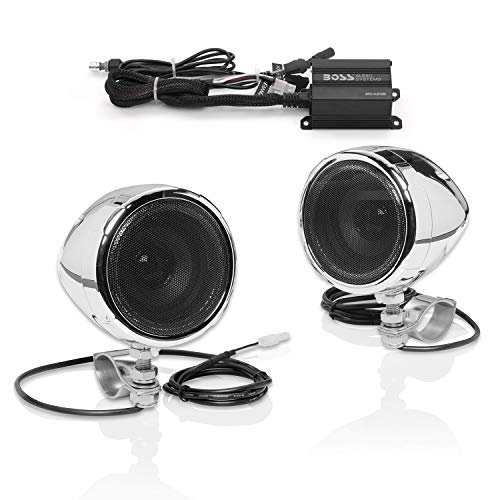
The MC420B pairs its Bluetooth amplifier with two chrome, 3-inch full-range speakers, unlike standalone amps that require a separate speaker purchase. Its adjustable brackets fit handlebars from 0.75 to 1.25 inches, a useful fit range to compare against your bar diameter before installation. The included amp is compact, weatherproof and Class D, and it also has a 3.5 mm auxiliary input.
Bottom line: Pick this if chrome speakers and included handlebar brackets suit your bike.
BOSS MCBK420B Black Speaker Kit

The MCBK420B distinguishes itself with matte black 3-inch speakers and an inline volume control, rather than the chrome finish of the other BOSS kit. Its Bluetooth Class D amplifier is weatherproof, and adjustable brackets fit 0.75- to 1.25-inch handlebars. A 3.5 mm auxiliary input provides a wired source option alongside Bluetooth. The package is a two-channel system, so it is less suitable than a four-channel amp for riders planning a larger multi-speaker layout. Measure the handlebar before choosing the brackets.
Bottom line: Choose this if you want black speakers, included brackets and an inline control.
How to Choose a Bluetooth Motorcycle Amplifier
Start with the installation plan: a standalone amp needs separately selected speakers, while a speaker kit bundles speakers and mounts. Channel count determines how many speaker outputs are available; a four-channel amp can support four speakers, while a two-channel system is aimed at a smaller setup. Compare RMS output at the speaker impedance, not only peak wattage, because the two figures describe different power ratings. For handlebar-mounted speakers, measure the bar diameter where the bracket will clamp; a 0.75- to 1.25-inch bracket range will not fit every bar. With less than 0.75 inch or more than 1.25 inches at the mounting point, choose a different mounting solution.
Weather Protection for Motorcycle Amps
Weather protection ratings help distinguish an ingress rating from general weatherproof claims. IP65 means dust-tight protection and resistance to water jets, not a guarantee against every exposure or indefinite submersion. A maker’s “weatherproof” wording alone does not establish an IP rating. Motorcycle placement matters: avoid mounting where a tire can spray water directly at connectors, and keep cable entries protected and secure. Vibration can loosen electrical connections, so inspect mounting hardware and wiring periodically. No weather rating makes an amplifier safe to operate with damaged insulation or exposed conductors; disconnect power before electrical work.
Bluetooth Amp Setups Compared
Choose a setup by what you need to supply separately: an amplifier-only unit offers flexibility, while a speaker package reduces the number of components to source. A wired remote can be easier to reach than a phone while riding, but any audio adjustment should be made while stopped. The table separates the common configurations and the decision they suit.
| Setup | What it includes | Choose when |
|---|---|---|
| Standalone four-channel amp | Amplifier; select speakers separately | You want a larger or custom speaker layout |
| Speaker kit | Amplifier, two speakers and brackets | You want a bundled handlebar setup |
| Remote-controlled amp | Amplifier and separate wired remote | You want a concealed amp with reachable control |
Safe Motorcycle Audio Installation
Motorcycle audio wiring must be secured away from hot engine parts, steering movement and sharp edges. Leave enough slack for full handlebar lock in both directions, then check that cables cannot pinch or pull tight. Use a properly fused power connection sized for the amplifier and wiring; an oversized fuse can leave a wire unprotected during a fault. Mount speakers so they do not interfere with controls or obscure the rider’s view. Keep listening volume low enough to hear traffic and emergency signals, and make pairing or control changes before moving.
Frequently Asked Questions
Can a Bluetooth motorcycle amp work without a head unit?
Yes, some amps stream directly from a Bluetooth phone without a head unit. Pair and set audio before riding so you are not handling a phone in motion.
What does IP65 mean for a motorcycle amplifier?
IP65 indicates dust-tight protection and resistance to water jets. It is not a promise of protection during prolonged submersion, so mount the amp away from direct spray and protect its wiring.
How do I know whether handlebar speaker brackets will fit?
Measure the handlebar diameter at the intended clamp location. Brackets specified for 0.75 to 1.25 inches need a bar within that range and adequate clearance from controls.
Is RMS power more useful than peak power?
RMS is the more useful figure for comparing continuous amplifier output, while peak power describes short-duration maximum output. Compare RMS figures at the same impedance for a fair match.
Where should a motorcycle amplifier be mounted?
Choose a firm location protected from direct tire spray, engine heat and moving parts. Leave space for connectors and route wiring so full steering lock cannot pinch or tension it.