
Best Winter Boots No Slip: 5 Options Compared

OUTJET Men’s Insulated Snow Boots is the strongest match for most people seeking winter boots with slip-resistant traction because its maker describes a rugged rubber outsole for icy or uneven ground. Choose a women’s option instead if you need a women’s size or a particular closure style.
Winter boots combine insulation and weather protection with an outsole designed for winter footing, but no ordinary boot guarantees grip on slick ice.
We earn a commission if you buy through links on this page. As an Amazon Associate I earn from qualifying purchases. Products are compared on manufacturer specifications, not hands-on testing.
- Best overall: OUTJET Men’s Insulated Snow Boots – Its maker claims a rugged rubber outsole for icy or uneven surfaces, plus 200g insulation.
- Best for waterproof suede: MIFAWA Women’s Waterproof Suede Snow Boots – The maker describes a waterproof suede upper and rubber outsole.
- Best for quick adjustment: Qiucdzi Women’s Hook-and-Loop Snow Boots – The hook-and-loop closure allows a fast, adjustable fit.
| Product | Best for | Upper or water protection | Outsole | Insulation or lining | Shop |
|---|---|---|---|---|---|
| OUTJET Men’s Insulated Snow Boots | Cold outdoor work | Waterproof membrane | Rugged rubber | 200g Thinsulate | Check Price on Amazon |
| MIFAWA Women’s Waterproof Suede Snow Boots | Waterproof suede | Waterproof suede | Rubber | Short plush lining | Check Price on Amazon |
| SHIBEVER Women’s Fur-Lined Ankle Boots | Lightweight ankle boot | Waterproof claim | Non-slip sole | Faux fur lining | Check Price on Amazon |
| HOBIBEAR Women’s Mid-Calf Snow Boots | Adjustable rope closure | Water resistant | Slip-resistant sole | Faux fur lining | Check Price on Amazon |
| Qiucdzi Women’s Hook-and-Loop Snow Boots | Fast adjustable fit | PU upper | TPR | Full lining | Check Price on Amazon |
Winter boots with slip-resistant soles
Compare the outsole, weather protection, and warmth claims to find a pair suited to your conditions.
OUTJET Men’s Insulated Snow Boots
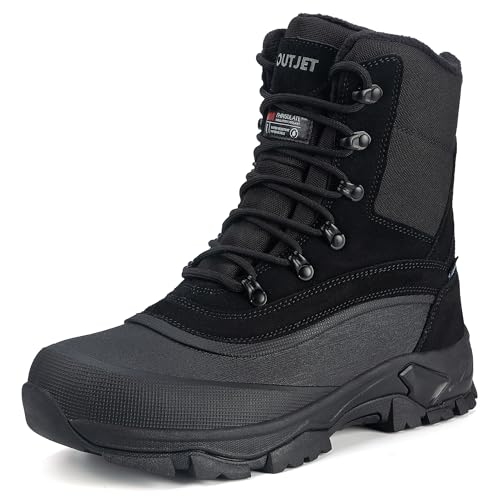
For colder outdoor work or winter hiking, OUTJET Men’s Insulated Snow Boots pairs a waterproof membrane with 200g 3M Thinsulate insulation. The maker claims warmth down to -25°F and describes a rugged rubber outsole for icy or uneven ground. That combination makes this the clearest choice here for buyers prioritizing insulation and outdoor traction. The boot is men’s size 11 in the option, so it will not suit someone needing a women’s size or another size. A slip-resistant outsole is not a guarantee on smooth ice; use added traction when conditions demand it.
Bottom line: Choose this pair if you need men’s size 11, substantial insulation, and a maker-claimed cold rating.
MIFAWA Women’s Waterproof Suede Snow Boots

For buyers who want a women’s snow boot with a suede upper, MIFAWA Women’s Waterproof Suede Snow Boots stands apart with a waterproof upper and rubber outsole. The maker says the sole is non-slip and describes a short-plush lining for warmth. Its black, size 9 option suits buyers matching that size and color, while the high-top plush edge gives it a different look from lower ankle booties. The specifications do not give an insulation weight or temperature rating, so it is harder to compare its cold-weather range with a boot that supplies those figures. Treat the traction claim as a design feature, not an ice guarantee.
Bottom line: Pick this if a waterproof suede upper and women’s size 9 are your priorities.
SHIBEVER Women’s Fur-Lined Ankle Boots

For a slip-on ankle-height style, SHIBEVER Women’s Fur-Lined Ankle Boots is the lightweight option among these winter boots. Its name calls it waterproof and non-slip, and its product features describe a faux-fur interior and cushioning for extended walking. The black, size 9 option fits buyers looking for that specific size and a simple slip-on design rather than a lace or hook-and-loop closure. The specifications give no insulation weight, temperature rating, or outsole material, so buyers facing sustained deep cold or needing a defined tread material may prefer an option with those specifications.
Bottom line: Choose this for a women’s size 9 slip-on ankle boot with a fur-lined interior.
HOBIBEAR Women’s Mid-Calf Snow Boots

Among the women’s options, HOBIBEAR Women’s Mid-Calf Snow Boots has the taller mid-calf profile and an adjustable rope closure rather than a slip-on or hook-and-loop fastening. The maker describes a water-resistant upper, a slip-resistant sole, and faux-fur lining. That combination suits buyers who want adjustable coverage around the lower leg and a simple way to tighten the fit. The upper is water resistant, not described as waterproof, so prolonged wet exposure is a meaningful limitation compared with a waterproof design. The available option is black, size 7, and the fields give no insulation weight or temperature rating.
Bottom line: Choose this if you want a mid-calf women’s boot with an adjustable rope closure.
Qiucdzi Women’s Hook-and-Loop Snow Boots
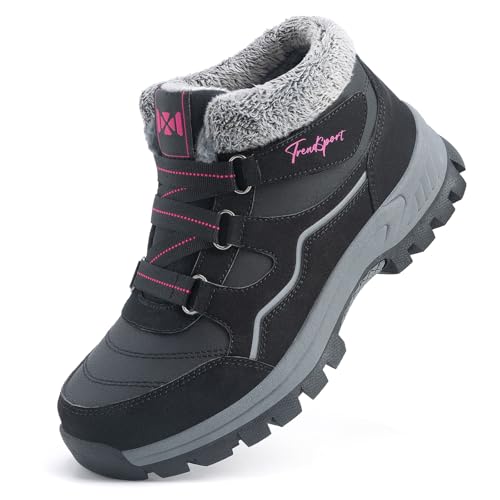
For a fast adjustable fastening, Qiucdzi Women’s Hook-and-Loop Snow Boots uses a hook-and-loop closure with a low-top ankle-boot shape. The maker describes a PU upper and TPR outsole, plus lining from outsole to insole; it also claims the sole is non-slip. This suits buyers seeking a women’s black size 8 boot that is easy to tighten or loosen without laces. Its lower profile offers less leg coverage than a mid-calf boot, and the upper is described as helping keep snow out rather than as waterproof. Buyers expecting frequent wet slush should favor an explicitly waterproof option.
Bottom line: Pick this for women’s size 8 and quick hook-and-loop adjustment.
How to choose winter boots for traction
Start with the ground you cross most: packed snow, wet pavement, and smooth ice demand different levels of caution. Deep, widely spaced lugs can bite into loose snow, while a flatter contact patch can help on pavement; neither outsole style makes polished ice reliably safe. Rubber compound also affects grip, and product names such as “non-slip” do not supply a standardized traction score. For routine sidewalks, prioritize a rubber outsole with a visible tread pattern and secure fit. If your route includes clear ice or slopes, add removable traction devices rather than relying on the boot alone. Among these options, OUTJET Men’s Insulated Snow Boots is the only one whose maker specifically calls out icy or uneven surfaces.
How much insulation winter boots need
Insulation weight is one useful comparison, but it is not a complete temperature guarantee. A 200g insulated boot such as OUTJET Men’s Insulated Snow Boots supplies a measurable insulation figure, while the women’s options here use lining descriptions rather than weights. Warmth also changes with sock thickness, activity level, fit, and how long you stand still; tight boots can leave too little room for warm air and socks. For long periods outdoors below freezing, choose a boot with an insulation amount and pair it with a moisture-wicking sock. If feet get damp, insulation loses effectiveness, so waterproofing and changing wet socks matter alongside lining thickness.
Waterproof and water-resistant winter boots
Waterproof and water-resistant describe different protection levels, so choose based on exposure. Waterproof membranes or uppers are the clearer choice for repeated slush, wet snow, or puddles; water-resistant materials can shed light moisture but should not be treated as a promise for prolonged immersion. Snow can enter from the top of any boot, so a taller shaft helps in deeper snow only when the opening is secured. For regular wet conditions, prefer an explicitly waterproof option such as MIFAWA Women’s Waterproof Suede Snow Boots or OUTJET Men’s Insulated Snow Boots over a water-resistant design such as HOBIBEAR Women’s Mid-Calf Snow Boots. Dry boots fully between outings and avoid direct high heat, which can damage adhesives and materials.
Winter boot fit and safe use
Leave enough room to wiggle toes and wear the socks you plan to use; a snug fit should not compress the forefoot. Check both feet while standing, because foot length and width can differ, and confirm the maker’s size guidance before choosing a size. A boot that is too loose can let the heel move and compromise footing, while a tight boot can reduce warmth. No ordinary sole eliminates fall risk on black ice: shorten steps, keep hands free for balance, and use ice cleats when the surface is slick. Remove cleats indoors to avoid slipping on hard floors and to protect indoor surfaces.
Frequently Asked Questions
Are non-slip winter boots safe on black ice?
No ordinary non-slip boot can guarantee grip on black ice, which is an exceptionally smooth, low-friction surface. Use removable ice traction on icy routes and walk with short, deliberate steps.
Is 200g insulation warm enough for winter?
A 200g insulation rating is a useful mid-weight comparison, but it does not set a universal temperature limit. Activity, sock choice, fit, and time spent standing still all change how warm a boot feels.
Do water-resistant boots work in slushy snow?
Water resistance can help with brief exposure, but repeated slush is better matched to a boot explicitly described as waterproof. Snow may also enter at the shaft opening even when the lower boot is waterproof.
Should winter boots fit with thick socks?
Try winter boots with the socks you expect to wear and leave toe room without heel slippage. Thick socks in an already tight boot can compress the foot and reduce comfort and warmth.