
Best Winter Pool Covers for Inground Pools Compared

Robelle Super Winter Cover, 20 x 40 ft suits many 20-by-40-foot inground pools because its 25-by-45-foot cover size provides 5 feet of overlap for positioning. Choose a different option if you need mesh drainage, an anchored safety cover format, or a cover sized for a 45-by-25-foot pool.
Winter covers protect a closed pool from seasonal debris; solid and mesh designs handle water differently, so match the style and finished dimensions to your pool.
We earn a commission if you buy through links on this page. As an Amazon Associate I earn from qualifying purchases. Products are compared on manufacturer specifications, not hands-on testing.
- Best overall: Robelle Super Winter Cover, 20 x 40 ft – Its 25-by-45-foot size gives a 20-by-40-foot pool 5 feet of overlap.
- Best for anchored mesh: CIDNN Mesh Safety Cover, 18 x 36 ft – The mesh cover fits 18-by-36-foot pools and includes anchors, springs and installation tools.
- Best for sunlight blocking: Blue Wave Arctic Armor, 20 x 40 ft – Its solid polyethylene construction has a black underside to block sunlight.
- Best for 45-by-25 pools: UIRWAY Reinforced Cover, 45 x 25 ft – The cover is sized 49 by 29 feet for a 45-by-25-foot rectangular pool.
| Product | Best for | Pool fit | Cover size | Construction | Shop |
|---|---|---|---|---|---|
| Robelle Super Winter Cover, 20 x 40 ft | Extra overlap | 20 x 40 ft | 25 x 45 ft | Polyethylene, 8 x 8 scrim | Check Price on Amazon |
| CIDNN Mesh Safety Cover, 18 x 36 ft | Anchored mesh | 18 x 36 ft | Pool-compatible; 2 ft extra coverage | Polypropylene mesh | Check Price on Amazon |
| Blue Wave Arctic Armor, 20 x 40 ft | Solid cover | 20 x 40 ft | 20 x 40 ft + 5 ft overlap | Polyethylene, 7 x 7 scrim | Check Price on Amazon |
| UIRWAY Reinforced Cover, 45 x 25 ft | Larger rectangles | 45 x 25 ft | 49 x 29 ft | LDPE, 185 gsm | Check Price on Amazon |
Winter pool covers for inground pools
Compare the pool fit, cover dimensions and construction before choosing a winter cover.
Robelle Super Winter Cover, 20 x 40 ft

For a 20-by-40-foot pool, the 25-by-45-foot cover size provides 5 feet of overlap, which gives room to position the cover around the pool. The polyethylene weighs 2.36 ounces per square yard and uses an 8-by-8 scrim, meaning 8 threads per inch in each direction. The maker includes a 10-year warranty. This solid-style cover suits owners prioritizing generous overlap on a rectangular pool. Confirm that the pool shape and dimensions match before choosing it; a different pool footprint may need a different cover size.
Bottom line: Choose this when a 20-by-40-foot pool needs generous cover overlap.
CIDNN Mesh Safety Cover, 18 x 36 ft

Unlike the solid polyethylene options, this 18-by-36-foot cover is a mesh safety cover style and comes with brass anchors, steel springs and installation tools. Its rope length adjusts from 13.7 to 25.6 inches, and the maker says the cover provides 2 feet of additional coverage. That makes it a fit to consider for buyers who want an anchored mesh design rather than a solid sheet. The product name does not establish ASTM F1346 certification, so do not treat it as a child-safety barrier unless certification and installation requirements are confirmed.
Bottom line: Choose this for an 18-by-36-foot pool when you want an anchored mesh format.
Blue Wave Arctic Armor, 20 x 40 ft
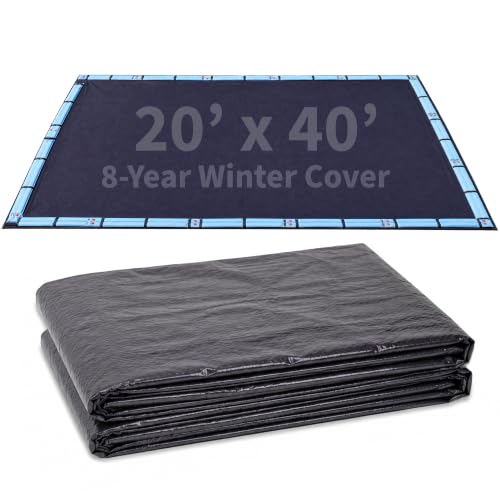
For a 20-by-40-foot pool, this solid polyethylene cover has a 7-by-7 scrim, heat-sealed seams and a black underside. The maker says the underside blocks sunlight and the seams create a watertight bond; sewn loops spaced every 4 feet are intended for securing the cover with water tubes. The extra 5-foot overlap accommodates positioning around the pool. This option suits buyers who want a solid cover with perimeter loops. Water tubes are a separate accessory, so plan how you will anchor the cover rather than assuming they are included.
Bottom line: Choose this for a 20-by-40-foot pool when solid coverage and sewn loops suit your setup.
UIRWAY Reinforced Cover, 45 x 25 ft

For a 45-by-25-foot rectangular pool, this cover measures 49 by 29 feet and is made from 185-gsm reinforced tarp material with a dual-layer LDPE coating. The maker says its 4-foot overlap, aluminum grommets and PE webbing support installation and help keep leaves and debris out. Its larger pool fit separates it from the 20-by-40-foot options here. It is intended for rectangular pools; owners with built-in steps or a nonrectangular outline should verify the actual coverage needed before ordering.
Bottom line: Choose this for a rectangular 45-by-25-foot pool with a matching cover footprint.
How to choose an inground winter pool cover
Choose the cover style first: solid covers block sunlight and debris, while mesh covers allow water to pass through. Solid covers generally need standing water removed from their surface during winter; mesh designs avoid the same surface-water collection but allow rain and snowmelt into the pool. Then match the cover dimensions to the pool, including any extra material required for overlap and anchoring. The products here include 20-by-40-foot and 45-by-25-foot pool fits, so the largest cover is not automatically the best fit. Measure the pool at its widest points and account for steps or unusual outlines. With an irregular pool edge, confirm coverage before ordering rather than relying on nominal rectangular dimensions.
Pool size, overlap and fit
Measure the waterline footprint and the deck or anchor area needed to hold the cover; a nominal pool size alone does not tell you whether the edges can be secured. The covers show why cover dimensions matter: a 20-by-40-foot pool fit can have a 25-by-45-foot cover dimension, while the 45-by-25-foot pool option measures 49 by 29 feet. Check whether an overlap is total added size or extra coverage around the perimeter, because those descriptions can be interpreted differently. A practical rule is to compare the actual cover width and length with the pool footprint before purchase and ensure each edge reaches its intended securing point. Account for built-in steps as part of the outline.
Solid, mesh and anchored safety cover styles
Solid covers form a barrier over the water and block sunlight; mesh covers let precipitation drain through, so the pool can receive water during winter. Anchored safety cover styles attach to deck anchors with hardware such as springs, unlike covers held around the edge with water tubes. These product types serve different setup needs and should not be treated as interchangeable. A product called a safety cover is not automatically verified as a safety barrier: confirm ASTM F1346 certification and the required installation conditions before relying on it to restrict access. Compare cover style to how you manage winter precipitation and debris, then match its installation system to the pool deck.
| Cover type | Water handling | Typical securing approach |
|---|---|---|
| Solid winter cover | Blocks water from entering through the cover | Water tubes or edge anchors, depending on design |
| Mesh winter cover | Allows water to drain through | Anchors and springs |
Winter cover setup and care
Secure the perimeter evenly and check the cover after storms, because wind and accumulated snow can stress loose edges. Solid covers can collect rain or meltwater; use a cover pump to remove pooled water, and never stand on a pool cover. Keep children and pets away from every covered pool: a cover is not a substitute for a compliant barrier unless it is a certified safety cover installed as specified. Before winter, clear sharp debris from the pool edge and cover contact points to reduce abrasion. Inspect seams, grommets, loops and anchoring hardware during setup, and replace damaged components before relying on the cover through the season.
Frequently Asked Questions
Do solid inground pool covers let rainwater through?
Solid covers are designed to block water from passing through the cover material. Rain can collect on top, so standing water may need removal with a cover pump; mesh covers instead allow water to drain through.
How much overlap should an inground pool cover have?
The needed overlap depends on the cover design and how its edges are secured. These options specify 4 or 5 feet of overlap, so compare the actual cover dimensions against the pool footprint and anchoring area before ordering.
Can a winter pool cover support a child?
Do not assume a winter cover can support a child. Only rely on a cover as a safety barrier when it is certified to ASTM F1346 and installed to the required specifications; keep children and pets away from covered pools.
Should I choose a mesh or solid pool cover?
Choose solid material when blocking sunlight and debris is the priority; choose mesh when you want precipitation to drain through the cover. Solid covers can collect water on top, while mesh covers let water enter the pool.
How do I size a cover for a pool with steps?
Measure the full outline, including the step projection, rather than using only the main rectangular dimensions. If the cover size or overlap cannot reach the intended securing points around the steps, confirm the fit before ordering.