
Best Wire Cutters for Jewelry Making: 5 Picks Compared

5-Inch Flush and Diagonal Cutter Set suits most jewelry makers because its pair includes a 5-inch flush cutter and a 5-inch diagonal cutter for different cutting tasks. Choose a dedicated memory-wire cutter instead when memory wire is your main material, or a lighter precision tool for delicate work.
Wire cutters use opposing blades to sever wire; flush cutters are shaped to leave a close cut, while diagonal cutters are suited to general snipping. Match the blade style and cutter capacity to the wire rather than relying on tool length alone.
We earn a commission if you buy through links on this page. As an Amazon Associate I earn from qualifying purchases. Products are compared on manufacturer specifications, not hands-on testing.
- Best overall: 5-Inch Flush and Diagonal Cutter Set – Pairs a 5-inch flush cutter with a 5-inch diagonal cutter for two cutting styles.
- Best for memory wire: Beaditive 5-Inch Memory Wire Cutter – Designed with bypass cutting action for memory wire.
- Best for mixed wire sizes: 5-Inch Micro and 6-Inch Cutter Set – Includes a 5-inch micro cutter rated up to 16 AWG and a 6-inch cutter rated up to 12 AWG.
| Product | Best for | Cutter length | Cutting style | Wire capacity | Shop |
|---|---|---|---|---|---|
| 5-Inch Flush and Diagonal Cutter Set | Mixed craft tasks | 5 in. | Flush and diagonal | — | Check Price on Amazon |
| Beaditive 5-Inch Memory Wire Cutter | Memory wire | 5 in. | Bypass | — | Check Price on Amazon |
| 5-Inch Micro and 6-Inch Cutter Set | Capacity range | 5 and 6 in. | Micro and diagonal | 16 AWG; 12 AWG | Check Price on Amazon |
| BOENFU 6-Inch Flush Cutter | Long cutting edge | 6 in. | Flush side cutter | Up to 12 AWG | Check Price on Amazon |
| BOOSDEN 6.5-Inch Wire Cutter | Longer handles | 6.5 in. | Diagonal | Up to 12 AWG | Check Price on Amazon |
Wire Cutters for Jewelry Making
Compare the cutting styles and stated capacities to find a tool that suits your wire and finish requirements.
5-Inch Flush and Diagonal Cutter Set

This set pairs two 5-inch cutters, rather than relying on one blade style for every jewelry task. The flush cutter is intended for clean, close cuts, while the diagonal cutter handles tougher materials. Both are made from high-carbon steel and have spring-loaded handles. The combination suits makers who switch between beading wire and other craft materials. The features do not give a wire-gauge limit, so this set is a less direct choice when a specific maximum wire size is essential; match each material to the cutter’s intended use.
Bottom line: Choose this set if you want flush and diagonal cutters in one pair.
Beaditive 5-Inch Memory Wire Cutter

This is the only option here specifically presented for memory wire, with bypass cutting action intended to produce a clean, flush cut. Its 5-inch size and high-carbon-steel construction make it a focused choice for makers whose projects regularly use memory wire.
Bottom line: Pick this dedicated cutter when memory wire is your main cutting task.
5-Inch Micro and 6-Inch Cutter Set

This two-piece set is the only choice with separate stated capacities: the 5-inch micro cutter handles wire up to 16 AWG, and the 6-inch diagonal cutter up to 12 AWG. Both are made from heat-treated high-carbon steel and are described as spring-loaded. That split gives a clearer basis for choosing between delicate and tougher cutting jobs than a single general-purpose tool. Its limitation is that the 6-inch cutter is described as diagonal rather than a dedicated flush cutter, which matters when a close finish is the priority.
Bottom line: Choose this set if you want separate cutters with gauge limits.
BOENFU 6-Inch Flush Cutter

The 6-inch BOENFU stands out for its extra-long cutting edge and stated capacity of up to 12 AWG. It is made from chrome-vanadium steel and has spring-loaded handles, with a compact design intended for tight spaces. The flush-cut style suits jewelry tasks where a close trim matters, as well as other craft uses. It is a single cutter rather than a set, so it offers less blade-style flexibility than paired options; its capacity also makes it a poor match for wire beyond 12 AWG.
Bottom line: Choose this single flush cutter for close cuts on wire up to 12 AWG.
BOOSDEN 6.5-Inch Wire Cutter
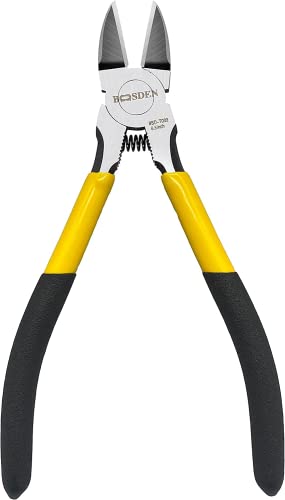
This 6.5-inch BOOSDEN is the longest single cutter here and is described as a diagonal cutter for soft copper, plastic, aluminum and soft-alloy wire. Its high-carbon steel blades are high-frequency hardened, and its rubber handles provide a grippy surface. The capacity is up to 12 AWG. This makes it a versatile craft snipper, but the diagonal blade style differs from a dedicated flush cutter; choose another option if a close, flush finish is central to your jewelry work.
Bottom line: Pick this cutter for soft craft wire when reach matters more than a flush finish.
How to choose jewelry wire cutters
Choose by blade shape first, then match the cutter’s capacity to your wire. Flush cutters are designed to leave one side of a cut closer to the work; diagonal cutters are general-purpose snips with angled jaws. Bypass cutters use blades that pass one another, a style used for a clean cut on memory wire. Wire gauge runs in reverse: a higher AWG number means thinner wire, so 16 AWG is thinner than 12 AWG. If you work with both delicate and heavier wire, a set with separate cutters can reduce the temptation to force a small precision tool through thicker stock. For a close finish near a bead or loop, favor a flush or bypass style over a general diagonal cutter.
Wire gauge and cutter fit
Use the cutter’s maximum capacity as a hard decision point: a tool rated up to 12 AWG should not be assumed suitable for thicker wire. Check the spool or supplier’s gauge, and remember that material changes cutting difficulty; copper, aluminum and steel wire of the same gauge do not require the same effort. For this group, only two options give a numeric capacity, so the others are better selected for their named cutting purpose rather than an assumed rating. A 5-inch micro cutter rated for 16 AWG is aimed at thinner work than a 12 AWG cutter. Do not use jewelry flush cutters on hardened steel wire, piano wire or other hard wire unless the tool is explicitly rated for it; hard stock can damage the cutting edges.
Flush, diagonal and bypass cutters compared
Flush, diagonal and bypass cutters solve different cutting problems, so blade style is a useful first filter. This comparison maps the style to the common jewelry task; material hardness and the tool’s capacity still matter.
| Style | Typical use | Choose when |
|---|---|---|
| Flush | Close trimming near a component | A low-profile cut edge matters |
| Diagonal | General snipping of softer craft wire | You need a versatile angled jaw |
| Bypass | Memory wire and clean cutting | The wire type matches the cutter’s purpose |
Many flush cutters have one flat side intended to sit against the work, but designs differ, so orient the flat face toward the finished piece when the jaw shape allows. Cut away from your hands and eyes, and control offcuts; short wire ends can spring free.
Using and maintaining jewelry cutters
Use jewelry cutters only on wire within their material and capacity range. A cutter that is comfortable on soft copper may be unsuitable for steel or hardened wire, even when the diameter seems similar. Make cuts with the wire seated near the joint rather than at the very tip, where leverage is lower, and keep fingers clear of the blade path. Small offcuts can fly, so point the cut away from your face and use eye protection when snipping springy wire. Wipe blades dry after work and keep the joint free of grit; a drop of light tool oil at the pivot can help maintain smooth movement. Stop using a cutter if the edges chip, loosen or no longer meet cleanly.
Frequently Asked Questions
What wire gauge is best for jewelry cutters?
Choose a cutter whose capacity includes the wire gauge you use; AWG numbers rise as wire gets thinner. A 16 AWG wire is thinner than 12 AWG, and a tool’s maximum should not be treated as a suggestion to cut harder material.
Can flush cutters cut memory wire?
Some cutters are made specifically for memory wire, and a bypass design is one suitable style. Do not assume a standard flush cutter can handle memory wire; use a tool intended for that material to protect the cutting edges.
Which side of flush cutters faces the jewelry?
When the jaws have one flat side, place that side against the component for the closer cut. The angled side leaves the more pronounced cut end, so orient the tool before snipping.
Can jewelry cutters cut steel wire?
Do not use ordinary jewelry cutters on hardened steel or piano wire unless they are explicitly rated for it. Hard wire can nick or blunt the blades; use a cutter designed for the material.
How should I protect my eyes while cutting wire?
Wear eye protection when cutting springy wire, and point the jaws away from your face. Short offcuts can become airborne, so keep other people clear of the cutting path as well.