
Bike Seats for Stationary Bikes: 4 Models Compared

For a full replacement seat, Twomaples Super King Noseless Seat is the standout choice here if you want a wide, noseless saddle; its dimensions are 13 by 9 inches.
We earn a commission if you buy through links on this page. As an Amazon Associate I earn from qualifying purchases. Products are compared on manufacturer specifications, not hands-on testing.
- Best overall: Twomaples Super King Noseless Seat – Its 13-by-9-inch noseless saddle suits buyers seeking a wide replacement seat.
- Best for a vented saddle: Men’s and Women’s Vented Replacement Saddle – The replacement saddle has a center airflow vent and measures 9.7 by 8 inches.
- Best for a backrest shape: BLUEWIND Noseless Oversized Seat – Its maker describes a noseless saddle with a novel backrest design.
| Product | Best for | Dimensions (L × W) | Height | Shop |
|---|---|---|---|---|
| Twomaples Super King Noseless Seat | Wide noseless seat | 13 × 9 in | 4.8 in | Check Price on Amazon |
| Men’s and Women’s Vented Replacement Saddle | Vented replacement saddle | 9.7 × 8 in | 3.7 in | Check Price on Amazon |
| BLUEWIND Noseless Oversized Seat | Noseless broad saddle | 10.2 × 10.2 in | 4.5 in | Check Price on Amazon |
| Red Oversized Exercise Bike Saddle | Red foam saddle | 10.4 × 10.4 in | 5.1 in | Check Price on Amazon |
Bike seats for stationary bikes
Compare full replacement saddles by shape and size, and make sure a cover matches the saddle you already have.
Twomaples Super King Noseless Seat

Twomaples Super King Noseless Seat is the widest replacement seat in this group with a width of 9 inches, and its noseless shape is intended to reduce thigh contact. The saddle measures 13 inches long and 4.8 inches high. The maker says it suits stationary and exercise bikes, among other bicycle types; its instructions call for removing the adapter to fit a bike with a rail post. That mount detail matters because a seat that cannot attach securely is not a usable fit. Buyers wanting a conventional nose or a narrower saddle should compare other shapes.
Bottom line: Choose this if a wide, noseless replacement saddle is your priority.
Men’s and Women’s Vented Replacement Saddle

Men’s and Women’s Vented Replacement Saddle is a more compact replacement saddle than the 13-inch-long option, measuring 9.7 by 8 inches. It has high-density foam padding, a center airflow vent and a non-slip leather cover; the maker says its cushioning is intended to soften bumps. A saddle adapter and mounting wrench are included, so this is a complete replacement rather than a cover for an existing seat. Its 8-inch width may not suit riders who specifically want an oversized platform, so measure the available space and compare it with your preferred support area.
Bottom line: Choose this if you want a compact replacement saddle with a center vent.
BLUEWIND Noseless Oversized Seat

BLUEWIND Noseless Oversized Seat offers a squarer listed footprint, measuring 10.2 inches long by 10.2 inches wide, rather than the longer shape of Twomaples Super King Noseless Seat. Its noseless design and microfiber artificial leather surface distinguish it from the vented conventional saddle. The maker says the seat has 7 cm of foam and a backrest-style shape; the product dimensions give a height of 4.5 inches. It is described as fitting most exercise or road stationary bikes, but buyers should check that their bike’s seat attachment accepts this saddle before replacing the original.
Bottom line: Choose this if you prefer a square, noseless saddle with a backrest-style shape.
Red Oversized Exercise Bike Saddle
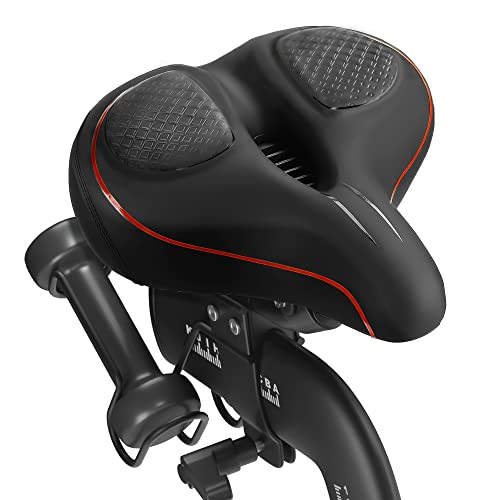
Red Oversized Exercise Bike Saddle is the only red saddle in this selection, with a size of 10.4 by 10.4 inches and a height of 5.1 inches. Its high-density foam and elastomer spring suspension distinguish it from the gel cover and the noseless designs. The maker says it is compatible with Peloton Bike and Bike+ as well as exercise and road bikes. The color and substantial dimensions may not suit someone seeking a slim or neutral-colored replacement, so compare the footprint with the bike’s available seat area.
Bottom line: Choose this if you want a red, broad replacement saddle with foam and spring suspension.
How to choose a stationary bike seat
Start by deciding whether you need a full saddle replacement or a cover over the saddle already on your bike. A cover attaches over an existing seat; a replacement saddle must connect to the bike’s seat post or rail hardware. Measure the current seat’s length and width before choosing a cover, since a cover designed for an 11-by-10-inch saddle may not stay secure on a smaller shape. For replacement saddles, compare the mount and available adjustment as well as the seat footprint. At the bottom of a pedal stroke, a slight knee bend—often around 25 to 35 degrees—is a useful starting fit check; set saddle height before judging comfort.
Seat width and riding position
Seat width should support the sit-bone area rather than simply maximize padding. Sit-bone spacing differs among riders, so compare actual saddle widths and your riding posture instead of assuming an oversized seat fits everyone. A more upright position commonly needs a broader support area than a forward-leaning road position, because the pelvis contacts the seat differently. Measure your bike’s existing seat, then compare its footprint with the candidate saddle; a change of even an inch can affect clearance around thighs and nearby frame parts. If your knees track close to the seat, check that a wider shape leaves room through a full pedal rotation.
Replacement saddles versus seat covers
A replacement saddle swaps the seat itself, while a cover adds padding over the original and can be removed without changing the seat hardware. The distinction is useful when diagnosing discomfort: an oversized cover cannot correct a poorly adjusted seat height, and a new saddle does not automatically match the bike’s attachment. Most indoor cycling saddles attach by rails or a clamp-style mount, so inspect the hardware before ordering a replacement. Use this comparison to match the solution to the job.
| Need | Choose | Check |
|---|---|---|
| Add a removable padded layer | Seat cover | Existing saddle width and length |
| Change the saddle shape | Replacement saddle | Seat-post or rail attachment |
| More room across the seat | Wider saddle | Thigh clearance while pedaling |
Stationary bike seat setup and safety
Set saddle height so your knee remains slightly bent at the bottom of the pedal stroke; locking the knee straight can strain the joint, while a seat set too low can crowd the knee. Make small height changes and pedal slowly to check that your hips stay level rather than rocking from side to side. After replacing a saddle, confirm that its attachment is fully tightened and the seat does not twist under hand pressure before riding. Covers should also be cinched securely over the existing saddle; a shifting cover can interfere with a stable riding position. Stop if pain persists rather than relying on extra padding to solve a fit problem.
Frequently Asked Questions
How wide should a stationary bike seat be?
Seat width should support your sit bones without rubbing your inner thighs. Rider anatomy and posture both affect the right width, so measure your current saddle and check thigh clearance during a full pedal rotation.
Can I put a seat cover on any exercise bike?
A cover must fit the existing saddle’s shape and dimensions to stay secure. Measure its length and width first; a cover sized for an 11-by-10-inch seat may not fit a narrow saddle.
How do I know whether a replacement saddle will fit?
Check whether your bike uses rails or a clamp-style seat-post attachment, then confirm the replacement is compatible with that hardware. Also compare the saddle’s width and length with the space around your bike’s frame.
Why does my stationary bike seat feel uncomfortable?
Incorrect saddle height or a shape that does not support your riding posture can cause discomfort. Check for a slight knee bend at the pedal’s lowest point and make sure the seat width does not rub your thighs.